Vietnamese envoy urges businesses to expand direct presence in US market
Vietnamese enterprises should step up direct investment in the US to reduce tariff risks while gaining access to advanced technology, capital and a strong innovation ecosystem, the Vietnamese Consul General in San Francisco said.
HCM CITY — Amid global economic volatility and erratic US trade policies, Vietnamese enterprises should move beyond exports and accelerate direct investment in the US to reduce tariff risks while gaining access to advanced technology, lower-cost capital and a world-leading innovation ecosystem, according to the Vietnamese Consul General in San Francisco.
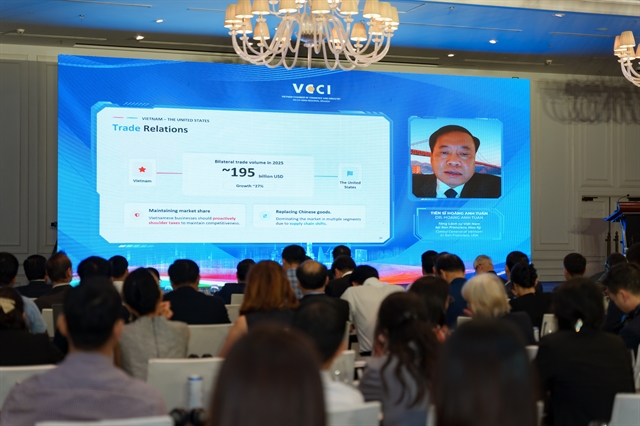
Despite tariff pressures and global uncertainty, Việt Nam-US bilateral trade in 2025 still recorded strong growth, reaching nearly US$195 billion, up 27 per cent year on year, and making a significant contribution to Việt Nam’s economic growth of more than 8 per cent, Hoàng Anh Tuấn told the “Business–Investment in the Southern Key Economic Region” forum held in HCM City last week.
While prospects for business and investment cooperation between the two countries remain substantial, advantages vary across sectors. Vietnamese enterprises should therefore focus on strategic industries to capitalise on US policy incentives and the ongoing restructuring of global supply chains.
Technology, semiconductors and artificial intelligence were identified as particularly promising fields. As Việt Nam moves beyond assembly towards deeper participation in global supply chains, enterprises can partner with US corporations in research and development and in building AI data infrastructure.
States such as Texas, California, Washington and Oregon, which host mature technology ecosystems, offer Vietnamese firms access to cutting-edge technologies and advanced sources of capital.
At the same time, investing in manufacturing in the US is becoming an increasingly strategic option, particularly for sectors facing high tariffs, including electronic components, wood products, textiles and footwear.
Establishing factories in the US allows products to carry the “Made in USA” label, benefit from corporate income tax incentives and low energy costs, gain direct access to the world’s largest consumer market, and significantly reduce exposure to tariff-related risks and trade barriers.
In agriculture and food processing, a shift from raw-material exports to investment in deep processing is recommended to raise export value, alongside the establishment of distribution centres in the US. Firms are also urged to comply with US Food and Drug Administration standards and hygiene and safety requirements, and to develop organic and sustainable product lines.
Beyond this, Vietnamese companies can expand into energy, logistics and support services through technology-transfer partnerships, the provision of logistics services to US corporations, or by supplying software solutions and business process outsourcing services, both in the US and other markets.
Recommendations for Vietnamese enterprises
Drawing on practical experience, Tuấn outlined several key recommendations.
Enterprises need to diversify their business models by moving from pure exports towards direct investment through joint ventures or wholly owned operations in the US. This will help firms adapt to US policies while benefiting from domestic manufacturing stimulus programmes.
Strict compliance with rules of origin is considered essential. Transparency in sourcing not only enables access to tariff preferences but also demonstrates that Việt Nam is not being used as a transshipment hub.
In addition, enterprises are encouraged to form alliances with US corporations to leverage local market expertise, distribution networks and stronger legal protection. Early engagement with legal counsel is seen as critical to managing compliance risks and potential disputes.
Firms need to raise technological content and innovation by investing in research and development and producing higher value-added products to enhance competitiveness, while adhering to stringent ESG and environmental standards to meet market demands.
Finally, enterprises are urged to establish dedicated research and analysis units to monitor policy changes proactively and work closely with Việt Nam’s representative offices in the US. The Consulate General in San Francisco stands ready to act as a bridge by providing market information, supporting project appraisal, assisting with dispute resolution and advising on customs and tariff procedures.
For small- and medium-sized enterprises, joint ventures with local partners are generally considered more suitable than wholly owned investments due to constraints in capital and human resources. Joint ventures offer quicker access to distribution networks, legal expertise and established customer bases, while reducing initial market-entry costs.
Wholly owned investment, by contrast, is seen as more appropriate for enterprises with international experience, strong financial capacity and competitive products, as it allows full control over technology, branding and strategy, albeit with higher governance and compliance requirements.
When selecting US partners, Vietnamese enterprises are advised to prioritise three criteria: alignment in strategy and long-term vision; proven market capability and legal compliance; and transparency and discipline in governance, financial disclosure and risk sharing.
Looking ahead, US economic policy is expected to become more stable and predictable, while interest rates are likely to decline, enabling international businesses to access cheaper capital. This will create favourable conditions for Vietnamese technology, manufacturing and service companies to expand their presence in the US.
Tariff challenges are not unique to Việt Nam but common across many countries, and can be overcome through the ability to anticipate policy changes and act quickly and decisively.
Over the longer term, Việt Nam has strong potential to become a key partner in the US’s evolving global value chains, he said. — VNS