Wood exports maintain growth momentum as firms eye Middle East rebound
Reconstruction demand for infrastructure and housing in the Middle East after the conflict could create new opportunities for Vietnamese wood exporters.
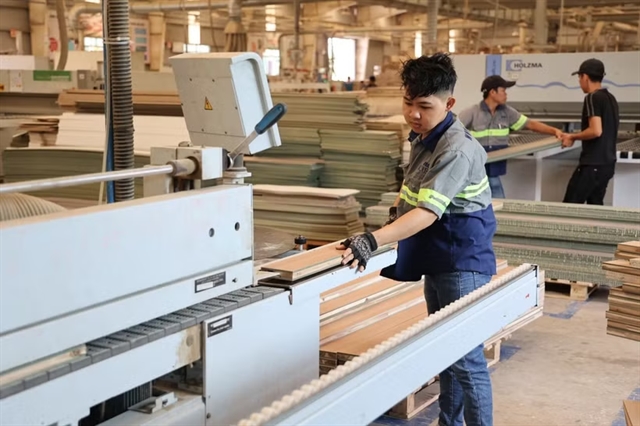
HÀ NỘI — The domestic wood and timber industry maintained positive export growth in the first five months of 2026 despite global economic uncertainties and increasingly stringent sustainability requirements from major markets, according to industry insiders.
Ngô Sỹ Hoài, secretary general of the Vietnam Timber and Forest Products Association (Viforest), said exports of wood and wood products reached US$7.1 billion during the January-May period, up 3.8 per cent compared with the same period last year.
Of which, processed wood products, mainly value-added indoor and outdoor furniture, accounted for approximately $4.5 billion.
The US remained Việt Nam's largest export destination, with turnover estimated at around $3.5 billion, representing nearly half of the industry's total exports. Other key markets included China, Japan, the European Union (EU) and South Korea, with shipments to China and the EU recording notable growth.
According to businesses, many export orders have been secured through the end of the second quarter, with some companies already receiving contracts for the third quarter.
The positive performance comes despite persistent challenges stemming from trade defence measures, rising logistics costs and increasingly demanding requirements related to legal timber sourcing, carbon reduction and anti-deforestation standards.
To achieve the sector's export target of around $19 billion this year, enterprises are continuing to diversify markets, accelerate green transformation and increase the share of deeply processed products while taking advantage of free trade agreements.
Developments in the Middle East have also become a key factor closely monitored by exporters.
Recent positive signals from negotiations between the US and Iran have eased concerns over disruptions to global energy supplies and contributed to lower oil prices.
A decline in energy prices could help reduce fuel and international shipping costs, providing support for the wood sector, where logistics expenses account for a significant portion of export costs.
Industry players expect lower transportation costs and improved consumer sentiment in major economies to support demand for furniture and wood products in the second half of the year.
Huỳnh Quang Thanh, general director of Hiep Long Woodworking Co., Ltd., said geopolitical tensions in the Middle East had created difficulties for exporters in the first months of 2026, but the industry still recorded year-on-year growth.
"That is a positive signal because customers have resumed placing new orders instead of mainly consuming inventories as they did last year," Thanh told nld.com.vn.
He noted that ocean freight rates surged following the conflict in the Middle East. Shipping a 40-foot container to the US previously cost around $1,800-1,900, but since March rates had at times risen to $4,300-4,500 per container.
Besides higher costs, delivery times had also lengthened.
"When international shipping routes, including the Strait of Hormuz, return to stable operations, export activities will become more favourable," Thanh said.
"This also coincides with the industry's peak export season in August and September to serve year-end shopping demand in major markets."
Another director of a wood enterprise also shared similar expectations, saying that stabilisation in the Middle East could facilitate the movement of shipments that had previously been disrupted.
He added that reconstruction demand for infrastructure and housing in the region after the conflict could create new opportunities for Vietnamese wood exporters.
Many companies had proactively quoted prices and established connections with partners in the region. If conditions remain favourable, the Middle East market could become vibrant again within the next few months, he said.
Apart from the US, India was also being viewed as a promising market thanks to its large population and rising demand for premium furniture products.
An increasing number of Indian buyers had approached Vietnamese companies to negotiate orders for high-end product lines.
Trần Quốc Mạnh, vice chairman of the Vietnam Handicraft Exporters Association, said positive developments in US-Iran negotiations had already affected global oil prices.
Brent crude oil prices fell by 8 per cent last week, dropping to $80.4 per barrel.
"If tensions are completely brought under control, maritime freight costs will decline, making export activities, especially for the wood industry, much easier," Mạnh said. — BIZHUB/VNS