Chinese firms see strong potential for agricultural mechanisation cooperation with Việt Nam
Business representatives said mechanisation not only helps reduce reliance on manual labour but also improves production efficiency, shortens planting and harvesting times, reduces post-harvest losses and enhances the quality of agricultural products. For rice-producing countries like Việt Nam, they noted, accelerating mechanisation is an inevitable trend to strengthen the competitiveness of the agricultural sector.
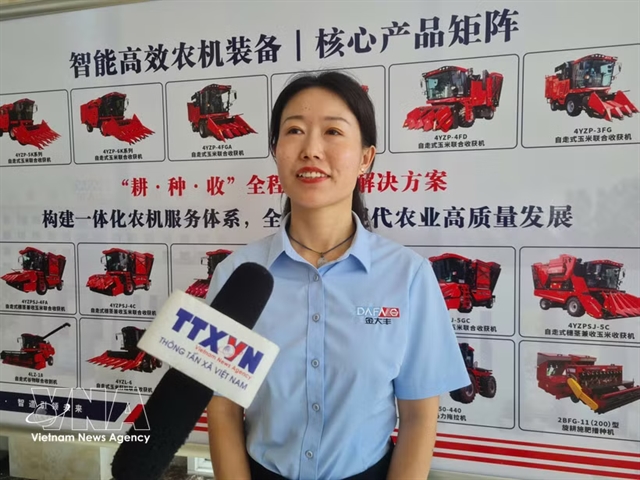
BEIJING — Việt Nam’s agricultural modernisation, together with growing demand for higher productivity, lower production costs and greater mechanisation, is opening up new opportunities for cooperation between Vietnamese and Chinese businesses in agricultural machinery, according to Chinese agricultural equipment manufacturers.
Speaking to Vietnam News Agency correspondents in China, business representatives said mechanisation not only helps reduce reliance on manual labour but also improves production efficiency, shortens planting and harvesting times, reduces post-harvest losses and enhances the quality of agricultural products. For rice-producing countries like Việt Nam, they noted, accelerating mechanisation is an inevitable trend to strengthen the competitiveness of the agricultural sector.
Wei Xiaoli, a representative of Shandong Jindafeng Machinery Co Ltd said Việt Nam is among Southeast Asia’s promising markets for agricultural machinery, thanks to its large area of cultivated land, rising demand for mechanisation and farming conditions that share similarities with those in other countries across the region.
Small- and medium-sized machinery suited to small-scale fields, soft soil and hot, humid weather is considered particularly well positioned to meet practical market needs.
Chinese businesses said bilateral cooperation in agricultural mechanisation is moving beyond equipment trade toward more comprehensive partnerships covering technology transfer, technical training, maintenance systems, spare-parts supply and after-sales service networks. These factors are considered crucial to maximising equipment efficiency and extending machinery service life.
The implementation of the Regional Comprehensive Economic Partnership (RCEP), together with China’s well-developed agricultural machinery supply chains, is also creating favourable conditions for expanding cooperation with ASEAN countries, including Việt Nam.
Beyond equipment exports, a number of Chinese companies are exploring opportunities to work with Vietnamese partners in product assembly, distribution networks and technical service centres as the market reaches a sufficient scale.
Chinese business representatives noted that Việt Nam is promoting modern agriculture through the application of science and technology and a shift toward larger-scale production, which is creating greater demand for mechanised equipment in land preparation, planting, cultivation and harvesting.
They viewed this as an important foundation for the two countries to expand cooperation in agricultural mechanisation, contributing to higher labour productivity, lower production costs and more sustainable agricultural development.
In the coming period, Việt Nam-China cooperation in agricultural machinery is expected to expand from equipment trading toward long-term partnerships in technology, technical services and human resources training. Such cooperation will help meet Việt Nam’s agricultural modernisation needs while providing fresh momentum for bilateral economic cooperation in agriculture. — VNA/VNS