Vietnamese firms urged to adapt proactively as China tightens imported food regulations
The event was jointly organised by the Ministry of Agriculture and Environment and the Đắk Lắk provincial People’s Committee.
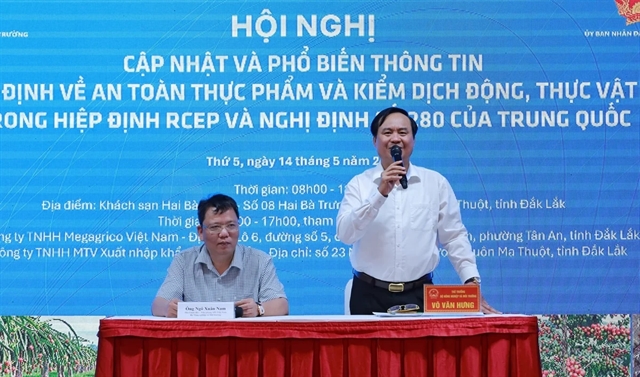
ĐẮK LẮK — A conference on sanitary and phytosanitary (SPS) measures under the Regional Comprehensive Economic Partnership (RCEP) and China’s Decree No. 280 was held on Thursday to help local authorities and exporters update compliance requirements for agricultural shipments to China.
The event was jointly organised by the Ministry of Agriculture and Environment and the Đắk Lắk provincial People’s Committee.
Speaking at the conference, Deputy Minister Võ Văn Hưng said new-generation free trade agreements, particularly RCEP, have created significant opportunities for Vietnamese agricultural and food products to access international markets.
RCEP connects ASEAN economies with China, Japan, South Korea, Australia and New Zealand.
However, he noted that importing countries are imposing increasingly strict requirements on food safety, plant and animal quarantine, traceability, labelling, packaging and raw material management.
As global agricultural trade shifts towards greater transparency and tighter value-chain quality control, compliance with SPS regulations is now a mandatory condition for maintaining market access and improving competitiveness rather than a purely technical requirement, Hưng said.
Officials said effective implementation of SPS commitments under the agreement is expected to help expand export markets while requiring Vietnamese businesses to strengthen compliance with international standards and technical regulations.
China, one of Việt Nam’s largest export markets for agricultural, forestry and fishery products, is also tightening its imported food management system.
Notably, the General Administration of Customs of the People’s Republic of China issued Decree No. 280 on the registration of overseas food production facilities exporting to China in October last year. The decree will take effect on June 1 this year, replacing the previous Order No. 248.
The new regulation will directly affect Vietnamese management agencies, enterprises, cooperatives and processing facilities exporting to China, according to the ministry.
China has also updated requirements related to production facility registration, food safety control, quarantine measures, labelling, packaging and traceability.
The ministry warned that exporters could face shipment disruptions if they fail to proactively update regulations or prepare production conditions, documentation and quality control systems in line with the new requirements.
Vietnamese agriculture authorities said strengthening SPS compliance capacity is now a key priority, shifting from simply meeting market requirements to proactively building competitiveness through standards, quality and transparency.
The ministry also urged local authorities and businesses to review production, processing and export chains, strengthen quality control, standardise cultivation area codes, packaging facilities and traceability systems and regularly monitor SPS updates in import markets.
Officials said effective implementation of SPS regulations and compliance with China’s new requirements will support Việt Nam’s agricultural exports in becoming safer, higher quality, more transparent and more sustainable.
The Central Highlands, South Central Coast and Southeast regions remain major agricultural production hubs supplying key export products such as coffee, pepper, fruit, livestock products, forestry products and processed foods. These areas are also prioritised for improving SPS compliance capacity and developing sustainable supply chains.
Vice Chairman of the Đắk Lắk provincial People’s Committee Nguyễn Thiên Văn said the conference played an important role in improving awareness and implementation capacity regarding SPS commitments under RCEP and China’s new regulations.
He expressed confidence that participants would gain the knowledge needed to better access high-potential export markets and promote safer, higher-quality and more sustainable agricultural exports. — VNS