Việt Nam urged to simplify green credit access for SMEs
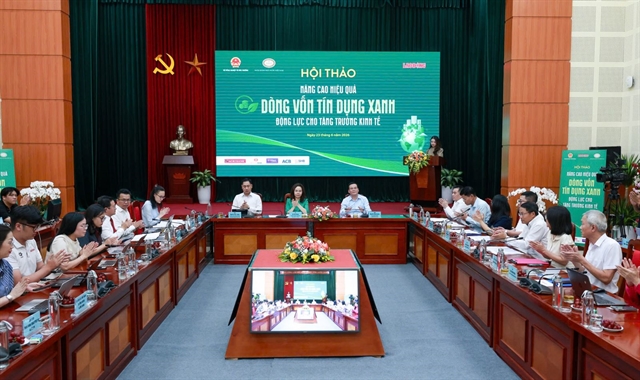
Việt Nam should simplify certification requirements for green projects and build a digital data platform for environmental data to help small and medium-sized enterprises (SMEs) access green loans, experts said at a conference on June 23.

HÀ NỘI — Việt Nam should simplify certification requirements for green projects and build a digital data platform for environmental data to help small and medium-sized enterprises (SMEs) access green loans, experts said at a conference on green capital held on June 23.
Statistics from the State Bank of Vietnam (SBV) showed that outstanding green loans totalled VNĐ828 trillion (US$31.4 billion) by the end of the first quarter, up 4.6 times from 2017, when the programme was launched, but accounted for only about 4.3 per cent of total credit in the economy.
Most of the funding has gone to projects in agriculture, forestry, fisheries and renewable energy, with a total outstanding loan of more than 63 per cent.
Deputy director at the Private Economic Development Research Board Bùi Thanh Minh said that green finance has mainly been directed towards large projects with clear business models, collateral and documentation that satisfy banks' appraisal requirements.
SMEs, which account for 97-98 per cent of businesses in Việt Nam, often struggle to access green loans because they lack standardised environmental data, governance systems and collateral, while around 80 per cent have no prior credit history, he said.
If green finance policies are designed only for large enterprises, the green transition will not be inclusive, Minh said.
He went on to warn that smaller firms face a double challenge of being unable to secure financing for green transitions, while also risking the loss of markets as environmental standards become stricter.
Data is critical
Data remains one of the biggest obstacles to expanding green lending.
Many companies, particularly SMEs, lack the environmental records and reporting systems required to qualify for green loans, while banks face difficulties accessing reliable information to assess projects and monitor risks.
Bùi Khánh Dũng, director of eco-friendly manufacturer Musa Pacta, said many businesses – especially smaller ones – do not know where they stand in the green transition, because Việt nam lacks a unified and practical set of green standards.
He proposed establishing a transparent scoring system that would allow companies to measure their compliance with green criteria and identify areas for improvement before approaching banks.
Scores should be linked to preferential lending rates, unsecured loan ratios or credit limits to create stronger incentives for businesses to invest in green upgrades rather than viewing them as an additional cost, Dũng said.
Meanwhile, Nguyễn Hồng Quang, deputy director general of the Environment Department under the Ministry of Agriculture and Environment, said data is the weakest link in Việt Nam’s green finance ecosystem.
Unlike conventional lending, green credit requires banks to measure greenhouse gas emissions reductions, resource efficiency, climate resilience and other environmental benefits, Quang said.
The absence of standardised databases, measurement indicators and information-sharing mechanisms has increased appraisal and monitoring costs while limiting the expansion of green lending, he stressed.
He said Việt Nam's challenge is no longer the development of policy frameworks, but the effective implementation of those policies through a transparent and measurable green finance ecosystem.
Nguyễn Quang Ngọc, deputy head of the credit policy board at Agribank, one of the country's largest lenders, said the absence of a national classification system for green economic activities and a publicly available database of green projects has made it difficult for banks to apply consistent environmental, social and governance (ESG) standards.
Many businesses remain unprepared, lacking environmental documentation, ESG reporting capacity and adequate collateral, he said.
To address the problem, Minh proposed simplifying green project certification criteria for SMEs rather than applying the same requirements used for large corporations.
He also called for a shift in policy from promoting green lending to helping businesses become eligible for green lending, arguing that the Government should play a stronger role instead of placing the burden solely on commercial banks.
Minh urged the Government to use budget resources to subsidise interest rates to enable businesses to access loans at rates up to 2 per cent lower.
Developing a digital intermediary platform that would consolidate environmental data and connect it with the banking system is also necessary, according to Minh. — VNS