Việt Nam to introduce securities regulatory sandbox from March 2027
The revised law was approved by 463 of the 464 deputies present at the ongoing second session of the 16th National Assembly.
HÀ NỘI — Việt Nam will introduce a controlled testing mechanism for new technologies, products, services and business models in the securities sector from March 1, 2027, under amendments to the Law on Securities passed by the National Assembly on Friday.
The revised law was approved by 463 of the 464 deputies present at the ongoing second session of the 16th National Assembly. It comprises of three articles and will take effect on March 1, 2027.
A key provision adds Article 6a, establishing a regulatory sandbox that allows State agencies to authorise limited trials of new technologies, products, services and business models in real-world conditions where existing legislation has yet to provide for them or where they differ from current legal requirements.
Trials will be subject to restrictions on scope, participants, location and duration, with the aim of encouraging innovation while safeguarding market stability, assets, data and investors' rights.
Organisations seeking to participate must meet eligibility and assessment criteria, obtain certification and operate under the supervision of competent State authorities.
The mechanism must also comply with requirements on national defence, security and securities market safety, as well as relevant laws on science, technology, innovation and the digital technology industry.
The Government will issue detailed regulations on implementation.
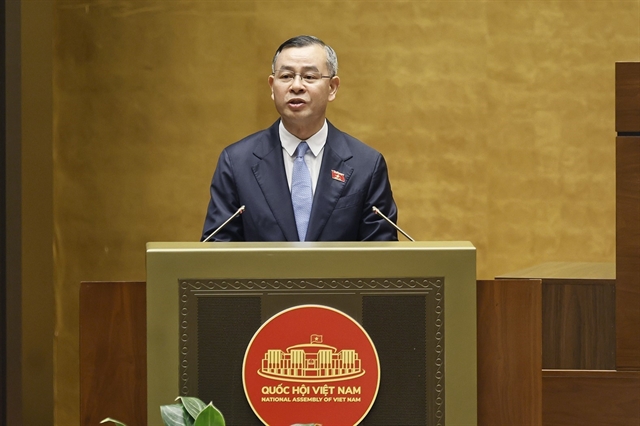
Presenting the Government's report on the draft law before the National Assembly, Minister of Finance Ngô Văn Tuấn said revisions had clarified the requirements for interim and final assessments of sandbox trials.
Based on the results, competent authorities will consider whether to extend the trials or complete the legal framework before allowing the new models, products and services to be officially introduced.
The law establishes basic principles and limits, while assigning the Government responsibility for detailing procedures, risk-control measures and the handling of trial results.
More flexibility in market organisation
The revised law also stipulates that the Prime Minister will decide on the organisational model of the stock exchange, providing flexibility to meet development requirements at different stages.
Provisions on restructuring State capital at the stock exchange have also been revised to ensure consistency with regulations governing State capital management at enterprises and other relevant legislation.
The law further clarifies the distinction between general human resource development policies for the securities sector and specific employment policies for officials of the State Securities Commission.
Several conditions and documentation requirements for securities depository registration have been removed to avoid duplicating checks on capital adequacy indicators already supervised under banking regulations.
However, requirements for technical capacity and operational competence in securities depository services will remain subject to control through membership registration and operational supervision by the Vietnam Securities Depository and Clearing Corporation (VSDC).
The law also clarifies professional qualification requirements for managers, legal representatives and securities practitioners according to their respective responsibilities.
A two-year transitional period, or until relevant personnel changes occur, will give businesses time to arrange staffing in compliance with the new requirements.
Minister Tuấn stressed that administrative simplification must not come at the expense of market safety.
The Government has also prepared two draft decrees and one draft circular to provide detailed guidance for implementing the revised law.
Reviews of relevant regulations, operational procedures, human resources and technological infrastructure will continue to ensure the necessary conditions are in place for its enforcement. — BIZHUB/VNS