Legal framework for commodity derivatives market proposed to NA
The proposed legislation aims to provide a comprehensive and consistent legal framework for commodity derivatives trading while supporting the development of a market that can better serve businesses, cooperatives and producers seeking to hedge against price volatility.
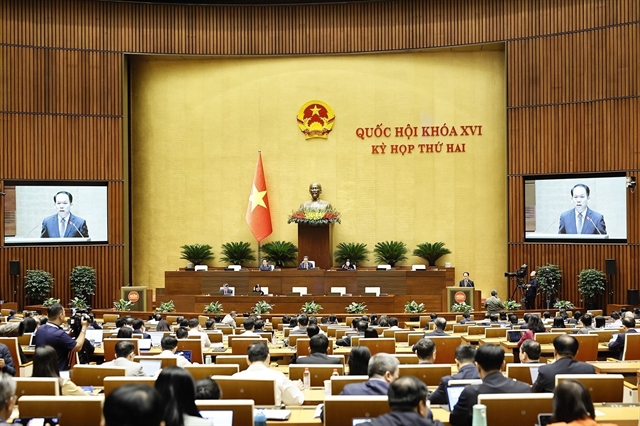
HÀ NỘI — Việt Nam is seeking to establish a dedicated legal framework for its commodity derivatives market, according to a draft law submitted to the National Assembly on November 11 to address regulatory gaps and support market development.
The commodity derivatives market recorded average notional trading value of approximately VNĐ7.5 trillion (US$285 million) per day but continues to face challenges related to liquidity, infrastructure and risk management, Minister of Justice Hoàng Thanh Tùng said while presenting the Government’s proposal on the draft law.
The proposed legislation aims to provide a comprehensive and consistent legal framework for commodity derivatives trading while supporting the development of a market that can better serve businesses, cooperatives and producers seeking to hedge against price volatility.
More than 20 years after the implementation of the 2005 Commercial Law, Việt Nam’s commodity derivatives market has made initial progress with the number of centrally traded contracts ring from approximately 58,900 in 2019 to around 1.54 million in 2025. About 38 commodities, covering more than 40 types of contracts, are currently traded.
Sixteen commercial banks and foreign bank branches are also authorised to provide commodity price derivatives products.
However, market scale and liquidity remain limited, while relatively few manufacturing and trading businesses use derivatives to hedge against price fluctuations.
Most products are linked to overseas exchanges, with relatively few contracts based on Vietnamese commodities and domestic benchmark prices. Clearing and settlement systems, risk management, warehousing, delivery and data supervision infrastructure also remain insufficiently integrated, Tùng said.
He added that the proposed law will help connect derivatives trading more closely with production, processing, distribution, exports and consumption, while improving market infrastructure and risk management.
The legislation, comprising of eight chapters and 57 articles, is also expected to facilitate greater participation by Vietnamese businesses in global supply chains and gradually strengthen the country's role in regional and international commodity price formation.
It provides for both centralised trading through commodity exchanges and over-the-counter (OTC) trading through intermediaries. OTC transactions conducted directly between parties without intermediaries would be governed by civil law.
Commodity exchanges would be permitted to operate both centralised spot and derivatives markets, provided that products, membership, accounts, settlement and risk management arrangements are clearly separated.
Presenting the appraisal report, Phan Văn Mãi, chairman of the National Assembly's Economic and Financial Committee, called for further revisions to ensure consistency with existing legislation and compatibility with relevant international treaties.
The committee also urged a more thorough assessment of national defence and security requirements, foreign exchange management, anti-money laundering measures and the resources needed to implement the law.
Participation in commodity derivatives trading should remain voluntary, Mãi said, warning against administrative intervention or requirements forcing market participants to trade through commodity exchanges.
The committee also called for stronger policies to protect investors and manage risks, alongside further development of standardised derivatives contracts based on commodities in which Việt Nam has competitive strengths.
For centralised markets, the committee urged ownership and operating models for commodity exchanges and clearing houses to be assessed to make effective use of existing financial market infrastructure.
The draft should further clarify requirements for financial capacity, technology and risk management, as well as rules governing margins, clearing support funds, position limits, benchmark prices, settlement prices and physical delivery.
For OTC transactions, the committee recommended a regulatory framework proportionate to their risk levels, including clearer classifications of transactions, eligibility requirements for participants and products, collateral valuation, reporting obligations and circumstances requiring central clearing.
It is necessary to develop clearer rules governing cross-border market connectivity, including partner selection, foreign exchange management, margin flows, settlement, cross-border data transfers and data security, Mãi said.
The committee also stressed the need for effective early-warning mechanisms and measures to prevent market manipulation, insider trading and fraud. — VNS