Việt Nam targets ASEAN AI hub status by 2030
Việt Nam aims to build a stronger AI ecosystem and become a leading AI hub in ASEAN by 2030, targeting an AI economy worth 6 per cent of GDP and US$5 billion in annual exports of AI products and services.
HÀ NỘI — Việt Nam is targeting an AI economy equivalent to around 6 per cent of GDP and AI-related exports of US$5 billion by 2030, as it moves to make artificial intelligence a key driver of national economic and social transformation.
The targets are part of the National AI Strategy to 2030, with a vision to 2045, approved by Deputy Prime Minister Hồ Quốc Dũng on August 28.
Under the strategy, Việt Nam aims to rank among the three leading Southeast Asian countries in AI research and development by 2030 and become a regional and Asian centre for AI research, development, application and value creation.
The government expects AI adoption to raise labour productivity by 10-15 per cent in sectors using the technology. It also aims for 60 per cent of AI-adopting businesses to report higher productivity, lower costs or increased revenue.
AI is also set to become more deeply embedded in public administration. All civil servants and public employees are expected to use AI in their official work at least weekly, while 60 per cent of government management decisions are targeted to be supported by data and AI.
All online public services are expected to be AI-enabled, with AI support extended to the processing of administrative dossiers.
Building capacity at scale
The strategy puts the development of domestic capabilities alongside AI adoption.
By 2030, Việt Nam aims to have 10,000 highly qualified AI professionals and 50,000 university graduates with the skills needed to apply AI. A further 500,000 workers will be trained or retrained to deploy and operate AI systems, while 10 million trained workers will receive basic AI skills.
Annual investment in AI is targeted at 1-1.5 per cent of GDP. The country also plans to develop a national platform to coordinate AI computing capacity, a Vietnamese-language AI model evaluation platform and at least five shared AI platforms.
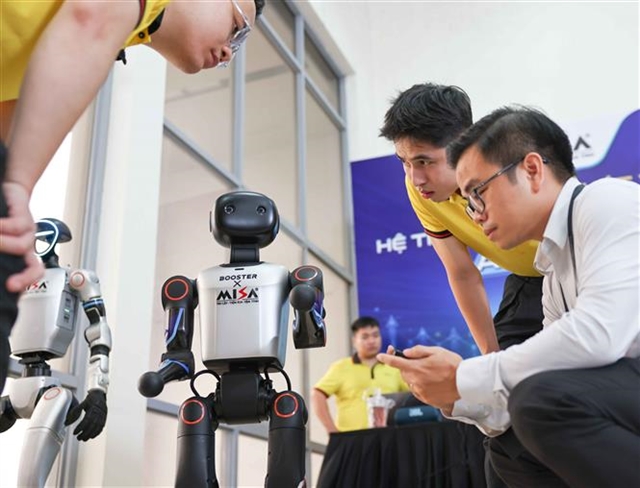
The strategy targets 10 Vietnamese AI brands and eight Vietnamese-language AI models, while critical datasets are to be digitised, standardised, cleaned and made ready for AI applications.
Computing capacity is expected to reach around 560 EFLOPS in BF16 or 1,100 EFLOPS in FP8, supported by about 500MW of electricity capacity.
The government also wants Vietnamese AI companies to become the main force in developing and deploying AI, while encouraging AI-native businesses and “Make in Viet Nam” products, platforms and services.
AI across the economy
AI adoption will be expanded well beyond the technology sector, with applications planned in science, manufacturing, agriculture, finance, healthcare, education, culture and environmental management, as well as defence and security.
The approach combines technological development with safeguards on safety, security, transparency and accountability. International cooperation will be pursued to supplement domestic capabilities while maintaining strategic autonomy and diversifying technology partners and supply chains.
The strategy is organised around nine broad pillars, including talent and nationwide AI skills, data and models, infrastructure, research, governance, business adoption, ecosystem development and trustworthy AI.
To translate these priorities into implementation, the government has set 32 targets and 97 tasks across 14 groups. Each task will have designated responsibilities, expected outputs and timelines.
Six priority areas will focus on improving institutions and legislation, strengthening national coordination, mobilising funding, expanding international cooperation and standards, promoting responsible AI use and monitoring progress.
Implementation will follow a “six clear” principle covering clear people, tasks, timelines, responsibilities, outputs and authority.
The strategy took effect on the date of signing, replacing Decision No. 127/QĐ-TTg of January 26, 2021. Ongoing projects under the earlier framework will continue until completion or be adjusted and incorporated into the new strategy.
The broader objective is to shift Việt Nam from primarily researching and applying AI to using the technology as a capability embedded throughout national development. — VNS