Việt Nam strengthens science–technology innovation links
Globalisation and deeper international integration require Việt Nam to participate more effectively in global value chains, which demands stronger innovation capacity among domestic enterprises.
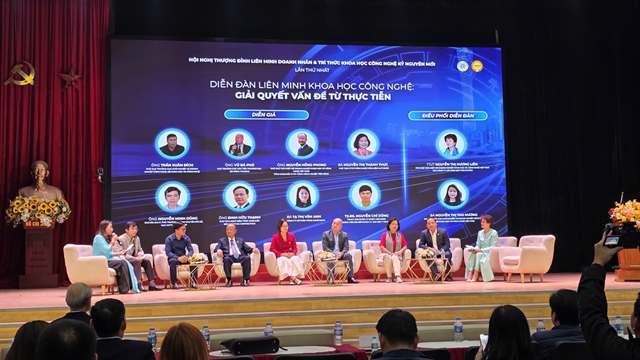
HÀ NỘI — Việt Nam's science and technology community called for stronger links between the state, scientists and businesses to accelerate the country's shift toward a knowledge-based economy at the first New-Era Alliance of Entrepreneurs and Scientific–Technological Intellectuals Summit held on December 5.
The event, organised by the Vietnam Association of Science and Technology Enterprises (VST) in coordination with the National Agency of Startups and Technology Enterprises under the Ministry of Science and Technology, gathered scientists, entrepreneurs and experts under the theme: 'Connecting Vietnamese Intelligence – Joining Hands to Master Vietnamese Technology and Develop the Knowledge Economy'.
The summit aimed to strengthen cooperation between research institutions and enterprises, ensuring that scientific and technological outputs are transferred effectively into production and daily life.
VST Chairman and Labour Hero Hoàng Đức Thảo said the Fourth Industrial Revolution is reshaping economic operations through breakthroughs in artificial intelligence, big data, digital technology and intelligent automation.
"In this context, Vietnamese enterprises and scientific–technological intellectuals must demonstrate technological autonomy, pioneering spirit and readiness to invest in research and commercialisation to expand domestically and integrate internationally," he said.
Development triangle for innovation
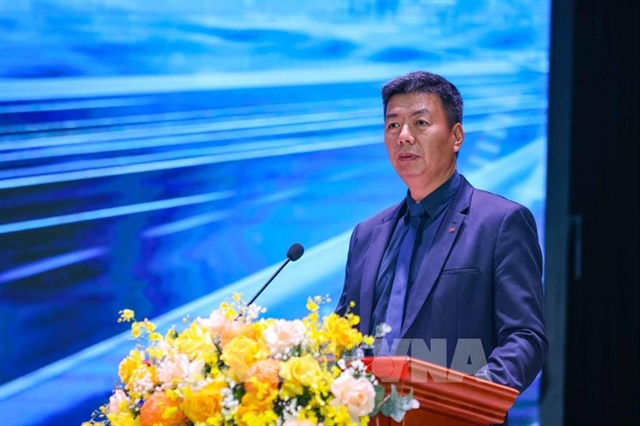
Addressing the conference, Trần Xuân Đích, deputy director general of the National Agency of Startups and Technology Enterprises, highlighted that the state, scientists and businesses each play distinct roles but share a common goal: driving national development through science, technology and innovation.
He said globalisation and deeper international integration require Việt Nam to participate more effectively in global value chains, which demands stronger innovation capacity among domestic enterprises.
The rise of digitalisation, combined with growing public expectations for online public services and e-commerce, is also exerting pressure on both the public and private sectors to accelerate digital transformation.
According to Đích, the state provides the enabling environment through policies such as the Politburo's Resolution 57, Government resolutions, the Law on Science, Technology and Innovation 2025, Decree 268 on science and technology enterprises, technology exchanges, incentives on taxation and land and various funding mechanisms.
Scientists, he noted, build the knowledge foundation through research, inventions and new technical models across fields such as healthcare, agriculture, logistics, digital transformation, energy and materials.
Enterprises, especially science and technology enterprises, create value by accepting risks, investing in experimentation and commercialising research outcomes.
"When operating separately, each stakeholder faces enormous challenges. But when connected, they form a development triangle: real problems from production, technological solutions from research institutions, and policy tools from the State," Đích said.
Real models, real investment, real impact
Speakers at the event emphasised that science and technology enterprises sit at the convergence of scientific knowledge, capital, market demands and policy frameworks.
They are also seen as the core force behind the 'Make in Vietnam' spirit and Việt Nam's pursuit of technological self-reliance.
Several examples were highlighted as evidence of the effectiveness of the tripartite linkage model.
In agriculture, Tien Nong Industrial and Agricultural JSC and ThaiBinh Seed have partnered closely with research institutes to develop crop varieties and smart fertilisers to improve farming efficiency and climate resilience.
In pharmaceuticals, companies such as Savipharm and Sao Thai Duong JSC have invested heavily in R&D, mastering formulation technologies and supplying high-quality products that reduce reliance on imports.
Infrastructure enterprise Busadco has commercialised research results to deploy urban drainage and anti-flooding solutions, while technology firms in the healthcare sector are advancing hospital digitalisation and data-driven medical services.
Đích encouraged each enterprise, especially science and technology enterprises or companies with innovation aspirations, to identify at least one technological challenge or need and submit it to the VST, relevant departments or digital platforms for connection.
He also suggested that research groups select one transferable research output and present it "in the language of business", with clear descriptions of application, market potential, cost and expected efficiency.
On the regulatory side, the Ministry of Science and Technology and local science departments committed to continuing controlled testing (sandbox) mechanisms for new models and products, simplifying procedures for accessing funds and support programmes and maintaining dialogue with the new alliance of scientific–technological entrepreneurs.
The goal is to shorten the distance from laboratory to factory, from idea to product and from policy to market.
Đích also underscored the message 'Doing it for real is patriotism.' In science, technology and innovation, they said, "doing it for real" means real research to solve real problems, real investment in R&D with a willingness to take risks, real utilisation of available policies and real cooperation among stakeholders.
He believed that the summit would mark the beginning of new collaborations in research and development, technology transfer contracts, the establishment of more science and technology enterprises within universities and institutions, and policy refinements based on feedback from the innovation community. — BIZHUB/VNS