Việt Nam steps up efforts to promote sustainable consumption: forum
The 2023 Law on Protection of Consumers' Rights contains provisions encouraging sustainable production and consumption, including support for investment in the production, circulation, distribution, import and export of environmentally friendly products, goods, services and technologies.
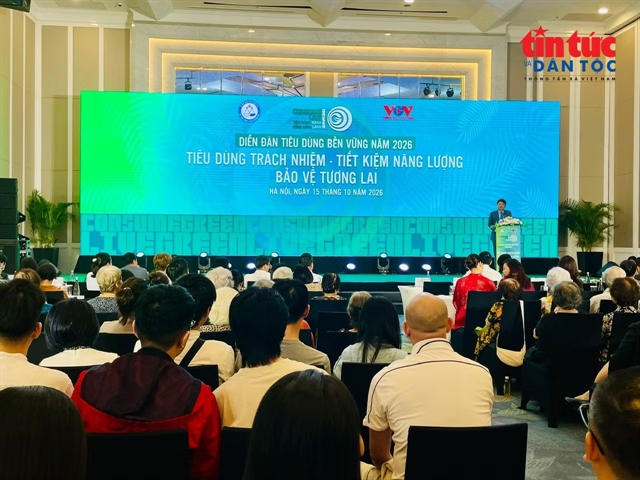
HÀ NỘI — Việt Nam is working to refine policies and strengthen cooperation among the state, businesses, consumers and social organisations to promote sustainable consumption, improve resource efficiency and support the transition to a green and circular economy, a conference heard in Hà Nội on Thursday.
Phạm Mạnh Hùng, deputy general director of Voice of Vietnam (VOV) – one of the event's organisers – said green development and sustainable consumption have become key drivers of economic model transformation, national competitiveness and improvements in development quality.
He highlighted the need to make sustainable consumption a convenient and cost-effective choice for consumers, with policies helping energy-efficient and environmentally friendly products become more competitive. Greater corporate transparency and accountability are also essential, he said.
Hùng called for a shift from raising public awareness alone towards building a comprehensive ecosystem for sustainable consumption, in which the State develops policies and standards, businesses supply responsible products, consumers exercise their rights and monitor market practices and social organisations and the media promote transparency.
Digital transformation and technology could also support product traceability, information verification, better alignment between production and consumption, and waste reduction, he added.
Trịnh Anh Tuấn, chairman of the Vietnam Competition Commission under the Ministry of Industry and Trade, said sustainable consumption has extended beyond choosing environmentally friendly products to encompass responsible resource use, waste reduction, quality of life and the long-term effects of consumption decisions on communities and future generations.
The 2023 Law on Protection of Consumers' Rights contains provisions encouraging sustainable production and consumption, including support for investment in the production, circulation, distribution, import and export of environmentally friendly products, goods, services and technologies, Tuấn said.
These provisions are intended to support the development of a green and circular economy, increase consumer benefits and encourage the public to participate actively and responsibly in sustainable production and consumption initiatives, he added.
Dr Tạ Đình Thi, vice chairman of the National Assembly’s Committee on Science, Technology and Environment, said the Party’s consistent policy is to establish a new growth model driven by science, technology, innovation and digital transformation.
The model aims to improve economic productivity, quality, efficiency, added value and competitiveness, while promoting sustainable production and consumption and strengthening the responsibility of businesses and individuals for environmental protection and the efficient use of energy and natural resources, he said.
These goals are reflected in the National Green Growth Strategy for 2021-30, with a vision to 2050, the National Power Development Plan and other strategic frameworks.
Thi outlined four priorities for turning awareness into action: refining institutions and policies while strengthening oversight; promoting the pioneering role of businesses; making energy conservation and responsible consumption everyday practices for individuals and families; and expanding public communications through the media and social organisations.
The transition to a green economy and Việt Nam’s commitment to achieving net-zero emissions by 2050 would bring both challenges and significant opportunities for sustainable development, he said. — VNS