Việt Nam seeks to move public-sector AI from pilots to integrated operations
The country is moving to integrate AI into public services, with experts stressing the need for measurable results, secure data and human accountability.
By Ly Ly Cao
Việt Nam is accelerating integration of artificial intelligence (AI) into public administration and services, with experts calling for stronger data governance, clearer accountability and measurable performance indicators as government agencies move from isolated applications to AI-supported operations.
Đặng Chiến Công of the Ministry of Science and Technology’s National Institute of Digital Technology and Digital Transformation said wider use of AI did not, in itself, show how well it worked.
Công said 35 of the 36 government organisations surveyed had used AI, but only 10 reported measuring its impact.
He said AI projects should begin with the work that needs improvement rather than with a particular AI model. Before choosing the technology and deciding how to deploy it, agencies should define what they want to achieve, find out where the relevant data is stored and decide who will review the results.
For example, an AI assistant supporting the monitoring of tasks assigned by agency leaders could initially be used to consolidate progress reports, identify overdue assignments, and draft reports.
Its functions could then be expanded through a structured process covering user requirements, system functions and automation, deployment options, integration with existing operational systems, testing and evaluation.
He outlined three possible deployment arrangements: an agency's own infrastructure, a shared platform, and external services or hybrid models.
An AI model alone does not constitute a complete virtual assistant system, according to Công. Such a system may need a knowledge base, tools and application programming interfaces, links to existing business systems and a mechanism to control user permissions.
Integrated workflows
Phạm Quang Nhật Minh, director of the AI Research and Development Centre at FPT IS, said many public-sector AI projects remained at the exploratory or pilot stage.
He cited OECD research indicating that 58 per cent of public-sector AI use cases in the EU remained at the planning, pilot or development stages.
In the UK, 8 per cent of government AI projects had demonstrated measurable benefits, while 70 per cent of government agencies surveyed by the National Audit Office were piloting or planning AI, with 37 per cent having deployed it.
Minh identified five reasons why AI had yet to become part of routine organisational operations: selecting the wrong problem; high costs and inadequate infrastructure; the need for trustworthy AI; standalone applications that were not integrated into complete workflows; and fragmented data without a shared understanding of organisational terminology and business rules.

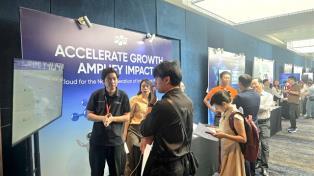
At the Vietnam Artificial Intelligence Forum, he presented an integrated approach in which AI supports an entire process rather than a single task.
In drafting legal documents, for instance, a standalone chatbot may provide legal information that officials must copy into other software and check separately. An integrated system can support the full workflow, including legal research, drafting, checking references, consolidating comments and comparing versions.
Minh highlighted the importance of a semantic layer — a structured description of data, terminology, relationships and business rules that enables AI systems to interpret information in the context of an organisation.
He also cited examples of AI applications in government agencies. FPT's Government OS, a specialised virtual-assistant platform developed with the Ministry of Finance, recorded 4,650 interaction sessions and generated 3,609 reports across 34 units over six months.
During the trial, 90 per cent of feedback had been addressed or was being processed, including 63 per cent already resolved.
Human accountability
Nguyễn Đắc Tình, founder of Vietnam MarTech and the TicketX platform and developer of AISAFE, said AI had already entered workplaces, whether or not organisations had formally adopted it.
Tình proposed a five-step approach to treating AI as a new colleague: assigning appropriate tasks, providing operational instructions, setting data permissions, supervising and checking its work, and evaluating performance while retaining human responsibility.
He recommended starting with repetitive tasks that follow established templates and whose errors can be detected, such as summarising lengthy documents, compiling reports and preparing drafts. AI should not be assigned decisions directly affecting citizens' rights, tasks involving state secrets or work for which officials cannot independently verify the results.
Before using AI-generated outputs, civil servants should check the legal basis and validity of cited documents, the accuracy of figures, signing authority, deadlines and whether confidential information has been exposed.
Tình also proposed dividing information into three categories: data that must not be entered into AI systems, data that can be used only under specified conditions, and information that is permitted for use.
Sensitive personal information may require anonymisation and approval, while state secrets, confidential drafts, passwords and access keys should not be entered into public AI tools, he added. — BIZHUB/VNS