Việt Nam remains ASEAN+3 growth leader despite inflation pressures: AMRO
Despite a slight downgrade to growth forecasts, Việt Nam is projected to outperform most ASEAN+3 economies as resilient domestic demand and exports continue to support expansion.
HÀ NỘI — Việt Nam is expected to remain one of the fastest-growing economies in the ASEAN+3 region this year, although rising energy costs linked to the prolonged conflict in the Middle East are likely to push inflation higher and slightly slow growth momentum, according to the latest outlook from the ASEAN+3 Macroeconomic Research Office (AMRO).
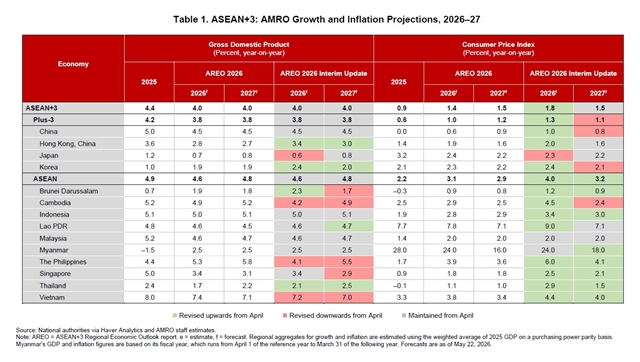
In an interim update to its regional economic outlook released on Tuesday, the Singapore-based organisation forecast Việt Nam's economy to expand by 7.2 per cent in 2026 and 7.0 per cent in 2027.
While both figures are slightly lower than the projections published in April, they remain among the highest growth rates in ASEAN+3, reflecting the country's resilient domestic demand, investment activity and export performance.
AMRO also revised its inflation forecast for Việt Nam.
Consumer prices are now expected to rise by 4.4 per cent in 2026, compared with the 3.8 per cent forecast issued in April. Inflation is projected to remain elevated at 4.0 per cent in 2027, up from the previous estimate of 3.4 per cent.
The revisions come as the conflict in the Middle East enters its fourth month, lasting longer than initially anticipated and keeping global energy and commodity prices elevated.
The region has been affected by disruptions to shipping routes and supplies of key industrial inputs, leading to higher transport, production and logistics costs.
AMRO noted that while first-quarter economic growth across ASEAN+3 was stronger than expected, the full impact of higher energy prices has yet to be felt.
For economies such as Việt Nam, inflationary pressures are expected to become more visible as rising fuel and input costs gradually feed through to businesses and consumers.
The organisation said stronger inflation pass-through in some ASEAN economies, including Việt Nam and the Philippines, could weigh on household spending and dampen domestic demand over the remainder of the year.
Across ASEAN+3, AMRO maintained its growth forecast at 4 per cent for both 2026 and 2027, unchanged from its April outlook.
The regional economy expanded by 4.4 per cent in the first quarter of this year, supported by robust domestic demand and continued strength in technology-related exports.
According to the report, private consumption remained resilient across the region, underpinned by favourable labour market conditions and income growth. Investment activity also remained solid as earlier investment commitments continued to support expansion in key sectors.
Regional exports have remained a major driver of growth, particularly shipments linked to artificial intelligence (AI), semiconductors and electronics. AMRO said the ongoing technology cycle has provided strong support for several economies despite mounting external uncertainties.
However, inflation prospects have deteriorated. The regional inflation forecast for 2026 was revised upwards to 1.8 per cent from 1.4 per cent previously, before easing to 1.5 per cent in 2027.
The agency said around 80 per cent of vessel traffic through the Strait of Hormuz remains disrupted, contributing to sustained increases in energy and commodity prices.
Since the conflict began, crude oil prices have risen by roughly 50 per cent, while prices of refined petroleum products and fertiliser inputs have increased even more sharply.
So far, businesses have largely managed the disruptions through alternative sourcing arrangements. Nevertheless, a prolonged conflict could lead to more significant production disruptions and additional inflationary pressures across the region.
"ASEAN+3 growth has remained resilient, supported by firm domestic demand and technology exports. But incipient signs of stress are emerging," AMRO Chief Economist Dong He said.
"Higher energy and transport costs are feeding into inflation and adding pressure on industrial supply chains. If the conflict persists, these pressures could broaden and weigh on regional growth."
AMRO identified the duration and severity of the Middle East conflict as the most significant near-term risk to the outlook.
Under an adverse scenario in which Brent crude oil prices average US$125 per barrel this year, compared with a baseline assumption of $95 per barrel, and supply disruptions worsen further, ASEAN+3 growth could slow sharply to 2.5 per cent in 2026. — BIZHUB