Việt Nam ranks among world's top 50 economies in digital and AI competitiveness
Việt Nam ranked 13th in AI application, 15th in digital and AI governance, and 21st in efficiency, highlighting its strengths in digital technology and AI application, and in digital governance.
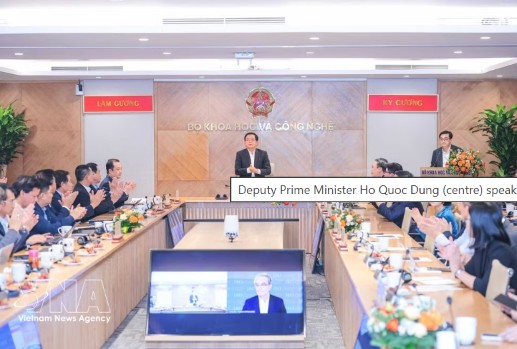
HÀ NỘI — Việt Nam ranked 37th among 70 economies in the 2026 World Digital and AI Ranking (WDAIR 2026), placing it among the world's top 50 in its first official assessment by the International Institute for Management Development (IMD) of Switzerland.
The Ministry of Science and Technology announced the result at a ceremony in Hà Nội on November 11.
Việt Nam’s strengths and areas for improvement
Trần Minh Tân, deputy director of the Vietnam Academy of Science and Technology Strategy under the Ministry of Science and Technology, said Việt Nam scored 78.09 points, ranking third among six Southeast Asian economies assessed, including Singapore, Malaysia, Thailand, Indonesia and the Philippines.
The result reflects progress in implementing the Political Bureau’s Resolution No. 57-NQ/TW on breakthroughs in science and technology development, innovation and national digital transformation, particularly efforts to develop digital infrastructure, promote digital transformation, apply technology, and reform governance methods, he noted.
Việt Nam ranked 13th in AI application, 15th in digital and AI governance, and 21st in efficiency, highlighting its strengths in digital technology and AI application, and in digital governance.
Prof. Arturo Bris, Director of the IMD World Competitiveness Centre, said the rankings drew on data collected from regions worldwide and recognised Việt Nam’s strengths in the above-mentioned areas.
However, he also pointed out several weaknesses Việt Nam needs to address in the coming time, including the high cost of AI tools, a shortage of AI talent, cybersecurity risks, data leaks and AI governance.
He recommended developing shared infrastructure to reduce AI costs, building a pool of AI experts and increasing investment in research and development. He also said the Government should become a model user of AI, expressing his confidence that Vietnam can improve its ranking in the coming years.
New phase of development in productivity, knowledge and creative capacity
In his remarks, Deputy Prime Minister Hồ Quốc Dũng stressed that science, technology and innovation are becoming key drivers of growth, while digital transformation is reshaping governance, production and service delivery. AI is opening new opportunities to improve productivity, knowledge and creative capacity.
The digital and AI competitiveness ranking provides an important reference for assessing how economies seize opportunities, adapt to changes and build development advantages, he said, noting that for Việt Nam, this presents both a major opportunity and an urgent need for action.
Resolution No. 57-NQ/TW sets the target of placing Việt Nam among the top three countries in Southeast Asia and the world's top 50 in digital competitiveness and e-government development by 2030, as well as among the Southeast Asian region's top three in AI research and development, he said, stressing that achieving these goals requires continual innovation, substantive capability advancement, and national position elevation in global value chains.
The Deputy PM urged ministries, agencies and localities to strengthen institutional quality, governance quality and implementation efficiency, accelerate administrative reform and online public services, enhance data connectivity and sharing, and facilitate businesses’ adoption of digital technologies and AI to their operations.
He also called for greater investment in strategic platforms, next-generation telecommunications and data infrastructure, and computing resources, alongside efforts to reduce AI access costs for businesses, particularly small- and medium-sized enterprises.
He stressed that priorities should include strategic technology research and development, AI workforce training to meet practical demand, and ensuring that investment is aligned with the capacity to utilise technology and its actual effectiveness.
The State should play an enabling role, businesses should take the lead, and research institutes and universities should contribute to knowledge, technology and human resources development, Dung went on.
The Deputy PM tasked the Ministry of Science and Technology with leading a review of IMD’s new methodology, analysing its indicators and identifying the causes of Việt Nam’s strengths and shortcomings, particularly the areas needing improvement.
The ministry should then propose targeted tasks and solutions with clear responsibilities, expected outcomes and regular assessment mechanisms, focusing on institutional quality, public service efficiency, infrastructure, human resources and AI adoption costs, he said. — VNA/VNS