Việt Nam looks seaward with ESG++ coastal mega cities for future growth
To achieve the ambition of becoming one of the world’s 20 largest economies, Việt Nam can no longer rely solely on traditional development models.

As land-based urban space reaches its limits and traditional development models lose momentum, Việt Nam is increasingly turning its gaze to the sea for future growth.
This shift has prompted the need for a sustainable investment strategy centred on ESG++ mega urban cities, a conference in Hà Nội heard last week.
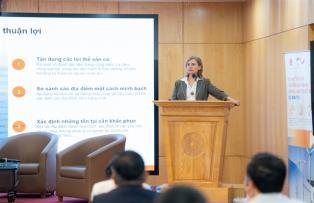
At the event, held by Việt Nam Real Estate E-Magazine (Reatimes) and Vietnam Institute of Real Estate Market Research (VIRES), Phạm Nguyễn Toan, vice president of the Việt Nam Real Estate Association, said that Việt Nam had, for decades, followed a familiar trajectory, expanding industrial, commercial and residential areas along highways and outward from core urban zones.
"This model has significantly contributed to accelerating economic growth throughout nearly four decades of Đổi mới (Renewal), but is now reaching its limits," he said. In this context, the sea is emerging as a strategic space with huge potential for maritime economy, seaports, logistics, tourism, services, and green urban development, according to Toan.
Countries like Singapore, Japan, South Korea, and the UAE, which achieved breakthrough developments, share a common strategy of turning toward the sea and making coastal areas strategic growth poles.
“The question is how should we advance seaward?” he asked, stressing that simply reclaiming land to build houses or expand cities would damage the ecosystem and undermine resilience to climate change, posing threats to sustainable development.
"It is vital to develop a right approach for seaward advancing and unlock the country’s maritime space potential, with ESG++, combining traditional environmental, social, and governance standards with enhanced pillars of regeneration and climate resilience, at the core," he said.
According to Lê Xuân Sang, vice president of the Institute of Việt Nam and World Economy, advanced economies are steadily tightening green standards in planning, land use, construction, and environmental protection, increasingly requiring urban developments to meet ESG, ESG+ and ESG++ benchmarks.
Nguyễn Sĩ Dũng, a member of the Prime Minister’s Policy Advisory Council, said the 21st century would belong to countries that can expand their development space and reorganise urban models following new standards, notably ESG++.
"This is a rare opportunity for Việt Nam with maritime space accounting for roughly two-thirds of the country’s total area," Dũng said. "To achieve the ambition of becoming one of the world’s 20 largest economies, Việt Nam can no longer rely solely on traditional development models."
"Advancing seaward through coastal mega cities would allow the country to expand its development space, create new growth poles, and better harness advantages in logistics, trade, finance, and innovation,” Dũng said.
“ESG++ urban development is the only way to move seaward without sacrificing the environment, and even to regenerate it.”
Dũng also called for bold institutional reform, prioritised investment in interregional infrastructure, openness to green capital flows, and technology-led governance.
Need a vision

The southern coastal belt has significant potential to develop a world-class coastal mega city, given its strategic geo-economic locations in Southeast Asia, close to major international maritime routes and directly connected to the 700-million-population ASEAN market and one of the world’s most efficient ports, Cái Mép – Thị Vải, according to Dũng.
The former Bình Dương Province, which was recently merged with HCM City, has emerged as a high-tech industrial hub and enlarged HCM City serves as the country’s financial and services centre while Cần Giờ plays a role as the region’s primary maritime gateway.
Dũng said that if the Kra Canal project was developed, Cần Giờ would become one of the most strategically advantageous locations in the world, capable of competing with regional hubs and potentially emerge as the most favourable maritime location in Southeast Asia.
When coastal, industrial, logistics and urban advantages are integrated into a single, unified development framework, Việt Nam could create a coastal mega city of 20–25 million people, generating regional GDP of between US$700 billion and US$1 trillion by 2050 and powerful enough to interact with leading ASEAN economic centres such as Singapore, as well as Seoul and Tokyo, he said.
However, experts stressed that to avoid repeating traditional urbanisation – rapid growth paired with environmental stress, flooding, loss of identity, and rising social costs – Việt Nam must adopt an entirely new ESG++ framework.
ESG++ is designed to meet 21st-century challenges by combining environmental, social, and governance principles with innovation, climate resilience, and a low-carbon circular economy.
Building an ESG++ mega city is not a short-term endeavour but a multi-decade strategy requiring long-term vision, strong institutions, and a phased development roadmap, according to Dũng.
As Cần Giờ is home to a UNESCO-recognised mangrove biosphere reserve, it is necessary to plan so that large-scale coastal development coexists with environmental protection.
From 2025-30, Việt Nam should focus on developing legal foundation for advancing seaward, including the introduction of a new law, potentially a law on coastal mega city development, a law on HCM City development or a law on a southeast region development, together with the establishment of a regional-level governance system.
To realise ESG++ mega city, it is necessary to develop foundational breakthroughs including institutional reform, infrastructure, financial mechanism for green capital, and technology.
“Sea is the new development space, ESG++ is the urban standard of the 21st century and coastal mega city is the strategic turning point for Việt Nam’s future development,” Dũng said.
According to Sang, as the global capital shifts toward future assets that not only can create growth but also ensure sustainability and resilience to climate change, ESG++ mega cities are expected to emerge as a magnet of investment.
ESG++ mega cities currently accounted for less than 1 per cent of the total global property market, he said, highlighting the enormous opportunity for Việt Nam to lead in sustainable, climate-resilient urban development in the next two decades. VNS