Việt Nam lays groundwork for quantum push amid global scramble
Now is the time for Việt Nam to move if it wants a place in the quantum value chain, according to Nguyễn Quốc Hưng, director of the Quantum Technology Institute under Vietnam National University, Hanoi.
HÀ NỘI — By placing cybersecurity and quantum technology at the top of its strategic agenda, Việt Nam is laying the groundwork to build research capacity, train talent and strengthen its self-reliance, experts say.
Quantum technology is emerging as a strategic frontier in global science, technology and security competition, as countries ramp up investment and gradually commercialise applications such as quantum communications and quantum sensing, while continuing to develop large-scale quantum computing systems.
Resolution 57, issued in December 2024 by the Communist Party of Việt Nam, and a prime ministerial decision naming quantum among the 10 strategic technologies provide the policy bedrock for labs, talent pipelines and early commercialisation.
Funding for quantum startups jumped in 2025, mostly for quantum computing, said Nguyễn Quốc Hưng, director of the Quantum Technology Institute under Vietnam National University, Hanoi (VNU Hanoi), citing a report by the global management consulting firm McKinsey & Company.
But advanced economies were tightening export curbs on cryogenic systems, high-frequency electronics and specialist components, raising barriers for latecomers, he warned.
Now is the time for Việt Nam to move if it wants a place in the quantum value chain, according to Hưng.
He pointed to Singapore’s lead in Southeast Asia with a mature research ecosystem, while Thailand, Malaysia and Indonesia are expanding programmes and partnerships.
Capacity gaps
Việt Nam plans to host a Southeast Asia Quantum Hackathon in July and the ASEAN Quantum Summit in October to build profile, test ideas and deepen cooperation.
Officials frame the effort as part of a broader strategy to channel science, technology and innovation into growth. Targets for 2030 include faster GDP expansion, a larger digital economy and higher contributions from total factor productivity, alongside ambitions to become a developed economy by 2045 and achieve net-zero emissions by 2050.
Policymakers argue that early preparation in regulation, talent and infrastructure is essential if Việt Nam is to capture value as quantum applications move from labs to markets.
On the ground, capacity remains thin.
Research groups are fragmented and largely theoretical; specialist training is scarce; private-sector participation is limited; and lab infrastructure is modest, according to Hưng. Financing and project evaluation frameworks also lag the needs of a field with long investment cycles and high risk.
He urged a targeted start in areas that match current capabilities and market demand: quantum communications, post-quantum cryptography, quantum sensing and workforce development.
A national programme with unified coordination, a phased roadmap and selective international partnerships would help avoid duplication and allocate resources more efficiently, he said.
VNU Hanoi’s new Institute for Quantum Technology aims to anchor infrastructure, core technology development and training while serving as a hub for collaboration with overseas labs and industry.
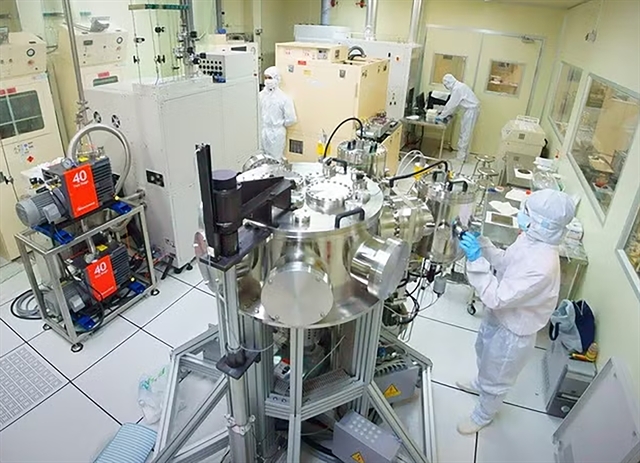
The institute is tasked with building testbeds, acquiring key equipment and piloting use cases where early benefits are plausible, such as secure communications and precision sensing.
Strategic race
Trần Quang Diệu, PhD, director of the Centre for Technology and Digital Transformation at the Hồ Chí Minh National Academy of Politics, said the world was shifting from digital to quantum governance, which uses quantum computing to explore many options at once and solve complex problems faster.
He noted that the United States, the European Union, Canada, the G7 and Denmark had rolled out national strategies, legislation and large investment programmes for quantum, while building research centres, infrastructure networks and new information-security standards.
"This shows that quantum technology is no longer a distant research trend but a key factor in strategic competition," he said.
For Việt Nam, early preparation in institutions, governance capacity, human resources and science-and-technology infrastructure would be critical to seize opportunities and raise competitiveness in the next phase of development.

According to Professor Trần Hồng Thái, president of the Vietnam Academy of Science and Technology, quantum technology is a demanding field requiring advanced science, infrastructure and skilled personnel. Many global lines of inquiry remain experimental and are not yet yielding large-scale commercial products.
Việt Nam cannot wait until everything is mature. Once standards, supply chains and markets are set, opportunities narrow.
“If we stay out because it is difficult, and we are slow to monitor and prepare, we will be passive later,” he said.
Some technologies could be learned after products are fully developed, but for strategic fields, waiting until standards and markets are fixed and supply chains are controlled would make entry very difficult.
He pointed to two urgent reasons, growing recognition of quantum as a strategic field and escalating data-security risks.
Long-term vision
Quantum technology could also unlock new capabilities in measurement, sensing, simulation, computing and materials, with applications across defence, security, telecommunications, finance, healthcare, energy, resources, environment and high-tech industry.
Talent could not be produced in a few months or through a single workshop, he said, adding that the workforce must be interdisciplinary, including physics, mathematics, computer science, cryptography, photonics, materials, electronics, control, metrology, software and data.
Building such a workforce would require early preparation: research groups, laboratories, defined problems, mentoring for young scientists and involvement of domestic and foreign experts.
"Given Việt Nam’s conditions, the question is not whether to pursue quantum but how, at which stages and to what extent, to build real national capability," Thái said.
Counting projects, conferences, equipment or MoUs would not be enough. Quantum as a long-term field would demand steady accumulation. When drafting a development plan, Việt Nam should avoid bandwagon spending, fragmentation, and the illusion that buying equipment equals mastering technology.
With policy foundations in place, Việt Nam is positioned to join the quantum race gradually. Doing so is both an opportunity to access strategic technologies and a requirement to strengthen autonomy in science, technology and innovation. It will take a long-term, focused investment roadmap and coordinated efforts by the state, research institutes, universities and businesses. — VNS