Việt Nam launches BPI for the first time alongside revamped PCI 2025
The Vietnam Chamber of Commerce and Industry (VCCI) on May 15 unveiled the country’s first-ever Business Performance Index (BPI) together with the newly redesigned Provincial Competitiveness Index 2025 (PCI 2025), as part of the Việt Nam Private Sector Economic Report 2025.
HÀ NỘI — The Vietnam Chamber of Commerce and Industry (VCCI) on May 15 unveiled the country’s first-ever Business Performance Index (BPI) together with the newly redesigned Provincial Competitiveness Index 2025 (PCI 2025), as part of the Việt Nam Private Sector Economic Report 2025.
This report was introduced at a time when there is the first anniversary of Resolution 68-NQ/TW on private sector development, and Việt Nam has been undertaking three historic reforms simultaneously on reducing the number of provinces and cities from 63 to 34, transitioning to a two-tier local government model, and institutionalising the strategy on developing the private sector as the nation’s most important economic driver.
The report was compiled based on surveys of 3,546 domestic private enterprises, 586 foreign-invested enterprises (FDIs), and 1,001 household businesses across 34 provinces and cities, making it one of the largest and most in-depth studies of Việt Nam’s private sector in recent years.
According to the inaugural BPI assessment, HCM City, Hà Nội and Quảng Ninh emerged as the top-performing localities. The national median BPI score stood at 4.2 points, indicating significant room for improvement nationwide.
The BPI consists of 23 indicators evaluating two core dimensions: the development level of the private sector and innovation capacity.
Meanwhile, after 21 years of implementation, the PCI this year marks a major transition with the official launch of PCI 2.0.
The new PCI 2.0 framework has been redesigned around nine component indices and 98 indicators, offering a more comprehensive assessment of business conditions, from market entry and resource access to transparency, informal costs, and legal institutions.
Most notably, 2025 marks the first year VCCI has introduced the BPI, adding a new dimension to Việt Nam’s economic governance assessment system.
While the PCI measures 'institutional input' – namely the quality of provincial governance – the BPI evaluates 'market output', reflecting the actual performance and effectiveness of the private sector.
In his opening remarks, VCCI Chairman Hồ Sỹ Hùng emphasised that the combination of PCI and BPI provides a more comprehensive picture, measuring not only reform efforts but also the tangible outcomes businesses experience.
According to Hùng, Việt Nam’s private sector has moved beyond a defensive phase and is now building internal capacity for stronger growth.
However, key bottlenecks related to market access, capital, and policy transparency remain unresolved. To achieve the target of two million businesses by 2030, policymaking must shift from a management-oriented approach toward one centered on partnership and competitiveness enhancement.
One of the most significant changes in this year’s PCI announcement is the abandonment of the traditional numerical ranking system in favour of a six-level governance quality grouping model.
Instead of ranking provinces from 1 to 34, PCI 2025 recognises groups of localities with the highest of governance quality, listed alphabetically within each category.
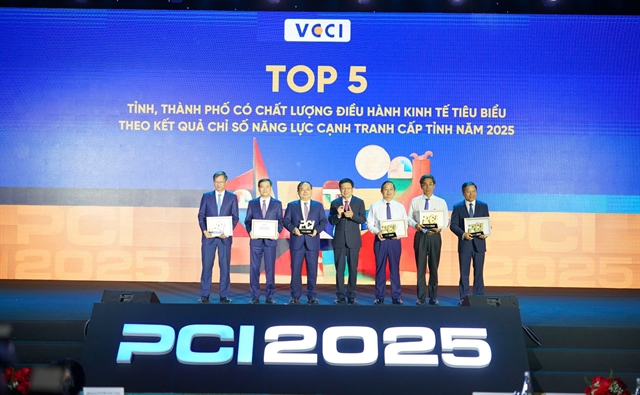
The five localities placed in the top governance quality of PCI 2025 are Bắc Ninh, Đà Nẵng, Hải Phòng, Phú Thọ and Quảng Ninh. These provinces and cities demonstrated relatively balanced governance structures, with at least five of the nine component indices ranking among the country’s top ten.
The shift toward grouping reflects a broader change in evaluation philosophy. According to Đậu Anh Tuấn, VCCI deputy secretary general and head of the Legal Affairs Department, PCI is no longer intended to create a race for rankings but rather to serve as a tool helping local governments identify bottlenecks and improve governance quality.
The new grouping approach instead shifts attention toward more substantive questions: what needs improvement and how improvements can be achieved.
Leading provinces
Among the top-performing localities, each demonstrated distinct strengths that reflect different reform approaches while sharing a common goal of improving the business environment.
Bắc Ninh stood out for its 'constructive governance' model, leading the nation in this category with 6.67 points while also ranking first in reducing administrative compliance costs. The results indicate that efforts to streamline procedures and enhance business support have delivered tangible outcomes.
Đà Nẵng continued to affirm its reputation for improving market entry conditions, recording the country’s highest score in this area. Its ability to create favorable conditions for new businesses is viewed as a key driver of economic momentum.
Hải Phòng impressed with its consistency, placing seven out of nine component indices among the national top ten, demonstrating stable governance quality across multiple dimensions.
Phú Thọ excelled in resource accessibility, ranking second nationwide, while Quảng Ninh maintained strong performance in equal competition and constructive governance – both considered foundational elements of a modern business environment.
Quảng Ninh further reinforced its leading position by simultaneously ranking among the Top 5 localities for governance quality under PCI 2025 and the Top 3 for private sector performance under the BPI.
The results suggest that institutional reforms in Quảng Ninh have not only improved the business climate but also translated into tangible growth outcomes for the private sector.
Bùi Văn Khắng, chairman of the Quảng Ninh Provincial People’s Committee, stated that the province views PCI not as a final destination but as a driving force for continued innovation and reform.
He stressed that maintaining the confidence of the business community and building a stable, transparent, secure, and competitive investment environment remain essential amid increasing global uncertainties.
A common feature among the leading group is that their performance does not rely on a single indicator but instead reflects balanced governance structures – a key principle underpinning the PCI 2.0 methodology.

Challenges
Despite positive signals, PCI 2025 also highlighted several challenges facing the private sector. Up to 60.2 per cent of businesses reported difficulties in finding customers, the highest level recorded in five years. Access to capital remains another major bottleneck, with 75.5 per cent of firms unable to secure loans without collateral.
The policy environment was also highlighted to lacking predictability, as only around 6-8 per cent of businesses said they could anticipate policy changes. This uncertainty increases both operational risks and business costs.
Household businesses are also under mounting pressure, with 81.5 per cent reporting declining revenues.
According to the VCCI chairman, these figures are not intended to paint a negative picture of the economy but rather to provide data-driven insights for identifying structural bottlenecks and designing more effective policy responses.
The Việt Nam Private Sector Economic Report 2025 shows that by the end of 2025, the country had more than one million active enterprises, up 6.6 per cent year-on-year.
Combined with approximately 6.1 million household businesses, the private sector currently employs around 26 million workers, accounting for 50.2 per cent of total employment nationwide.
Notably, 2025 saw 297,500 newly established businesses enter the market, an increase of 27.4 per cent compared to 2024 and the highest figure ever recorded.
Up to 85.7 per cent of businesses reported maintaining or expanding their operations, signaling a gradual recovery in business confidence following a prolonged period of difficulties. — VNS