Việt Nam, EU move towards high-quality economic partnership
The article also highlighted the elevation of Việt Nam–EU relations to a comprehensive strategic partnership in early this year, arguing that the upgraded framework would provide fresh momentum for cooperation in trade, investment, digital transformation, the green transition, energy, climate action and supply chain resilience.
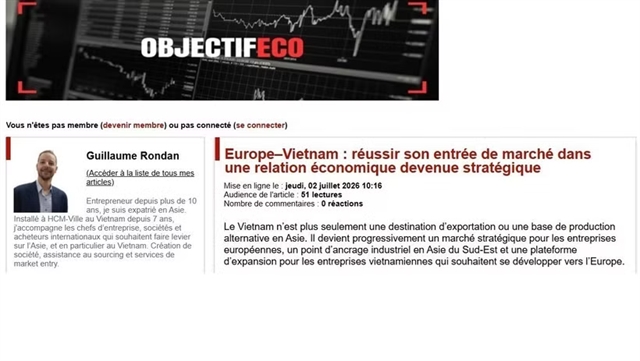
PARIS — French business news outlet Objectif Eco reported on July 2 that economic relations between Việt Nam and Europe are entering a new phase of development, with the focus shifting beyond expanding trade towards investment, innovation, the green transition and the development of resilient supply chains.
According to the publication, Việt Nam is no longer viewed by European companies merely as an export destination or an alternative manufacturing base in Asia. Supported by strong economic growth, a market of more than 100 million people, a rapidly expanding middle class and deepening international integration, Việt Nam is increasingly emerging as both a strategic market and a major manufacturing hub in Southeast Asia. Meanwhile, many Vietnamese businesses now regard Europe as a key market for expanding their commercial operations, increasing investment and integrating more deeply into global value chains.
The article cited data showing that Việt Nam continues to rank among Southeast Asia’s fastest-growing economies. In the fourth quarter of last year, gross domestic product (GDP) expanded by 8.46 per cent year on year, with the industrial and construction sector growing by 9.73 per cent, while the services sector recorded growth of 8.82 per cent. According to the author, these figures highlight the increasingly important role of industrial production and domestic demand in driving the country's economic growth.
Objectif Eco said the outlook presents significant opportunities for European companies in sectors where they possess particular expertise, including industrial technology, food processing equipment, water resource management, logistics, healthcare, education, professional services, energy, automation and sustainable development solutions. However, it noted that success in Việt Nam depends not only on technological capability or brand reputation. Competitive pricing, after-sales service, technical training, local support capacity and strong partnerships with Vietnamese counterparts are also critical factors.
The article also pointed to the increasingly diversified structure of trade between Việt Nam and Europe. Alongside traditional exports such as textiles and garments, footwear and agricultural products, computers, electronics and components now account for the largest share of Việt Nam's exports to the Netherlands, reaching around US$3.4 billion last year. Machinery, equipment and spare parts exceeded $2.2 billion, while agricultural exports, including coffee, cashew nuts, fruit and vegetables, seafood and wood products, all recorded robust growth.
According to the author, these trends demonstrate that economic ties between Việt Nam and Europe are becoming increasingly diversified and generating greater added value.
The article also highlighted the elevation of Việt Nam–EU relations to a comprehensive strategic partnership in early this year, arguing that the upgraded framework would provide fresh momentum for cooperation in trade, investment, digital transformation, the green transition, energy, climate action and supply chain resilience.
According to Objectif Eco, at a time of growing uncertainty in the global economy, Việt Nam–Europe relations are evolving beyond the expansion of merchandise trade to focus on building secure supply chains, strengthening industrial cooperation and fostering long-term strategic partnerships.
The publication concluded that opportunities for their cooperation are broader than ever. However, turning this potential into tangible results will require businesses on both sides to prepare carefully, develop a deeper understanding of each other's markets, identify suitable partners and pursue long-term development strategies. The author argued that the next phase of such relations will ultimately be defined not only by the scale of bilateral trade, but also by the quality of cooperation, the level of innovation and the ability of both sides to create lasting, sustainable value together. — VNA/VNS