Việt Nam, Cuba target US$500 mln in two-way trade
Cuba remains one of Việt Nam’s 10 key markets in Latin America, while Việt Nam is now Cuba’s second largest partner in the Asia-Pacific. Việt Nam is also Cuba’s largest Asian investor, and one of its leading foreign investors overall, with seven active projects spanning construction materials, consumer goods, industrial park infrastructure, and energy.

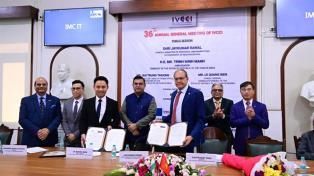
Vietnamese Deputy Minister of Industry and Trade Phan Thị Thắng and Cuban Vice Minister of International Trade and Foreign Investment Deborah Rivas Saavedra sign the meeting's minutes. VNA/VNS Photo
HAVANA — Vietnamese Deputy Minister of Industry and Trade Phan Thị Thắng and Cuban Vice Minister of International Trade and Foreign Investment Deborah Rivas Saavedra set a target to lift two-way trade to US$500 million soon as they co-chaired the first session of the Joint Committee of the Việt Nam - Cuba Trade Agreement in Havana on Monday.
The meeting launched the first formal periodic mechanism for both nations to monitor the 2020 bilateral trade agreement, remove bottlenecks, and identify priority areas for effective rollout. It was expected to advance economic, trade, and investment ties as the two nations mark their 65th anniversary of diplomatic ties this year.
Both sides conducted a comprehensive review of economic, trade, and investment ties since the agreement took effect on April 1, 2020.
Deputy Minister Thắng, who is also Chair of the Vietnamese sub-committee, noted that despite challenges posed by the COVID-19 pandemic, the global economic downturn, and Cuba’s acute economic difficulties, two-way trade has held steady at around $200 million, a reflection of the two countries’ concerted efforts to maintain momentum in their trade ties.
Cuba remains one of Việt Nam’s 10 key markets in Latin America, while Việt Nam is now Cuba’s second largest partner in the Asia-Pacific. Việt Nam is also Cuba’s largest Asian investor, and one of its leading foreign investors overall, with seven active projects spanning construction materials, consumer goods, industrial park infrastructure, and energy.
Looking ahead, Việt Nam plans more investment in wholesale and retail, rice cultivation, instant noodle and animal feed production, fertilisers, and joint ventures in research, production, and commercialisation of agricultural and biomedical biotechnology products, she said.
Agreeing with the Vietnamese side, Rivas, who is also Chair of the Cuban sub-committee, highlighted Cuba’s strengths in biotechnology and promising prospects for future cooperation. She pointed to opportunities in joint research and development of vaccines, pharmaceuticals, natural biological products, and potential local production of quality biomedical products in Việt Nam.
The committee reviewed progress on tariff reductions, rules of origin, institutional frameworks, and public-awareness campaigns under the five-year-old agreement.
Rivas expressed hope that more Cuban enterprises would capture concrete benefits from the deal, delivering real gains for them and boosting overall trade flows.
Both sides agreed to adopt supportive policies and mechanisms to address existing challenges, particularly those related to payment transactions to facilitate Vietnamese businesses operations in Cuba.
The session closed with the signing of its minutes that lays out immediate next steps to improve the agreement’s impact and generate measurable benefits for businesses and citizens of both countries. — VNA/VNS