Việt Nam, China strengthen durian trade partnership
Việt Nam's durian industry must shift its focus from competing on volume and price to competing on quality, standards and branding if it is to sustain its rapid export growth, industry leaders said at a conference aimed at strengthening supply chain cooperation with China.
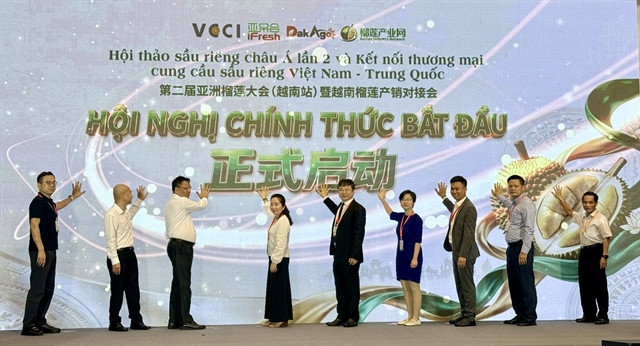
HCM CITY — Việt Nam's durian industry must shift its focus from competing on volume and price to competing on quality, standards and branding if it is to sustain its rapid export growth, industry leaders said at a conference on July 14, aimed at strengthening supply chain cooperation with China.
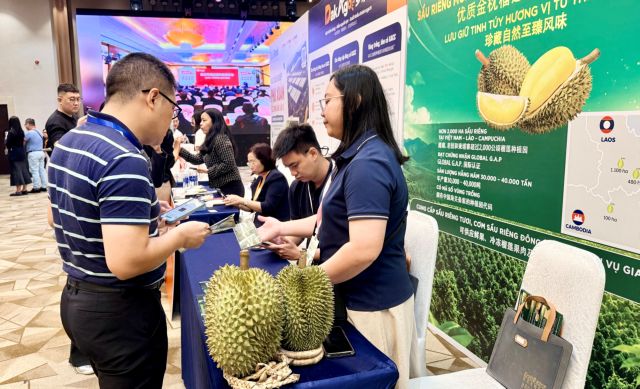
Jointly organised by the Vietnam Chamber of Commerce and Industry – HCM City Branch (VCCI-HCM), China's iFresh Asia Fruit B2B platform and Dakago Co., Ltd., the second Asia Durian Conference and Việt Nam–China Durian Supply and Demand Matching event brought together around 500 participants, including government officials, agricultural experts and businesses, to discuss ways to strengthen cross-border cooperation in one of Việt Nam's fastest-growing agricultural export sectors.
Speaking at the conference, Trần Ngọc Liêm, director of VCCI-HCM, said durian had emerged as one of the biggest success stories of Vietnamese agriculture in recent years.
According to the Vietnam Customs Department, Việt Nam exported US$562.4 million worth of durian in the first five months of 2026, up 45.2 per cent year-on-year. Fresh durian accounted for US$483.1 million, while frozen durian exports surged 60.3 per cent to US$77.9 million. Processed durian exports reached US$1.4 million, up 16.7 per cent.
China remained by far Việt Nam's largest export market, importing US$492 million worth of durian during the period, up 76.7 per cent from a year earlier and accounting for 87.5 per cent of total exports. Shipments to other markets, including the US, South Korea, Japan, Australia and Papua New Guinea, also recorded strong growth, highlighting opportunities for market diversification.
Despite the industry's rapid expansion, Liêm warned that challenges remained, including oversupply caused by the rapid expansion of cultivation areas and the limited proportion of fruit meeting export standards. These shortcomings contributed to customs delays, higher inspection costs and greater compliance risks.
Competition was also intensifying as Thailand maintained its strong market position while Cambodia, Laos, Malaysia, the Philippines and Indonesia expanded their presence in China.
"In this context, shifting from competing on volume and price to competing on quality, standards and branding is no longer a choice but a necessity for the sustainable development of Việt Nam's durian industry," he said.
According to the organisers, this year's conference focused on strengthening direct links between Vietnamese growers, cooperatives and exporters and Chinese supermarkets, distributors and e-commerce platforms; promoting standardised production and branding; improving compliance with quarantine and food safety regulations; and introducing digital management and post-harvest technologies to enhance competitiveness.
Cai Jianfei, founder of iFresh, said cooperation between Việt Nam and China was evolving from conventional trading into deeper collaboration across the entire durian value chain.
More than 100 Chinese companies, including leading distributors such as Pagoda, Xianfeng Fruit, JD Fresh, Goodfarmer Group and Shouheng Group, attended the event with concrete purchasing plans and a shared objective of sourcing high-quality Vietnamese durian.
"Việt Nam is one of the world's largest durian exporters, benefiting from favourable geographical conditions, extensive growing areas and increasingly advanced processing capabilities. Meanwhile, China is one of the world's most dynamic durian markets. Chinese consumers are shifting their focus from simply securing supply to demanding stronger branding, higher product quality and clearer grading standards.
"The combination of Việt Nam's strengths in production and processing with China's growing demand for premium, branded products is driving bilateral cooperation beyond traditional trade towards deeper integration across the entire durian value chain," she said.
According to Nguyễn Thị Mỹ Duy, director of 001 Fruit Co., Ltd., Việt Nam's durian industry has a significant opportunity to strengthen its position in international markets, but it must also accelerate its transition towards transparent, professional exports through official channels.
Her company is investing in integrated growing areas, QR code-based traceability systems, large-scale processing facilities and advanced freezing technology to meet increasingly stringent import requirements.
Đặng Thị Thủy, deputy director of the Đắk Lắk Department of Agriculture and Environment, said the province was promoting a digitalised durian supply chain, developing sustainable growing areas, protecting land and water resources, and strengthening direct links between farmers and businesses to reduce intermediary costs and enhance export value.
At the conference, Dr Ngô Xuân Nam, deputy director of the Vietnam Sanitary and Phytosanitary Notification Authority and Enquiry Point (SPS Việt Nam), updated participants on China's latest food safety and phytosanitary requirements for imported durian. He urged exporters to comply strictly with regulations on traceability, pesticide residue limits and packaging standards to minimise customs clearance risks.
Speakers from Việt Nam and China also discussed import-export policies, inspection and quarantine procedures, supply chain standardisation, brand development, post-harvest preservation technologies and logistics solutions.
The conference continues on July 15 with business-to-business meetings between Vietnamese exporters and Chinese buyers, followed by a field visit to durian-growing areas in Đắk Lắk Province on July 16 to strengthen links across the supply chain. — VNS