Việt Nam, Australia bolster support for green transition
Australia's Southeast Asia economic strategy to 2040 sets out a long-term commitment to deepen economic ties across the region, with Việt Nam identified as a priority market for Australian investment in clean energy, sustainable agriculture and climate technology, said Australian Consulate General in HCM City Sarah Hooper at the Việt Nam-Australia Green Transition Forum in HCM City.
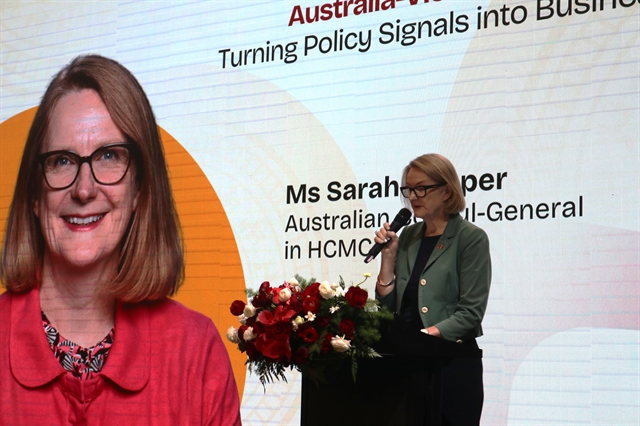
HCM CITY — Australia's Southeast Asia economic strategy to 2040 sets out a long-term commitment to deepen economic ties across the region, with Việt Nam identified as a priority market for Australian investment in clean energy, sustainable agriculture and climate technology, said Consul General of Australia in HCM City Sarah Hooper at the Việt Nam-Australia Green Transition Forum in HCM City.
The forum, launched on Thursday, served as a dialogue for policymakers, experts, and businesses to discuss how sustainability and innovation can help them meet market demands and embrace new growth opportunities.
It also provides insight into Australia-Việt Nam cooperation across key sectors such as clean energy, green manufacturing, sustainable agriculture, green finance and data-driven transformation.
Sarah said that Việt Nam represents one of Australia's fastest-growing bilateral trade relationships in recent years and is currently Australia's 14th largest two-way trading partner.
In 2024-2025, two-way trade in goods and services between Australia and Việt Nam reached AUD28.5 billion.
The Australia-Vietnam partnership recently celebrated the two-year anniversary of its elevation to a Comprehensive Strategic Partnership, the highest level of cooperation between Việt Nam and a foreign partner. It features a standalone climate and clean energy pillar that includes substantial investment.
Việt Nam has committed to reaching Net Zero by 2050. The country's Power Development Plan VIII maps out this pathway by targeting renewables and energy storage as the backbone of the future grid, alongside phasing out coal-fired generation by 2050.
"Energy supply disruptions, shifting trade flows, and tightening supply chain requirements are reshaping industries faster than most of us anticipated. In that context, the green transition is not a distant ambition for Việt Nam; it is an immediate reality, and that makes it equally immediate for Australian businesses and investors who want to be part of what Việt Nam is building next," she added.
Sarah also noted that Australia has been on its own transition journey. Solar and wind have been the primary drivers, more than doubling the nation's renewable generation expansion over the last decade.
"We're investing heavily to upgrade our grids and coordinate market reforms".
The Australian government supports Việt Nam in this sector through experts and capital projects, such as Australia's flagship economic resilience programmes: Aus4Growth and Aus4Innovation.
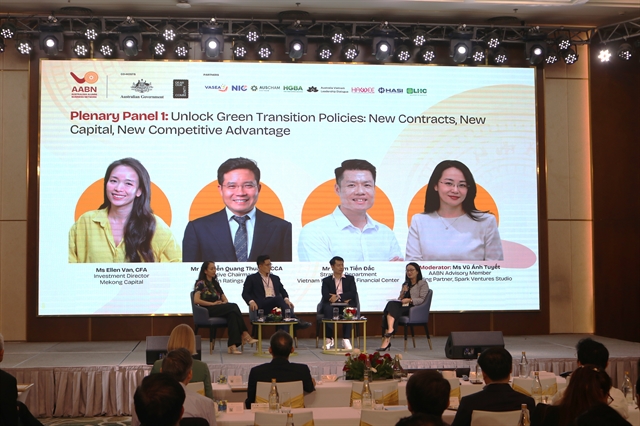
Cấn Văn Lực, a member of the policy Advisory Council to the Prime Minister, said green transition is a must, a long-term strategy amid Net Zero commitments by various economies and complicated climate change.
However, the Middle East conflict has altered the landscape, bringing both new drivers and challenges.
The short-term impacts and challenges include energy security risks, supply chain disruptions and the increased cost of green energy investments.
Conversely, fossil fuel price volatility reinforces the long-term strategic shift toward domestic renewable energy and electric vehicles. Accelerating investments in renewable energy lessens vulnerability and thus enhances energy security.
To fulfill its Net Zero commitments by 2050 and advance the green transition, the country is taking active steps.
In 2025, Việt Nam revised Power Development Plan VIII, setting a target for renewable energy to account for around 26 to 30 percent by 2030.
The country has also issued a green taxonomy covering seven priority sectors, including manufacturing, environmental services, and agriculture.
Furthermore, Hà Nội and HCM City have demonstrated strong commitments to pollution reduction and smart city development.
Prof. Andrew Blakers, Australian National University, Co-inventor of the PERC Solar Cell, shared some of the solutions for Việt Nam to adapt to the green transition.
He recommended allowing the energy transition to scale up rapidly while accelerating large-scale storage and transmission. Việt Nam should reduce investment in new fossil fuel vehicles and machines, focusing instead on solar and wind as the cheapest energy sources.
He highlighted the country’s potential for pumped hydro to store solar and wind energy. This method uses a system with two reservoirs at different altitudes. During sunny and windy periods, water is pumped uphill. At night, it flows back down to recover energy with an 80 per cent round-trip efficiency.
This requires no new river dams, is low-cost and easy to implement. This impact is much lower than the metal mining and refining needed for batteries. It also uses far less water than coal power since cooling towers are unnecessary.
The event was organised by the Australian Alumni Business Network and supported by the Australian Consulate-General in HCM City and its partners. —VNS