Urban planning, infrastructure drive new phase of Việt Nam property market
Việt Nam's property market is entering a new growth cycle, with urban planning, infrastructure investment, greater market transparency, and genuine housing demand gradually replacing speculation as the main drivers of growth, according to Batdongsan.com.vn.
HCM CITY — Việt Nam's property market is entering a new growth cycle, with urban planning, infrastructure investment, greater market transparency, and genuine housing demand gradually replacing speculation as the main drivers of growth, according to experts at property technology platform Batdongsan.com.vn.
Đinh Minh Tuấn, southern regional director of Batdongsan.com.vn, said three major shifts are reshaping the market.
The first is the growing influence of urban planning and infrastructure on both supply and demand.
In Hà Nội and HCM City, long-term planning strategies and major projects, including metro lines, ring roads and expressways, are redirecting new housing supply from traditional city centres to fringe urban areas, satellite cities and emerging development corridors.
The second is greater market transparency. Policies to standardise transactions, develop land and market databases and strengthen brokerage regulation are laying the foundations for a more professional market.
Although these reforms may not immediately improve liquidity, they are expected to reduce information asymmetry, curb speculation and improve transaction quality over time.
The third is increasing market segmentation.
Unlike the broad-based price gains seen in 2021-22, property segments are now performing very differently. Apartments continue to outperform, supported by genuine housing demand and stable rental yields, while land plots and other more speculative assets have slowed or corrected in some locations.
Batdongsan.com.vn's second-quarter 2026 data show apartments accounted for 37 per cent of buyer interest, followed by land plots at 23 per cent and private houses at 22 per cent. Townhouses and villas each attracted about 9 per cent.
Tuấn said the divergence is also evident within individual segments. Apartment projects with prime locations, clear legal status, strong transport links and comprehensive amenities continue to outperform those in less connected areas.
Likewise, land plots in locations with completed infrastructure, established communities, and clear planning have proved more resilient than those driven mainly by speculative expectations.
Infrastructure is also becoming a key determinant of property values rather than simply a driver of future price expectations.
A Batdongsan.com.vn survey of property brokers in the second quarter found that 65 per cent of respondents said buyers prioritised projects near metro lines, ring roads, bridges and other major infrastructure works. Meanwhile, 91 per cent said buyers were willing to pay a premium for well-connected properties, with 5-10 per cent being the most widely accepted.
But Tuấn cautioned that proximity to infrastructure alone does not guarantee value.
"Projects with genuine advantages are those that directly benefit from infrastructure, offer convenient access and have established residential communities or strong potential to develop them over the medium term."
Nguyễn Quốc Anh, deputy general director of Batdongsan.com.vn, said changes in urban planning, infrastructure, population distribution and economic functions would continue to reshape Việt Nam's property market.
A survey of more than 1,000 people by the company found 52 per cent saying urban planning has a "very significant" impact on property purchasing decisions.
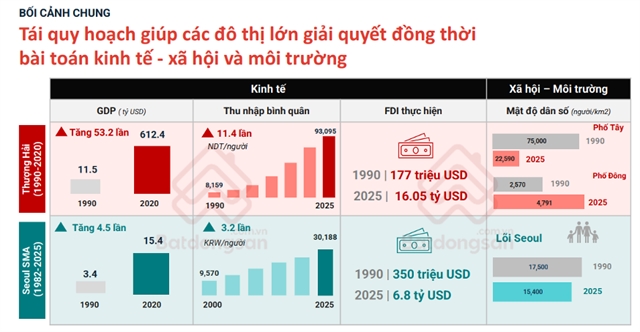
Anh said urban restructuring is an inevitable response to ageing city centres, population growth, environmental pressures, and the need to strengthen economic competitiveness.
He cited Shanghai and Seoul as models of multi-center urban renewal, where strategic infrastructure links decentralised key economic roles — such as Pudong's financial hub and Seoul's regional triad — easing central pressures while sustaining property value growth.
Anh said Hà Nội and HCM City are following similar paths.
Hà Nội is investing in the redevelopment of ageing apartment blocks, satellite urban areas, ring roads and metro lines, while HCM City is evolving into a multi-centre metropolitan region, with the city serving as a financial and technology hub, the former Bình Dương specialising in manufacturing and the former Bà Rịa–Vũng Tàu focusing on logistics and port services.
Projects including the Cần Giờ–Cái Mép Hạ port complex, Ring Roads 3 and 4, Long Thành International Airport, metro lines and regional expressways are expected to connect these growth centres. — VNS