Training workforce to master technology linked to real-world business challenges
Training needs to be more tightly linked with scientific research, data, and real-world business problems, thereby narrowing the gap between the lecture hall, the laboratory, and actual production practice.
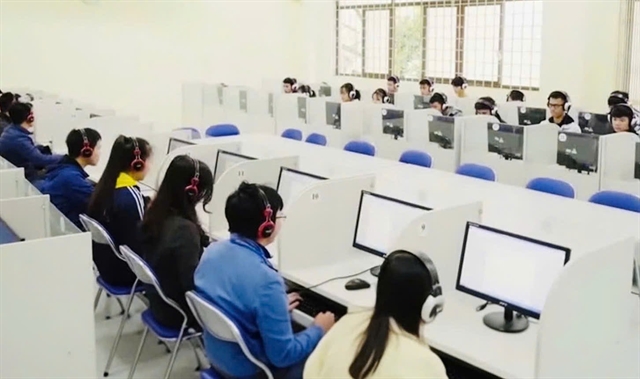
Thu Trang
HÀ NỘI — In the new era, training high-quality human resources is defined as being closely associated with science and technology and innovation.
Traditional strength will continue to serve as the basis, while simultaneously opening up new development spaces when combined with artificial intelligence (AI), big data, automation, energy technologies, interdisciplinary working capacity and practical production realities from enterprises.
Đặng Văn Huấn, deputy director of the Higher Education Department under the Ministry of Education and Training, emphasised that while deep professional expertise remained the foundation, future engineers would additionally need digital and AI competencies, interdisciplinary working skills, foreign languages and the ability to adapt to the labour market.
“Training needs to be more tightly linked with scientific research, data and real-world business problems, thereby narrowing the gap between the lecture hall, the laboratory and actual production practice,” said Huấn.
This forms the basis for expanding from applied research to training a workforce capable of mastering technology, while strengthening State, university and enterprise links.
Linking training to enterprises’ work
Associate Professor Nguyễn Thế Vinh, deputy rector of the Hà Nội University of Mining and Geology (HUMG), said that to shift from traditional engineering training to training personnel capable of mastering technology, deep professional knowledge would remain the most important factor.
“Mastering technology does not mean reducing the role of specialist knowledge," Vinh said.
"On the contrary, deep expertise must still be the foundation, but on that basis, engineers need to be equipped with additional capabilities in data, AI, modelling, automation, interdisciplinary working capacity, as well as solving enterprises’ problems and challenges.”
According to the deputy rector, instead of training AI, data or digital technology as separate content areas, the HUMG will gradually integrate these into each training programme.
“Students not only need to master disciplinary knowledge but must also know how to use data, AI, and digital tools to solve specific problems in their chosen field,” he said.
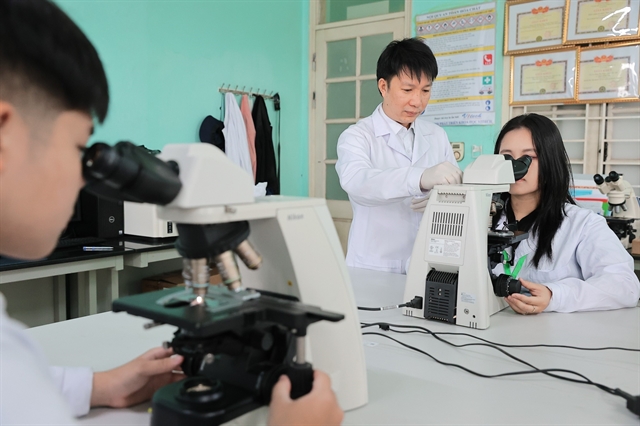
The HUMG consistently strengthens project-based training, simulation, laboratory practice and solving problems commissioned by enterprises.
From the 2026–2027 academic year, the university is prioritising a review of learning outcomes and curriculum content according to competency clusters comprising: deep specialisation; data and AI; interdisciplinary and systems thinking; foreign languages, innovation, and lifelong learning capacity.
Alongside innovation in training programmes, the HUMG is orienting the development of centres of excellence, focusing on strategic issues such as strategic minerals and underground technology; digital geospatial and digital twins; underground works, metro and high-speed rail.
“Each centre will not only have laboratories and research teams but must form a chain from basic research, applied research, through to product development, testing, and technology transfer,” he said.
Regarding human resources, the HUMG is orienting the development of strong research groups aligned with each strategic technology programme, while attracting domestic and international experts, postdoctoral researchers, and full-time doctoral candidates.
Another important direction is enhancing the role of enterprises in research and training.
“We need to shift from the approach of obtaining research results before seeking enterprises to a model where enterprises participate from the moment a research problem is formulated,” said Vinh.
The HUMG is developing a Mining and Geology Technology Transfer and Innovation Centre as the focal point for managing intellectual property, assessing application potential, connecting with enterprises and investors.
Promising research results will be supported with patent registration, prototype refinement, testing and transfer or licensing plans and be used to establish science and technology enterprises or independent companies.
Vinh added: “Enterprises must become co-authors of the research and development process: jointly defining problems, sharing data and field-testing sites, jointly evaluating products and, where appropriate, co-investing in the pilot phase.
"In that way, the distance between the laboratory and the market will be significantly shortened."
The ultimate goal, he added, was not merely to increase the number of research projects or scientific publications, but to create core technologies, prototypes, pilot lines, patents, technology transfer contracts, and enterprises arising from research results.
From traditional areas of strength such as geology, minerals, mining, energy, surveying and mapping, and underground works, the HUMG is expanding its development space by combining these with AI, big data, digital twins, automation and new energy technologies.
Through this, HUMG aims to narrow the gap between training, research, and practice, training a workforce that not only knows technology, but can progressively master and create technology, meeting national development requirements in the new growth period.
International standards
Associate Professor Phùng Mạnh Đắc, permanent deputy chairman and secretary general of the Việt Nam Mining Association, also stressed that human beings are the key factor in the future.
“The production process is shifting from basic mechanised equipment to automation, digitisation and AI applications, towards the goal of green, circular mining to optimise resources and energy,” said Đắc.
To meet these requirements, future personnel must be strong in their specialism while mastering core digital technologies such as modelling, geological databases, digital mapping, geographic information systems, automatic control, big-data analytics and artificial intelligence.
“Alongside this is the ability to access strategic technologies such as smart mining, remote control, advanced mineral processing, energy saving, new materials, emissions reduction, and the circular economy,” he said.
Đắc said that it was necessary to integrate strategic technologies into training programmes, strengthening modelling, simulation, digital twins, AI, big data, remote control, risk management, low-emission technologies and the circular economy.
“Another important requirement is to build a close State–University–Enterprise cooperation model,” Đắc added.
In this relationship, the State plays the role of setting development priorities, commissioning strategic tasks, and investing in foundational infrastructure.
The university takes the initiative to innovate training programmes, enhance lecturer capacity, and standardise learning outcomes.
Enterprises can partner directly by participating in curriculum design, providing real-world business problems, data, internship spaces, and teams of supervising experts.
“In this way, enterprises are no longer merely destinations for graduates after completion of studies but become partners in co-creating human resources," said Đắc.
"This model also opens up the possibility of combining training, research, technology transfer, and policy advice, forming an ecosystem that connects the university with real-world development.”
Nguyễn Quốc Thập, chairman of the Việt Nam Petroleum Association, emphasised the requirement that training must be internationally benchmarked.
“Integration cannot stop at sending staff and students abroad to study. It must bring world standards into every programme, every module, and every research project within the university,” said Thập.
International technical standards, discipline-specific foreign-language capacity and working methods aligned with modern practice must become routine elements of the training process.
“Quality should be assessed not only by domestic metrics but must also be benchmarked against regional and global standards, so that every engineer and specialist has sufficient capacity to compete on an equal footing in the international labour market,” he added.
Experts confirmed that it was necessary to expand cooperation in training, academic exchange, mutual recognition of qualifications, and joint research with foreign universities and research organisations.
Building modern laboratories, shared databases, and learning environments to international standards will help learners develop open thinking, practical skills and a global outlook. — VNS