Top leader orders removing implementation bottlenecks to spur growth
General Secretary and President Lâm asked the Government to further review and reallocate public investment funds from projects unable to spend their budgets to those capable of faster implementation. He also called for clear assessments on growth quality, employment and household incomes to improve policymaking and forecasting.
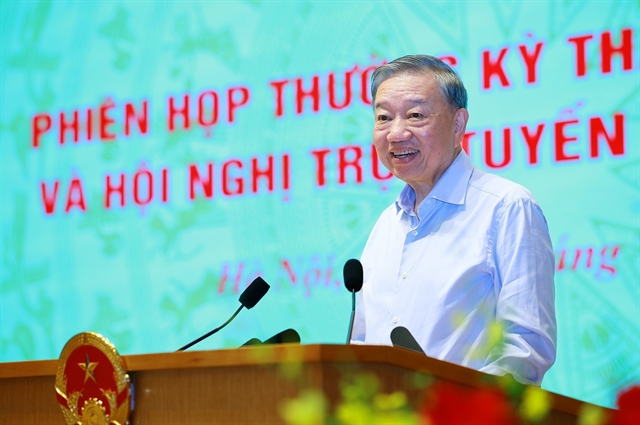
HÀ NỘI — Party General Secretary and State President Tô Lâm on Saturday urged the Government and local authorities to immediately remove obstacles to policy implementation, describing execution as the "bottleneck of all bottlenecks" at present, to accelerate economic growth and lay a solid foundation for the country's next development phase.
Addressing the Government's regular meeting for June and a teleconference with authorities of all localities nationwide, the top leader said 2026, the first year of implementing the Resolution of the 14th National Party Congress and also the start of a new development phase, requires the entire political system to act with greater urgency to deliver fast, sustainable and self-reliant development while strengthening economic resilience and improving people's living standards.
He commended the Government, ministries, sectors, localities, businesses and the public for maintaining socio-economic stability despite global uncertainties and for successfully carrying out many new, difficult and unprecedented tasks during the first half of the year.
However, he noted that economic growth of nearly 8.2 per cent in the first six months remained below the 9.7 per cent target, with 25 of 34 localities, including Hà Nội and HCM City, missing their first-half growth goals. Public investment disbursement and the implementation of strategic infrastructure projects, national target programmes and major works also lagged behind schedule, while spending on science, technology, innovation and digital transformation reached only about 10 per cent of the allocated capital.
General Secretary and President Lâm asked the Government to further review and reallocate public investment funds from projects unable to spend their budgets to those capable of faster implementation. He also called for clear assessments on growth quality, employment and household incomes to improve policymaking and forecasting.
He said growth remains uneven, the trading structure still faces many risks, domestic demand hasn't fully recovered, and the business environment has improved but yet to meet development needs. He also pointed out costly administrative procedures, delays in issuing implementation guidelines, and persistent obstacles involving land, planning, site clearance, construction materials and administrative procedures.
He noted that some localities still grapple with difficulties in operating the two-tier local administration model. Other challenges included slow progress in building boarding schools in border communes, shortages of teachers, inadequate training of high-quality human resources in science and technology, as well as urban pollution, housing shortages for workers and increasingly severe climate-related risks.
These problems continue to threaten social stability and sustainable development, the Party and State leader emphasised.
He stressed that implementation capacity, rather than institutional frameworks, has now become the greatest obstacle to development.
"The political system and officials must act, act and act," he said, adding that difficulties should be resolved through discussion and coordination instead of shifting responsibility. Without proper implementation, the Party's right resolutions will be unable to prove effective in reality, so solidarity and unity in action are a must.
He called on the Government to launch a special action plan for the remaining six months of 2026. He said a forthcoming resolution of the Party Central Committee will define Việt Nam's development model for the next stage, and it will place emphasis on the goal of maintaining stable economic growth.
Localities must act decisively to stay on schedule and lay a solid foundation for the years ahead, General Secretary and President Lâm went on.
He urged removing bottlenecks immediately to achieve growth of at least 10 per cent while maintaining macroeconomic stability. Priorities include leveraging public investment; unlocking private capital; strengthening domestic enterprises' capacity; safeguarding export markets; ensuring energy, food, water and data security as well as digital sovereignty; improving the business environment; ensuring the smooth operation of the two-tier local administration system; and promoting cultural, social and human development so that all people benefit from the country's development achievements.
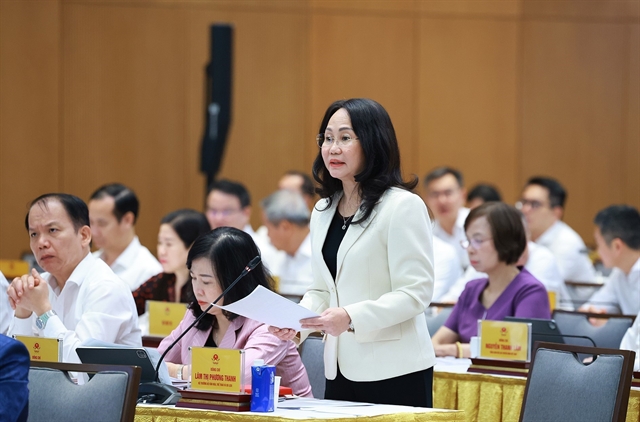
The leader also instructed ministries and localities to begin preparing the 2027 development plan from the third quarter of 2026, with clear priorities, implementation scenarios and accountability identified. The Government should translate tasks into monthly and quarterly action plans, clearly assign responsibilities, publicly report progress and enhance discipline while encouraging officials to take initiative for the common good.
He stressed that achieving the growth target is a shared responsibility but must also be tied to the personal accountability of each minister, head of sector, and leader of Party committee and locality. He encouraged officials to take bold action for the public interest while enforcing stricter discipline and stepping up efforts to combat corruption, wastefulness, vested interests, and buck-passing or avoidance of responsibility.
Regarding education, General Secretary and President Lâm described human resources development as a strategic advantage and urged fundamental and comprehensive reforms to meet the demands of fast economic transformation. He said Việt Nam must expand access to upper secondary education, ensure sufficient schools and teachers, and accelerate the training of engineers, scientists and technology specialists.
He instructed the Ministry of Education and Training to quickly translate the Party's Resolution No. 71 into concrete policies and ensure the 2026–2027 academic year delivers substantive improvements.
Highlighting international partners' confidence in Việt Nam's development prospects, the leader said the country must seize this opportunity with stronger determination and more effective implementation.
Việt Nam is presented with tremendous development opportunities, he said, but these can only be realised through strong political will, the right mindset, an enabling institutional framework, an efficient state apparatus, proactive and accountable officials, stronger businesses, and broad public consensus. — VNA/VNS