The quest for strategic autonomy
Economic development, when anchored in structural reform, institutional strength, and long-term resilience, becomes the most powerful instrument of autonomy in an uncertain world.
As Việt Nam enters the next development cycle, strategic autonomy should be understood not as isolation, but as the ability to engage the world on more equal, confident, and sustainable terms. That is about challenge but also opportunity. Economic development, when anchored in structural reform, institutional strength, and long-term resilience, becomes the most powerful instrument of autonomy in an uncertain world.
Võ Trí Thành*
The draft Political Report to be submitted to the upcoming 14th National Congress of the Communist Party of Việt Nam (slated for January 19-25, 2026 in Hà Nội) emphasises the goal of achieving strategic autonomy, reflecting a strategic vision of proactively planning, leading and shaping national development in an increasingly volatile and unpredictable world.
Last year marked a turbulent chapter for the global economy. Heightened geopolitical competition, rising protectionism, reciprocal tariffs, and climate shocks have combined to create an environment of deep uncertainty.
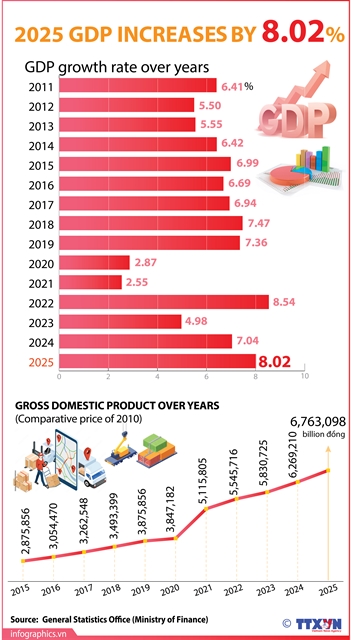
Against the volatile global backdrop, Việt Nam’s economic performance in 2025 stands out for its resilience. GDP growth reached 8.02 per cent for the whole year, bringing the average growth rate for 2021-2025 to 6.3 per cent. Excluding 2021, the year most severely affected by the pandemic, average growth during 2022–25 reached 7.2 per cent, exceeding the set target.
GDP per capita in 2025 is estimated at around US$5,100, approximately 1.4 times higher than in 2020, officially placing Việt Nam in the group of upper-middle-income countries. Inflation continued to be effectively controlled, remaining below 4 per cent throughout the term. In 2025 it was estimated at around 3.31 per cent, providing favourable conditions for policy management and reinforcing market confidence.
Export performance exceeded expectations despite major disruptions in global trade, with total import–export turnover reaching approximately $930 billion and a trade surplus of more than $20 billion. Public investment accelerated strongly, though not yet reaching 100 per cent of the plan assigned by the Prime Minister, while signs of recovery emerged in retail sales, foreign inflow disbursement, and private funding.
Public debt remains below 36 per cent of GDP, providing Việt Nam with valuable fiscal space in the medium term. This fiscal cushion is increasingly critical in a world where geopolitical or climate-related shocks are no longer exceptional events, but structural features of the global system.
This resilience represents the first and most basic dimension of strategic autonomy: the capacity to absorb external shocks without losing macro-economic stability or social cohesion.
Limits of expansion
The experience of 2025 highlights emerging constraints. Achieving growth rates of 8 per cent or higher through traditional channels, as in 2025, will be difficult to sustain.
Việt Nam’s credit-to-GDP ratio has climbed to around 144 per cent, exceeding thresholds identified by many studies as risk-prone. Credit growth has significantly outpaced monetary expansion, while the share of medium- and long-term lending remains high against short-term funding dominance within the banking system, placing pressure on liquidity. Managing the trade-offs between exchange rate stability, interest rates, and capital flows is becoming increasingly complex.
Overreliance on monetary policy and credit expansion, while fiscal space still exists, risks undermining macro-financial stability. From a strategic autonomy perspective, this exposes the economy to external financial cycles and reduces policy independence. A more balanced policy mix is therefore not just an economic choice, but a strategic one.
Meanwhile, the uncertain international environment remains a major risk. Geopolitical conflicts, trade and technology fragmentation, rising protectionism, along with cybersecurity and climate change challenges, continue exerting pressure on exports, foreign investment attraction, and macro-economic stability.
From a long-term strategic perspective, strategic autonomy should stem from structural transformation, especially when the global economy is forecast to remain fraught with risks.
While traditional growth drivers such as exports and investment have improved, breakthroughs in productivity-enhancing areas remain limited. The digital economy currently accounts for about 14 per cent of GDP, well below the 20 per cent target for 2025.
Private investment and consumption, although recovering, have yet to return to pre-pandemic levels, while public investment disbursement remains uneven. Businesses continue to face high input and logistics costs, volatile orders, and increasingly stringent requirements for greening and digital transformation.
In a world defined by technological rivalry and supply chain reconfiguration, dependence on low value-added segments leaves economies vulnerable.
Strategic autonomy requires Việt Nam to move alongside global leaders and eventually surpass them in selected domains. This entails accelerating the dual transition toward a green and digital economy, embedding innovation into production, and upgrading human capital to support higher productivity.
Demographic transformation further underscores the urgency. As population dynamics change, productivity growth – not labour expansion – must become the principal engine of development. Total factor productivity should become the key benchmark; with labour productivity improved through technology and high-quality human resource training.
In other words, Việt Nam must shift its growth model from extensive to intensive development, based on innovation, technology, and the green economy. Without this shift, high growth targets risk becoming increasingly costly in terms of financial stability and environmental sustainability.
Meanwhile, climate change and extreme weather are no longer temporary shocks but structural challenges. Việt Nam’s recent experience with natural disasters highlights the importance of shifting from post-disaster recovery to preventive risk management. Early warning systems, disaster mapping, climate-resilient infrastructure standards, and dedicated financial resources must be integrated into planning and investment decisions.
This approach strengthens strategic autonomy by reducing exposure to climate-induced disruptions and safeguarding long-term development gains. Strategic infrastructure, both physical and digital, plays a central role here, not only in supporting growth but also in enhancing national resilience and economic security.
In particular, it is essential to accelerate public investment in transport and energy infrastructure to create spillover effects and drive high growth.
From growth to autonomy
In an era of intensified competition for strategic foreign backing, Việt Nam must adopt a holistic approach that prioritises quality over quantity, strengthening links with domestic firms, and aligning investment attraction with national development goals. Supporting small- and medium-sized enterprises, improving regulatory predictability, and accelerating legal institutionalisation are essential to building endogenous growth capacity.
Economic security – encompassing financial stability, supply-chain resilience, energy security and food security – is increasingly inseparable from development strategy. Strengthening these foundations enhances Việt Nam’s ability to pursue independent policy choices while remaining deeply integrated into the global economy.
Strategic autonomy ultimately rests on institutional capacity. The effective implementation of key National Assembly resolutions, the streamlining of the state apparatus, the establishment of special mechanisms for selected localities, and initiatives such as international financial centres and free trade zones all point toward a more adaptive governance model.
Việt Nam’s experience in 2025 offers a critical insight: high growth and strategic autonomy are mutually reinforcing, but only if growth is resilient, inclusive, and innovation-driven. The challenge for the coming years is not simply to grow faster, but to grow in ways that reduce vulnerability, expand policy space, and enhance national capacity to shape outcomes rather than merely respond to them.
As Việt Nam enters the next development cycle, strategic autonomy should be understood not as isolation, but as the ability to engage the world on more equal, confident, and sustainable terms. Economic development, when anchored in structural reform, institutional strength, and long-term resilience, becomes the most powerful instrument of autonomy in an uncertain world.
* Dr Võ Trí Thành, an economist, is former vice-president of the Central Institute for Economic Management and a member of the National Financial and Monetary Policy Advisory Council.