Tea industry eyes quality, market diversification to expand exports
The tea industry is under pressure to improve quality and market diversification for a strategic shift over the next five years from bulk exports to repositioning itself higher in the global value chain, experts have said.
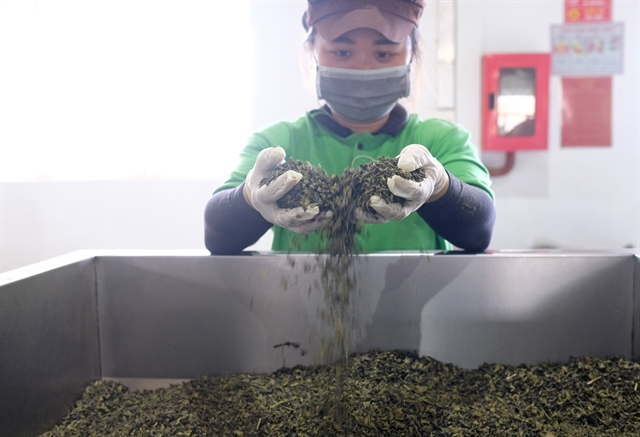
HÀ NỘI — The tea industry is under pressure to improve quality and market diversification for a strategic shift over the next five years from bulk exports to repositioning itself higher in the global value chain, experts have said.
According to Nguyễn Đình Thọ of the Institute of Strategy and Policy on Agriculture and Environment, restructuring the tea industry toward large-scale production and long-term links between farmers, processers and exporters along with the development of a digital traceability system is urgent, as major markets are tightening sustainability and traceability requirements.
In the global market, the tea industry is moving toward deeper processing, packaging design and brand storytelling, with tea increasingly positioned as a health supplement product rich in polyphenols, catechins and L-theanine.
The herbal and blended tea segment is recording a compound annual growth rate of about 8.1 per cent, while the ready-to-drink (RTD) tea market is forecast to reach over US$70.8 billion by 2034, expanding at 5.9 per cent annually.
Meanwhile, Việt Nam mainly exports conventionally dried green tea with low added value. Thọ said a focus on extraction technology, spray drying, vacuum concentration, IoT-based climate control and standardised cold chains would be necessary.
The tea industry also needed to diversify its products to include white, black and fermented teas as well as kombucha, alongside stronger cultural branding, to reposition exports, he stressed.
Experts also point out that free trade agreements, such as the EU-Việt Nam free trade agreement and the Comprehensive and Progressive Agreement for Trans-Pacific Partnership, are creating significant opportunities for the tea industry, but also require sustainability and origin traceability.
Green and low-emissions consumption trends are setting new rules for global agricultural trade, with sustainability certifications such as the Rainforest Alliance, fair trade and organic standards increasingly becoming prerequisites rather than marketing advantages.
Moving towards organic production is thus emerging as an inevitable direction for Việt Nam’s tea industry to strengthen the national brand of Vietnamese tea as a sustainable and premium product.
Currently, the average plantation area is only around 0.2ha per household, resulting in weak value chain links and making it difficult to implement certifications like Organic, VietGAP, GlobalGAP or Rainforest Alliance due to high compliance costs.
A representative from the Ministry of Agriculture and Environment said that the tea development strategy through 2030 would focus on improving quality and sustainability standards by issuing planting area codes and implementing a digital traceability scheme.
The tea industry would also invest in deep processing to increase the share of refined, RTD and functional tea products, along with efforts to diversify exports and build a national brand for Vietnamese tea.
Việt Nam currently ranks fifth globally in tea production and exports, with raw material areas in Thái Nguyên, Phú Thọ and Lâm Đồng provinces.
Tea exports reached 136,952 tonnes, worth nearly $238 million in 2025, down 7.07 per cent in volume and 0.72 per cent in value compared with 2024.
However, this January recorded positive signs of recovery, with export value increasing 27 per cent to nearly $21 million. — VNS