Sustainable raw materials critical for wood industry to reach $25b export goal
The target of $25 billion could be beyond reach if the industry continues to rely on short-term sources and imported raw materials, said Bùi Trung Nghĩa, deputy chairman of the Vietnam Chamber of Commerce and Industry (VCCI).
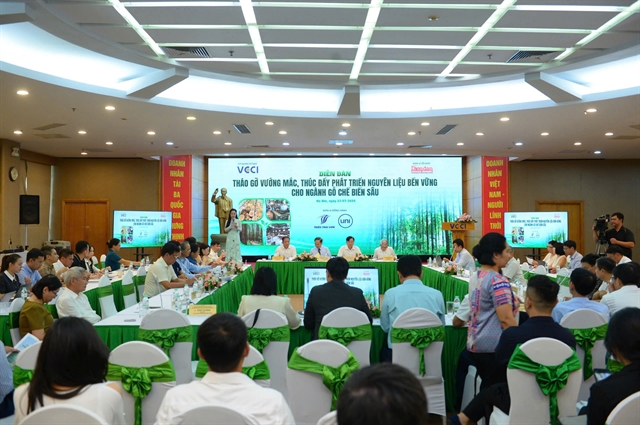
HÀ NỘI — Sustainable, transparent and traceable raw materials are becoming increasingly important for Việt Nam's wood processing industry to achieve an export target of US$25 billion by 2030, industry officials and experts said at a conference on July 23.
The target of $25 billion could be beyond reach if the industry continues to rely on short-term sources and imported raw materials, said Bùi Trung Nghĩa, deputy chairman of the Vietnam Chamber of Commerce and Industry (VCCI).
"Shifting towards sustainable forestry, becoming self-sufficient in raw materials, upgrading the value chain and optimising ecological efficiency per hectare of forest will determine the long-term position of Việt Nam's wood industry amid volatile global trade," Nghĩa said.
Future growth would depend more on quality, productivity and the ability to meet strict market standards than on expanding production volumes, he added.
He stressed that sustainable raw materials would help businesses improve competitiveness, secure supplies, reduce reliance on imports and increase the value of deeply processed wood products.
The coordination among the State, local governments, exporters, associations and farmers is critical to develop sustainable raw materials source, he said.
Nguyễn Văn Diện, deputy director of the Forestry and Forest Protection Department under the Ministry of Agriculture and Environment, said the key challenge was maintaining rapid industry growth while ensuring sustainability amid the shift towards green trade.
Domestic forestry supplied about 78 per cent of the industry's wood-processing demand during 2021-25, while Việt Nam has nearly 4.9 million ha of planted forests, he said.
Sustainability: the key
However, advantages in price and production capacity alone were no longer sufficient as global markets increasingly focused on the quality and sustainability of supply chains.
"The Vietnamese wood industry must shift from thinking about having enough raw materials for production to securing legal, transparent, responsible and sustainable sources, and from exporting large volumes to exporting high-value products," Diện said.
He said the industry still faced bottlenecks including limited areas of large-timber forests, a low proportion of forests with sustainable management certification, incomplete digitalisation of raw-material data, weak links between forest growers and businesses, insufficient deep processing and low technology levels among many companies.
The forestry authority plans to focus on developing large-timber raw-material areas, expanding certified sustainable forests, digitalising traceability systems, improving forest credit and insurance mechanisms, developing carbon credit markets and increasing the use of legal domestic timber, Diện said.
He added that the second half of 2026 would be critical for upgrading the industry's value chain and strengthening the position of Vietnamese wood products.
New international regulations, including the European Union Deforestation Regulation (EUDR), the Renewable Energy Directive III (RED III), Net Zero commitments and environmental, social and governance (ESG) standards are putting greater pressure on exporters to obtain sustainability certifications.
Bùi Thị Nha Trang, from Control Union Vietnam, said international markets were increasingly demanding not just wood products but also data proving their legal origin, traceability and carbon footprint.
She said that certifications such as FSC, PEFC, ISCC, GGL and SBP are becoming strategic assets in supply-chain management.
Phạm Đình Thắng, chairman of Triệu Thái Sơn Company, said the biggest challenge for processors was securing stable, legal and high-quality raw materials for deep processing.
He pointed out that for around three tonnes of fresh acacia wood, exporting it as woodchips generates about VNĐ3 million ($114), while producing wood pellets can generate around VNĐ6 million. Processing the timber into plywood and making use of by-products can generate more than VNĐ20 million, Thắng said, highlighting the importance of deep processing to retain more value-added production in Việt Nam.
Exporters agreed that policies needed to be improved together with closer links between the Government, businesses and forest growers to provide sustainable raw-material supplies and reduce reliance on unstable short-term sources.
Việt Nam's wood and wood product exports totalled more than $17 billion in 2025, making the country the world's fifth-largest, Asia's second largest and Southeast Asia's largest wood exporter. Vietnamese wood products are now exported to more than 140 countries and territories. — VNS