Stronger legal support needed for household businesses in transition to corporations
Experts said the draft amendments to the Law on Support for Small- and Medium-Sized Enterprises (SMEs) focuses largely on support after conversion, despite the fact that many household businesses face their greatest challenges before deciding to formalise.
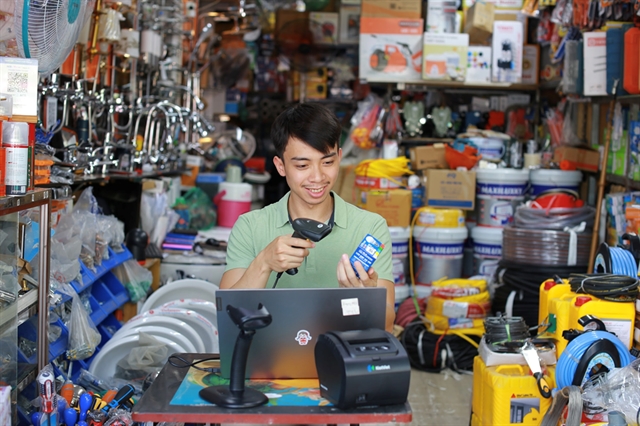
HÀ NỘI — Stronger legal safeguards and support measures are needed for household businesses convert into formal enterprises, experts said, as lawmakers consider amendments to the Law on Support for Small- and Medium-Sized Enterprises (SMEs).
The draft law introduces a number of incentives aimed at encouraging household businesses to transition to the corporate model.
Converted businesses would be allowed to apply simplified tax, accounting and reporting requirements designed for micro-enterprises for 36 months after receiving their initial business registration certificate.
The proposal also includes a more flexible social insurance contribution mechanism for employees, streamlined procedures for tax declarations and social insurance obligations, and reductions in unemployment and occupational accident insurance contributions during the first year of operation.
In addition, newly converted enterprises would be exempt from business registration fees, publication fees for business registration information and certain appraisal, licensing and permit fees associated with regulated business activities.
While welcoming the incentives, tax and business experts said the draft focuses largely on support after conversion, despite the fact that many household businesses face their greatest challenges before deciding to formalise.
Lê Thị Yến, director of Hanoi Tax Consulting Co, said household businesses often struggle with questions related to business structure, the transfer of assets and liabilities, existing contracts, tax obligations and labour requirements.
She proposed adding pre-conversion support measures, including advisory services on taxation, accounting, legal procedures, labour regulations, licensing requirements and trademarks.
Yến also called for a transitional mechanism that would allow household businesses sufficient time to complete asset and contract transfers while clearly defining the legal treatment of transactions conducted before and after incorporation.
To ensure a smoother transition, she suggested a three-year support roadmap, with intensive assistance during the first year, followed by a gradual reduction in direct support and an increased focus on mentoring and compliance guidance before businesses move to standard regulatory requirements.
According to Yến, the conversion policy can only succeed when household businesses see that becoming a company is not a leap into risk, but a process that is guided, supported and reasonably protected.

Lê Duy Bình, director of Economica Vietnam Co, said that alongside amendments to regulations on taxation, accounting and social insurance, a separate legal framework needs to be established for household businesses, individual businesses and other sole proprietorships.
Bình said a dedicated law should be developed for these business models, with tax regulations designed to be simple, easy to implement and aligned with the characteristics of sole proprietorships, while keeping compliance costs low.
He also called for a shift in the taxation approach for sole proprietorships. Instead of taxing revenue, as is currently the case, individual business owners should be taxed based on income.
Under the revised Personal Income Tax Law, which takes effect from the 2026 tax year, the tax-free income threshold will be set at VNĐ15.5 million (US$595) per month, or VNĐ186 million per year. Under such a system, business owners would only pay tax when their actual profits exceed that threshold.
Bình added that taxation based on income would be fairer, more accurate and less controversial.
Meanwhile, Nguyễn Hữu Thập, chairman of the Tuyên Quang Business Association, said support for household businesses transitioning into enterprises should be a central element of the amended law.
He said household businesses will only convert when they feel safer, more convenient, more profitable and less risky.
He proposed a 36-month support package for newly converted enterprises, covering business registration procedures, selection of legal structures, taxation, accounting, electronic invoices, digital signatures, social insurance, labour compliance, legal advisory services, corporate governance, digital transformation and market access.
The chairman also called for a compliance-support mechanism during the early stages of operation. He proposes that first-time violations related to taxation, accounting, invoicing, insurance, labour regulations or business conditions be addressed primarily through guidance and corrective measures, provided there was no fraud, no deliberate evasion of obligations or serious consequences. Administrative penalties, if applied, should be kept to a minimum, he said.
Việt Nam has around 1.2 million registered enterprises and 5.3 million household businesses, with SMEs accounting for about 98 per cent of all businesses.
The sector plays a key role in job creation, innovation and economic growth, but continues to face challenges including limited access to financing, market opportunities, technology adoption, digital transformation and rising compliance costs. — VNS