Southeast Asia marketers shift focus from AI adoption to integration
The State of AI in Marketing 2026 report, based on a survey of 143 MMA members in Indonesia, Việt Nam, the Philippines, Thailand and Singapore conducted between January and April 2026, found that 57 per cent of organisations have reached advanced stages of AI adoption.
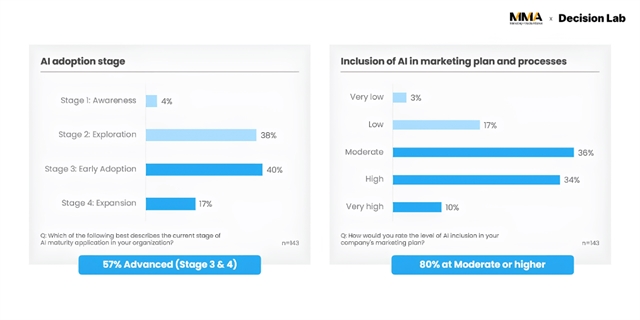
with 57 per cent of organisations at the two highest stages of the AI maturity journey. —Photo courtesy of Decision Lab
HÀ NỘI — Artificial intelligence has become a standard part of marketing operations across Southeast Asia, with the competitive gap increasingly determined by how effectively companies integrate the technology across their organisations rather than whether they adopt it, according to a 2026 report by the Marketing + Media Alliance (MMA) and Decision Lab.
The State of AI in Marketing 2026 report, based on a survey of 143 MMA members in Indonesia, Việt Nam, the Philippines, Thailand and Singapore conducted between January and April 2026, found that 57 per cent of organisations have reached advanced stages of AI adoption.
Around 80 per cent of organisations said AI features in their marketing plans at a moderate level or higher, while only 4 per cent remain at the awareness stage, suggesting the technology has moved beyond experimentation and become an industry norm.
The report said AI adoption is no longer a competitive differentiator on its own, with the focus shifting to how deeply organisations embed the technology into marketing operations.
Companies leading in AI adoption have also expanded its use across a wider range of marketing functions than their peers, the report found.
Among advanced adopters, 54 per cent have deployed AI at scale in content creation and creative asset development, compared with 25 per cent of organisations in the early adoption stage.
In customer insights and analytics, 41 per cent of advanced adopters have reached scaled deployment, nearly double the 21 per cent recorded among early adopters.
Advanced adopters also outperformed their peers in media allocation and measurement and attribution, where 33 per cent and 30 per cent respectively reported scaled AI implementation, compared with 10 per cent and 13 per cent among early adopters.
"This is where Advanced adopters are pulling ahead," said Rohit Dadwal, CEO MMA Global Asia Pacific and Global Head of Smarties Worldwide.
"Their advantage comes less from owning more tools than from scaled application across use cases, functions, and decision points. They are turning disciplined micro-actions into macro-impact.”
Data privacy remains the biggest concern for marketers using artificial intelligence, while many organisations have yet to establish formal frameworks to manage AI-related risks, according to the report.
About 62 per cent of respondents identified data privacy as their top AI risk. Awareness of the ethical implications of AI was higher among advanced adopters, at 83 per cent, compared with 62 per cent of early adopters.
However, governance has lagged behind awareness. Only 44 per cent of advanced adopters reported having a formal AI risk strategy in place, while the figure fell to 21 per cent among early adopters.
The findings suggest that although many organisations recognise the risks associated with AI, fewer have developed the governance capabilities needed to manage them effectively. — BIZHUB