Rice shrimp model delivers dual gains in Mekong Delta
The rice shrimp farming model in An Giang Province has brought stable incomes and improved livelihoods for farmers over the past two decades, with recent shifts towards organic and bio safe practices further boosting efficiency, product value and environmental sustainability.
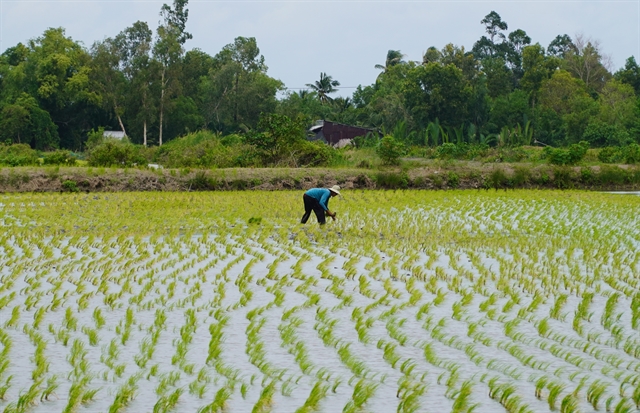
AN GIANG — The rice shrimp farming model in An Giang Province has brought stable incomes and improved livelihoods for farmers over the past two decades, with recent shifts towards organic and bio safe practices further boosting efficiency, product value and environmental sustainability.
Local authorities said that since 2022, the province has expanded the model under bio safe and organic oriented production standards, alongside strengthening linkages between farmers, input suppliers and processing enterprises.
The approach has helped reduce production costs, improve product quality and increase profits, while enhancing resilience to climate change and supporting the transition towards modern, sustainable agriculture.
Early adopters have recorded clear gains.
Lê Văn Tư, a farmer in Đông Hưng Commune, said that after more than three years applying organic oriented techniques on four hectares, his household has seen consistent improvements in both productivity and income stability.
His farm follows a rotational cycle of three shrimp crops and one rice crop each year, maximising land use efficiency while maintaining ecological balance.
He noted that the new method significantly reduces the use of seeds, fertilisers and chemical pesticides in rice cultivation. In shrimp farming, feed and veterinary costs have also declined thanks to the use of natural feed sources and biological products.
At the same time, productivity has improved. Rice yields have reached over 7.5 tonnes per hectare, about 1.5 tonnes higher than under traditional farming methods.
Shrimp output stands at around 700kg per hectare per crop under extensive farming conditions, with improved survival rates and product quality.
Prices have also increased.
Organic rice reaching around VNĐ8 million (US$320) per tonne – about VNĐ500,000 ($20) higher than conventional rice – while shrimp are priced at roughly VNĐ120,000 per kilogramme, up VNĐ20,000 compared to traditionally farmed products.
In addition, stable purchasing agreements with enterprises help ensure reliable sales, reduce market risks and protect farmers from price pressure by traders.
The model operates on a natural and mutually supportive cycle.
Rice is grown with minimal chemical inputs, with straw and leftover grains decomposing into natural shrimp feed. Farmers use lime and microbial products instead of chemicals to treat water, while nutrient-rich pond water supports rice growth, forming a low-impact closed-loop system.
Another farmer, Trần Văn Nam from Đông Hòa Commune, said local households began adopting the model later, starting in the 2024 rice season.
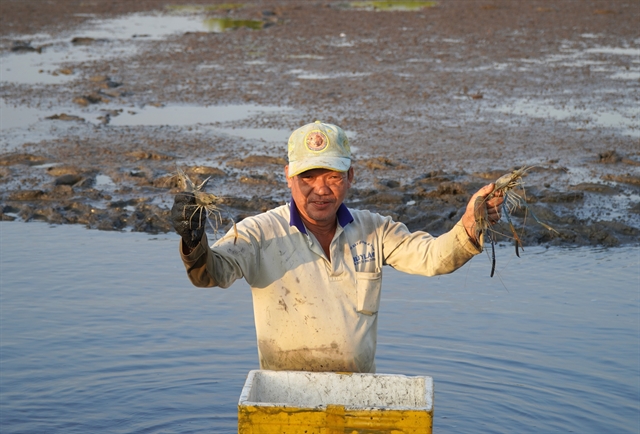
With support from agricultural extension centres and fisheries agencies, farmers received training, technical guidance and regular field supervision, enabling them to quickly adapt to the new farming practices.
He said that in previous years, traditional farming methods delivered low productivity and unstable incomes, especially under increasingly severe climate conditions between 2016 and 2024, including salinity intrusion and irregular rainfall.
The shift to bio safe production was therefore necessary to ensure both economic efficiency and long-term sustainability.
Farmers in the area are now cultivating high quality rice varieties such as ST24 and ST25 under VietGAP standards to meet export requirements, particularly for demanding markets such as Europe.
At the same time, shrimp and crab are raised using natural feed sources such as snails and small fish, helping improve product quality and meet food safety standards.
Output is purchased by enterprises under contract farming arrangements, ensuring stable market access and better price transparency.
According to the provincial Department of Agriculture and Environment, brackish water aquaculture in the province covers about 250,000ha, including more than 130,000ha of shrimp farming.
Rice output from rice shrimp areas is estimated at over 200,000 tonnes in the 2025 to 2026 season, reflecting the growing importance of the integrated model in the local agricultural economy.
Department's Director Lê Hữu Toàn said the integrated system, combining shrimp, crab and rice production under bio safe standards, has delivered higher yields, better product quality and more stable markets compared to traditional monoculture farming.
Production costs remain below VNĐ20 million ($800) per hectare, while profits exceed VNĐ30 million ($1,200), about 1.5 times higher than previous levels.
Looking ahead, the province aims to maintain more than 117,000 hectares of rice shrimp farming by 2030.
Authorities will continue to promote the application of science and technology, expand production linkages and organise value chains from input supply to farming, processing and distribution.
Enterprises are expected to play a central role in the model by acting as anchors in production chains, supporting branding, traceability and market expansion.
At the same time, local authorities will focus on strengthening cooperatives and farmer groups to improve production efficiency and bargaining power.
The model is also seen as a key solution for protecting the ecological environment, reducing chemical use and adapting to climate change in the Mekong Delta, where salinity intrusion and extreme weather events are becoming more frequent. — VNS