Digital transformation bridges governance gap
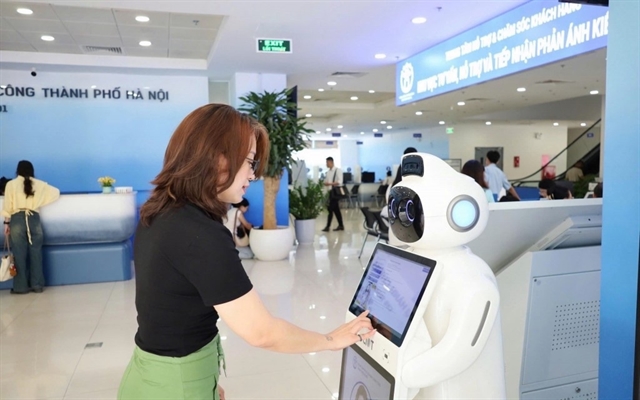
From technology-driven urban governance solutions to local online public services, digital technology is steadily narrowing the gap between Government and the business community.
HÀ NỘI — Since a recent Politburo resolution came into force, the digital transformation has become increasingly evident in administrative transactions and in the day-to-day interactions of citizens and businesses.
Issued on December 22, 2024, the Politburo’s Resolution 57-NQ/TW is focused on breakthroughs in science and technology, innovation and national digital transformation.
From technology-driven urban governance solutions to local online public services, digital technology is steadily narrowing the gap between the Government and the business community.
Party General Secretary Tô Lâm has repeatedly underscored the need to make science, technology, innovation and digital transformation the primary drivers of a new growth model.
He noted that significant work remains, particularly the shift from task implementation to delivering measurable, tangible results, and from fragmented efforts to concentrated resources addressing major strategic challenges.
He also called for more decisive, systematic and effective implementation of Resolution 57, with each task tied to concrete outcomes.
This year has been designated as a period of breakthrough action and widespread impact, requiring all levels and sectors to clearly define their responsibilities.
These directions are laying a crucial foundation for the digital transformation to take root in daily life and become a genuine engine of development.
A notable highlight of the national digital transformation process is the growing involvement of technology firms in delivering solutions for the public sector.
However, experts stress that technology alone is not sufficient. Hán Minh Cường, director of the AIST Institute for Construction Science and Technology, said that the decisive factor lays in governance mindset.
He emphasised that a user-centred approach is essential to ensure that technology simplifies procedures, shortens processing time and effectively supports both public officials and citizens.
This perspective aligns with the spirit of Resolution 57, which identifies digital transformation, innovation and science and technology as key drivers for restructuring the growth model.
Technology must therefore not only serve management purposes, but also enhance service quality and generate real value for society.
After the two-tier local government model was rolled out, workloads at the commune and ward levels increased significantly. In response, digital technology has emerged as a vital tool to ease pressure and improve administrative efficiency.
Integrating local data with the National Population Database and interconnected digital systems has significantly reduced processing times. Tasks that previously required manual verification can now be completed swiftly in a digital environment.
At one-stop service units, the process of receiving and handling applications has seen marked improvements. Documents are digitised and continuously updated, minimising errors and enhancing transparency.
Citizens can track progress online, reducing the need for repeated visits and long waiting times.
Phạm Thùy Liên, a resident of Hưng Yên Province, said the shift to electronic documentation has made administrative procedures more manageable for her.
Instead of preparing numerous paper documents and making multiple trips, she can now complete most steps online.
As the owner of a small business, Ngô Thị Luyên in Bắc Ninh Province also praised electronic certification. She noted that replacing paper-based certification with digital solutions not only makes document storage more convenient, but also facilitates transactions with foreign partners.
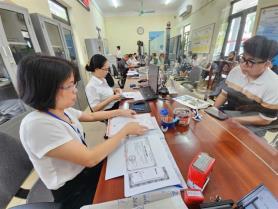
The model of commune-level public administrative service centres is proving increasingly effective. In Lạng Giang Commune, Bắc Ninh Province, the centre is organised into various functional areas, ranging from reception and information lookup to document digitisation and administrative processing.
Staffers are assigned according to specialised fields, enhancing professionalism and efficiency in handling tasks.
The centre processes hundreds of applications each day, with legal and civil status matters accounting for a significant share. Thanks to streamlined procedures and technological support, applications are handled quickly, minimising backlogs.
The development of internal procedures and the application of technology have ensured compliance in processing applications while improving service quality, said Vice Chairman of the Lạng Giang Commune People’s Committee Nguyễn Văn Sơn.
Citizens are not the only ones benefiting from this recent shift — foreigners living and working in Việt Nam have also seen positive changes.
As someone who has lived in Việt Nam for more than a decade, KGS International School System Principal Jeong Young Oh said he has observed significant improvements, particularly in the application of digital technology.
He noted that major advances in digitalisation policies have accelerated Việt Nam’s development in recent years.
This is especially evident at airports and similar locations, where passengers can now simply present electronic tickets and a VNeID on their mobile devices to board flights, without the need for paper documents as in the past.
With clear directions from Resolution 57 and a strong commitment across the political system, the digital transformation is opening up new development space for a modern administrative system.
The application of technology is narrowing the gap between the Government, citizens and businesses, moving toward a transparent, effective and service-oriented administration. — VNS