PM urges action to ensue macro stability, drive double-digit growth in 2026
The Government’s Steering Committee on Macroeconomic Management and Administration met to review economic performance in 2025 and outline priorities for 2026 and the 2026–2030 period on Monday.
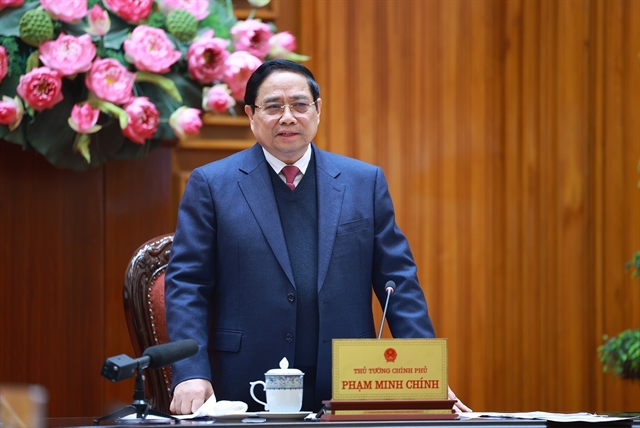
HÀ NỘI — Prime Minister Phạm Minh Chính has called for concrete action from the very start of 2026 to maintain macroeconomic stability, control inflation, safeguard major economic balances and sustain high growth as Việt Nam enters a new phase of development.
The Prime Minister made the remarks at the second meeting of the Government’s Steering Committee on Macroeconomic Management and Administration, which reviewed economic performance in 2025 and outlined priorities for 2026 and the 2026–2030 period on Monday.
“Economic management must ensure that what is said is done, done effectively and truly benefits the people,” PM Chính said.
According to the steering committee’s report, despite global uncertainties driven by geopolitical tensions and shifts in trade policy, as well as severe domestic impacts from historic natural disasters, Việt Nam posted strong results in 2025. Inflation stood at 3.31 per cent, macroeconomic stability was maintained and gross domestic product expanded by 8.02 per cent, among the highest growth rates globally, reinforcing confidence ahead of the next five-year plan.
2026 is a significant year, marking the first year of the 2026–30 socio-economic development plan and the beginning of what is described as a new era of national development.
To successfully implement the resolutions of the 14th National Party Congress, officials agreed priority must be given to ensuring macroeconomic stability, controlling inflation, maintaining major economic balances and achieving high growth.
This would require further institutional reform, the removal of bottlenecks and the mobilisation of all available resources for development, the committee said, proposing the establishment of a new growth model driven by science and technology, innovation and digital transformation, alongside economic restructuring, industrialisation and modernisation.
It was also critical to improve productivity, resilience and competitiveness, while making breakthroughs in economic and social infrastructure development and better utilising new development spaces, the committee added.
In conclusion, PM Chính said the 2021–25 period had laid a solid foundation for a faster and more sustainable growth phase, underscoring the importance of flexible and effective macroeconomic management.
While global conditions are forecast to remain complex and unpredictable in 2026, the Government must focus on ensuring macroeconomic stability, controlling inflation and striving for double-digit growth, he said.
The Prime Minister asked ministries and agencies to immediately begin implementing Party and Government resolutions for the 2026–30 term with discipline, decisiveness and accountability.
He called for an expansionary but targeted fiscal policy, with appropriate tax and fee measures to support growth drivers, alongside efforts to boost revenues, save expenditure and prioritise spending on defence, growth engines and social welfare. At the same time, monetary policy should remain proactive, flexible and timely.
Emphasising close coordination between fiscal and monetary policies, Chính urged stronger fiscal discipline, broadening the tax base and preventing tax losses, while tax and fee reductions and extensions must be implemented effectively to support businesses.
He also called for the effective use of resources for key national projects in priority areas such as science, technology, innovation and digital transformation.
The Prime Minister asked for efforts to promote the stable, transparent and healthy development of stock and corporate bond markets, manage interest and exchange rates in line with macroeconomic developments, stabilise the Vietnamese đồng and expand credit programmes for infrastructure, digital technology, production and business, while tightly controlling credit in high-risk sectors.
He further called for accelerating public investment disbursement, targeting a 100 per cent rate, especially for large-scale infrastructure projects such as railways, aviation and seaports, alongside efforts to cut administrative procedures and business conditions to facilitate enterprise.
In addition, the attraction of foreign direct investment must be promoted, especially in high-tech sectors such as semiconductors, artificial intelligence and digital technology.
Other tasks include resolving long-delayed projects, developing energy projects, expanding social housing and promoting a healthy and sustainable real estate market, accelerating agricultural restructuring to ensure food security, stimulating consumption, stabilising prices and cracking down on smuggling, trade fraud and counterfeits.
The Prime Minister also called for stronger trade promotion efforts and greater diversification of export markets, while urging breakthroughs in new growth drivers.
He further asked for effective implementation of the International Financial Centre in Việt Nam and for creating breakthroughs in innovation and data exploitation.
He also emphasised the need to accelerate the green transition, with concrete, appropriate and effective solutions tailored to key sectors including energy, transport, tourism, services and agriculture.
Việt Nam targets GDP growth of 10 per cent or higher this year. — VNS