Phenikaa University Hospital announces a successful delivery of triplets
On September 14, more than three months after birth, all three were discharged. Minh Khôi weighed 3.58kg, Minh Vũ 3.57kg and Minh Đức 3.70kg.
HÀ NỘI — The Hà Nội-based Phenikaa University Hospital has announced details of the successful delivery of triplets at the hospital on October 2.
A baby boy named Nguyễn Minh Đức was born at 9.50am on June 11 at a gestational age of just 27 weeks and six days. Weighing 900g with Apgar scores of six and eight, he was immediately transferred to the Neonatology Department for resuscitation.
However, the delivery process was not over. The remaining two babies were still in the womb. Following a consultation, the medical team decided to administer medication to suppress contractions, monitor the situation closely, and attempt to delay the delivery of the other two fetuses.
"One baby was already in an incubator in the Neonatology Department, while the other two were still inside, listening to their mother's heartbeat," said Dr Nguyễn Thị Sim, Deputy Director of Phenikaa University Hospital.
"From that moment on, we faced two battles unfolding simultaneously."
According to Dr Sim, this is known as 'Delayed Interval Delivery', a strategy considered in certain multiple-pregnancy cases where one fetus must be delivered, yet the remaining fetus or fetuses can continue to be sustained within the uterus.
Dr Sim added: "For extremely premature infants, every hour spent in the womb is precious. However, prolonging the pregnancy also means the mother and the remaining fetuses face risks such as infection, fetal distress, or progressing labour.
"The goal is not to 'hold on at all costs,' but rather to extend the pregnancy as long as conditions remain safe."
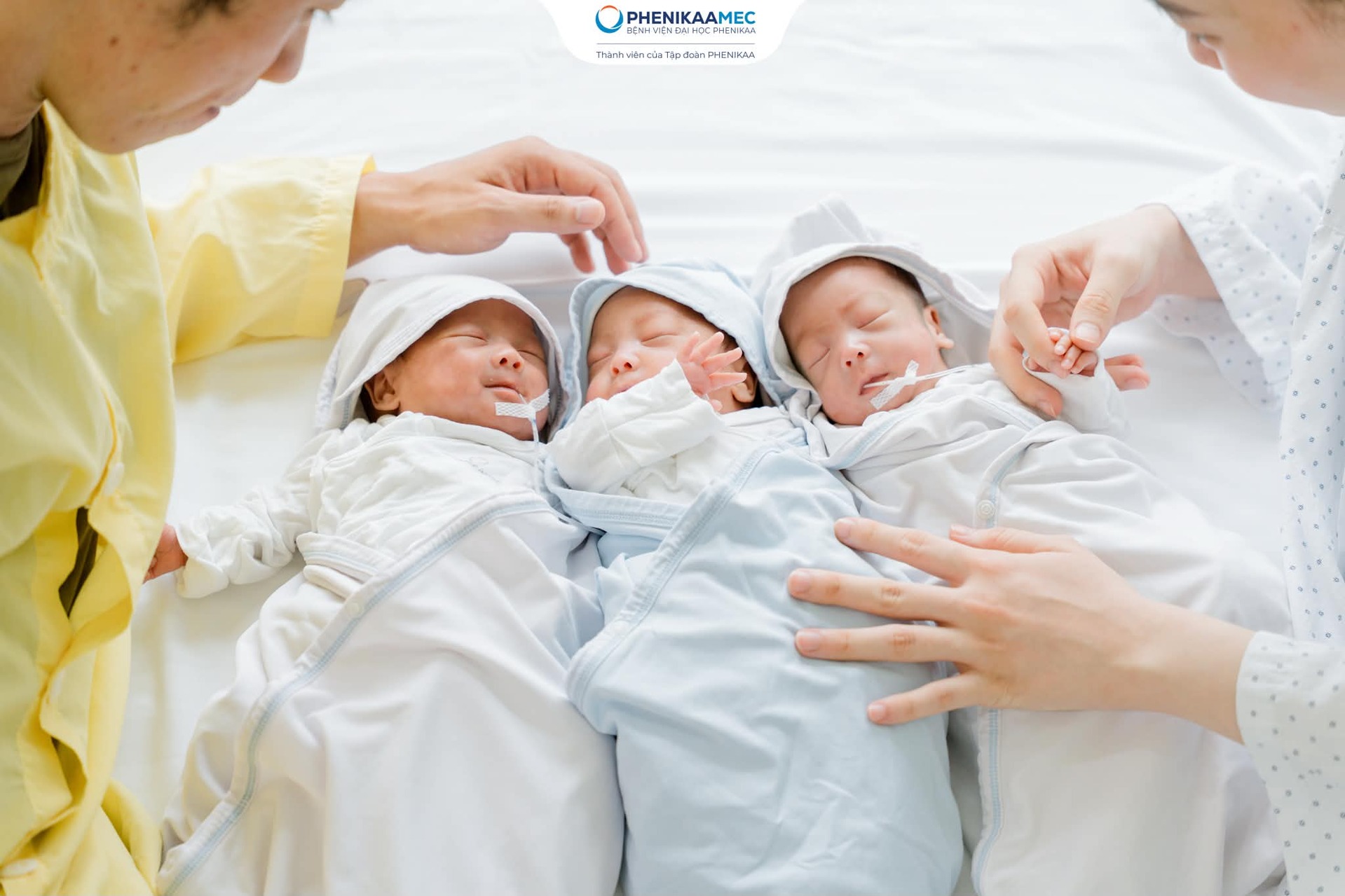
Nearly 38 hours later, Nguyễn Minh Vũ and Nguyễn Minh Hưng were delivered one after the other via emergency C-section. Vũ weighed 950g while Hưng weighed 1,000g. This marked the first case of triplets in Việt Nam with an interval of nearly 38 hours between births.
Previously, the 29-year-old mother, Phạm Hồng Nhung, from Hải Phòng City, had endured a challenging pregnancy journey, facing risks ranging from threatened miscarriage to various pregnancy-related medical complications.
Nhung was a first-time expectant mother who had undergone IVF due to polycystic ovary syndrome. Although two embryos were transferred, the pregnancy developed into triplets with three amniotic sacs and two placentas. From the very early weeks, it was a high-risk pregnancy.
The mother also suffered from a hypercoagulable state, requiring medication and regular monitoring. By mid-pregnancy, she developed polyhydramnios and gestational diabetes, posing significant challenges for the medical team.
At 27 weeks, despite having received injections to promote fetal lung maturity, the mother experienced a rupture of the amniotic sac for one of the fetuses, resulting in the natural delivery of the first baby.
After baby Minh Đức was delivered naturally, the doctors continued to suppress contractions and closely monitored the remaining two fetuses. The baby was immediately received by neonatologists for respiratory support and special care, while the other two remained in the mother's womb.
Doctors decided to employ a delayed delivery technique in an attempt to keep the remaining two fetuses in the womb; extending their time in utero was crucial for their development.
“We decided to try to keep the remaining two fetuses in the womb a little longer. With every passing hour, the condition of both the mother and the two fetuses was closely monitored,” Dr Sim said.
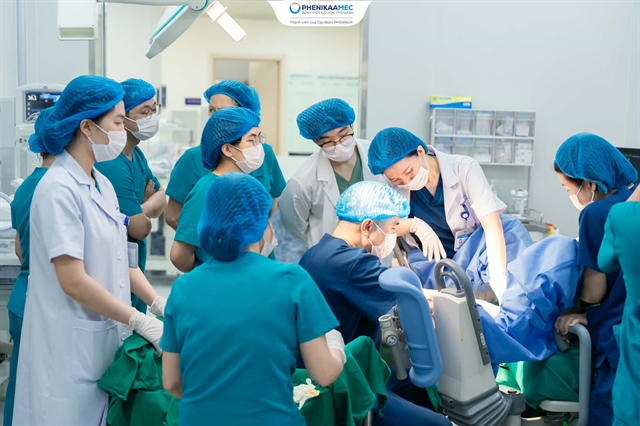
By 11.40pm on June 12, the expectant mother was experiencing strong uterine contractions and her water had broken, with the remaining fetuses in a transverse lie, Dr Sim decided to perform an emergency C-section to deliver them.
Four medical teams were mobilised immediately that night. While the anesthesia and resuscitation team ensured the mother's safety and the obstetrics team performed the surgery, two independent neonatal teams prepared to receive and resuscitate the two extremely premature infants simultaneously.
All three babies were born extremely prematurely and suffered from respiratory distress. They were transferred to the hospital’s Neonatal Unit for respiratory support and monitoring in a strictly controlled environment.
Nutrition, medication, and respiratory support were tailored to each infant's condition. The Neonatology Department also collaborated with the Pharmacy Department on specialised compounding to standardise medication dosages down to 0.1 ml.
Respiratory support was gradually stepped down, and the infants transitioned from intravenous nutrition to tube feeding, followed by practicing sucking, and finally bottle and breastfeeding. After approximately two months, all three were weaned off ventilators and were breathing entirely on their own.
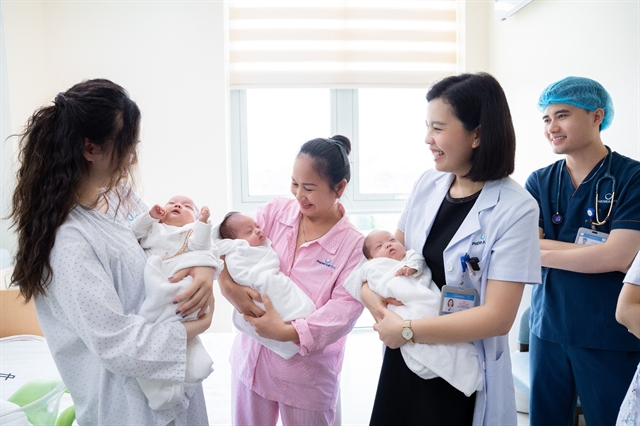
On September 14, more than three months after birth, all three were discharged. Minh Khôi weighed 3.58kg, Minh Vũ 3.57kg and Minh Đức 3.70kg. They were feeding well, showed no signs of respiratory distress, and exhibited healthy neonatal reflexes and normal motor function.
This is a rare success, even by global standards, and marks a new milestone for fetal medicine in Việt Nam. — VNS