New development space opens for commodity derivatives market
By 2030, around 10 Vietnamese commodities with potential and competitive advantages are expected to come into being, with domestic reference prices gradually established for three to five key commodities.
HÀ NỘI — The Minister of Industry and Trade has approved a project on developing Việt Nam’s commodity derivatives market for 2026-30.
The project, approved on September 28, formalises the development of the commodity derivatives market and provides a foundation for perfecting the legal framework, particularly the draft Law on Commodity Derivatives Trading currently being prepared for submission to the National Assembly.
Việt Nam’s commodity derivatives market has gradually taken shape and become a tool helping businesses manage risks arising from price fluctuations. However, there remains considerable room for expansion, particularly in developing products linked to Việt Nam’s competitive commodities, enhancing links with the physical commodities market, and gradually establishing domestic reference prices.
In 2025, the market recorded around 1.54 million contracts, with a total trading value exceeding VNĐ1.9 quadrillion (US$73.2 billion).
While most transactions remain linked to international markets, Việt Nam has a number of large-scale commodities that can be standardised, and demand for price risk hedging is growing.
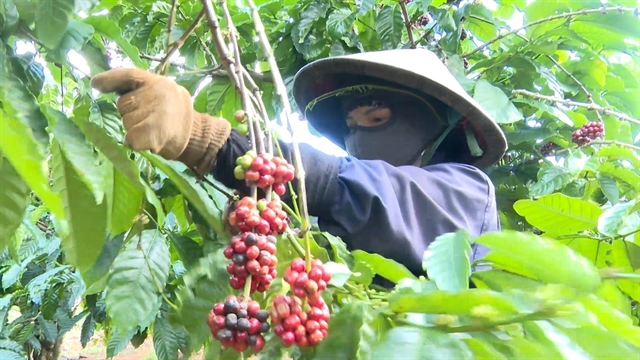
Coffee, rice, rubber, pepper and cashew alone have an underlying commodity value of around VNĐ30 billion annually, providing considerable scope for developing products suited to domestic conditions.
The project aims to establish and develop the commodity derivatives market based on market principles and in a transparent, safe and efficient manner, in line with international practices. It seeks to strengthen links with the physical commodities market and better meet the needs of production, business, import-export activities and price risk hedging.
The project is also a step to carry out the policy set out in Resolution No. 19-NQ/TW, dated July 28, 2026, on developing a commodity derivatives market, while laying the groundwork for fine-tuning the legal framework and developing the market in the new phase.
By 2030, around 10 Vietnamese commodities with potential and competitive advantages are expected to come into being, with domestic reference prices gradually established for three to five key commodities.
It also aims to reach 8-10 million contracts annually, attract 300-500 participating businesses, and raise the proportion of businesses in key commodity sectors using derivatives to hedge against price risks to around 20-30 per cent.
The roadmap will be implemented in stages. During 2026-27, efforts will focus on establishing the market foundation and completing trading, clearing and settlement, supervision, and risk management systems.
From 2028 to 2030, the scope of commodities will be expanded, contracts based on Vietnamese-origin commodities developed, domestic reference prices gradually set up, and international linkages expanded.
A key principle running throughout the project is that the commodity derivatives market should not develop separately from the real economy.
The project envisages a unified market model comprising an organised exchange market and an over-the-counter (OTC) market in accordance with regulations in force at each stage.
By 2045, Việt Nam aims to develop a commodity derivatives market with significant scale and strong connectivity within Southeast Asia, closely linked to the physical commodities market and supported by a legal framework approaching international standards.
The project aims to identify three to five key Vietnamese commodities that can serve as domestic price benchmarks, gradually helping shape regional pricing, and enhancing international connections and market integration.
Alongside infrastructure and products, it also targets developing human resources, disseminating knowledge and enhancing risk management capacity among businesses, cooperatives and other participants across commodity value chains. — VNA/VNS