Ministry seeks to simplify farm code procedures to support durian, agricultural exports
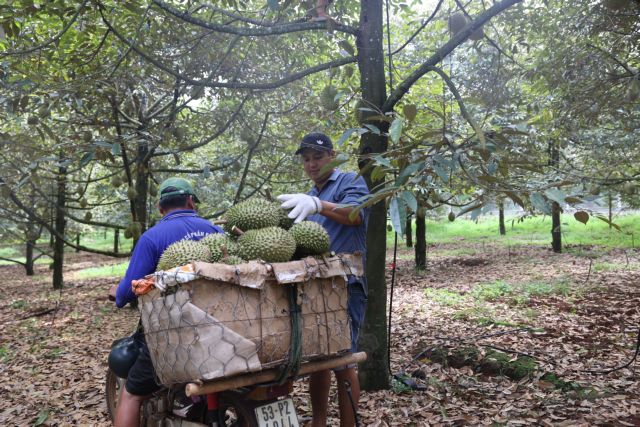
The Government plans to issue a separate resolution to immediately address obstacles in granting the codes, particularly as the Central Highlands' durian harvest is expected to enter its peak season in about 10 days.
HÀ NỘI — The Ministry of Agriculture and Environment has agreed to simplify code-issuing procedures for planting areas and packing facilities, while allowing commune-level authorities to certify land information where official land parcel identification numbers are unavailable.
The moves are aimed at easing bottlenecks for durian exports and other agricultural shipments, the ministry said at a consultation on July 15 about a draft Government resolution designed to streamline administrative procedures for granting planting area and packing facility codes.
Deputy Minister of Agriculture and Environment Nguyễn Hoàng Hiệp said the Government plans to issue a separate resolution to immediately address obstacles in granting the codes, particularly as the Central Highlands' durian harvest is expected to enter its peak season in about 10 days.
Hiệp said the resolution aims to reduce compliance costs for farmers and businesses, simplify administrative procedures and shift from a pre-inspection to post-inspection system while maintaining product traceability and meeting import market requirements.
The ministry identified three major bottlenecks to be tackled.
The first problem is the current requirement that planting areas cover at least 10ha. In fact, many production areas, particularly in the Central Highlands, are too small to qualify.
Another issue relates to intercropping regulations and their inconsistent interpretation by local authorities, which has complicated code issuance.
Finally, the last issue involves simplifying application procedures by reducing documentation and shortening processing times, without weakening traceability or compliance with importing countries' standards.
Fast, simple and accurate issuance of planting area codes is only one of the steps needed to support the upcoming durian export season, Hiệp said, adding that greater efforts are required to ensure smooth exports.
Huỳnh Tấn Đạt, head of the ministry's Plant Production and Protection Department, said the draft resolution outlines two options.
The first would link planting area codes directly to land parcel identification numbers in the national land database, with commune authorities verifying information where such identifiers are unavailable.
The second would prioritise immediate solutions to issues involving minimum area requirements, intercropping and administrative procedures, while integrating with the national land database once it is fully completed.
Under the draft, applications for planting area and packing facility codes will be simplified, processed online and managed through a digital database, with information integrated into national traceability and other relevant data systems.
Experts said that a balance between regulatory oversight and practical implementation is needed.
Đặng Thị Thuỷ, deputy director of Đắk Lắk Province's Department of Agriculture and Environment, said that planting area codes should be linked to land parcel identifiers to improve management consistency and reduce legal risks.
However, the province proposed allowing commune-level authorities to certify the location and actual area of land where ownership certificates or official parcel identifiers are still unavailable.
Representatives from the departments of agriculture and environment of Lâm Đồng, Gia Lai and Đồng Tháp provinces supported the simplified administrative approach, while recommending that commune authorities be assigned responsibility for pre-inspection and certification in cases lacking land identification numbers.
Hiệp said the ministry has chosen the second option, while linking codes to land locations where possible.
Existing information would be used for land parcels already included in the national database. Where no official identifier exists, commune-level authorities would verify the location and actual area.
The ministry also agreed to include detailed pre- and post-inspection procedures and inspection templates in the resolution.
For planting area codes intended for domestic use, valid applications would be processed within two to three working days, with inspections conducted afterwards.
For export-oriented codes, authorised agencies or commune-level authorities would conduct pre-inspections within a maximum of 10 working days to verify compliance with the specific requirements of each export market before submitting lists to importing countries.
Hiệp added that the reforms are intended not only to facilitate exports, but also to strengthen production management, traceability and food safety for both domestic and overseas markets.
As for China, Việt Nam's largest durian export market, Hiệp said officials would work with relevant agencies to accelerate recognition of submitted planting area codes and study possible revisions to bilateral protocols to give Việt Nam greater flexibility, while tightening oversight of high-risk planting areas and packing facilities to meet plant quarantine and food safety requirements.
He urged provincial departments of agriculture and environment to launch a nationwide campaign to digitise and standardise planting area data, while encouraging farmers to form cooperatives to create larger production zones, reduce the number of codes required and strengthen regional agricultural brands.
From July 15, the ministry plans to launch a fully online public service system for issuing planting area and packing facility codes. — VNS