Ministry proposes restoring consolidated e-invoicing to ease compliance cost, pressure on IT system
Under the ministry's proposal, selected service providers would be allowed to issue a single consolidated invoice for multiple transactions of low value and high frequency for non-business customers, instead of issuing a separate invoice for each transaction.
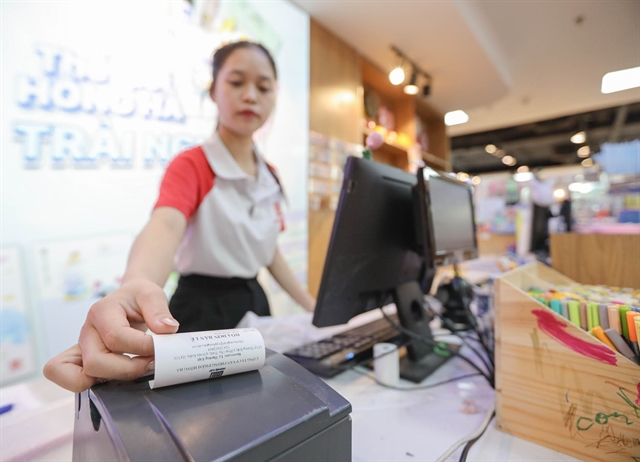
HÀ NỘI — The Ministry of Finance has proposed restoring the use of consolidated invoices by day or by month for certain high-frequency, low-value transactions to ease the pressure on the national e-invoicing system and reduce compliance costs for businesses.
The proposal was raised in a recent draft decree amending the Article 9 of Decree 123/2020/NĐ-CP dated October 19, 2020 on invoices and documents, which has already been amended by Decree 70/2025/NĐ-CP dated March 20, 2025.
Under the ministry's proposal, selected service providers would be allowed to issue a single consolidated invoice for multiple transactions of low value and high frequency for non-business customers, instead of issuing a separate invoice for each transaction as regulated under Decree 70, which took effect on June 1, 2025.
Banks, securities firms, insurers, e-wallet providers, electricity reconnection services, parking services, cinemas and e-commerce platforms that have software systems capable of tracking and managing each transaction in detail would be permitted to issue consolidated invoices at the end of the day or month, according to the draft.
For public passenger transport by bus and taxi using legally compliant metering software, operators would also be allowed to issue a single end-of-day invoice for individual customers, provided the system records full trip details including company name, vehicle plate number, route, distance and total fare.
The ministry said consolidated invoices must be based on detailed transaction data stored in companies’ management systems, and businesses would be responsible for accuracy and required to provide breakdowns to tax authorities upon request.
If customers ask for an individual invoice, service providers must still issue one, the draft stipulates.
The proposal comes after Decree 70/2025 scrapped the previous consolidated invoicing mechanism under Decree 123, creating difficulties for sectors with millions of small daily transactions and where most customers do not need individual invoices.
Requiring separate invoices for each transaction caused a surge in the number of e-invoices, far exceeding the designed capacity of the tax authority’s e-invoicing system, and piled up costs for businesses, the ministry said.
According to the ministry, the current e-invoicing system was designed to receive and process about 6.4 billion invoices per year, while the actual number has reached around 18 billion, nearly three times the original design.
Meanwhile, the number of e-invoices is forecast to reach 60 billion per year, well beyond the system’s capacity in terms of reception, processing and storage. The ministry’s Department of Taxation has warned that the rapid growth in e-invoices is already straining IT infrastructure and data processing.
Many banks and securities firms are still unable to issue separate invoices for each individual transaction due to insufficient IT infrastructure.
Previously, many businesses and associations, including Vietnam E-commerce Association, Shopee, Grab, BHD Star Cineplex and Lotte Cinema petitioned the restoration of the consolidated invoicing mechanism for individual customers. Mandatory per-transaction invoicing under Decree 70 has raised operational, staffing and data storage costs without significantly improving tax management for individual customers, they argued.
Under the draft, the ministry also proposed a transitional mechanism for firms that have not yet upgraded their IT systems to meet Decree 70 requirements, which would allow them to continue issuing invoices under the new decree starting from the effective date of Decree 70/2025, instead of being treated as non-compliant.
Welcome move
The Ministry of Finance’s proposal to restore consolidated invoices at the end of the day or month is seen as a sign that the Government is receptive to feedback from the business community and industry associations.
Keytas Tax Accounting Company Director Lê Văn Tuấn said Decree 70 had revealed a number of shortcomings after nearly a year of implementation.
He said that requiring businesses to issue large volumes of invoices to customers who did not need them had driven up compliance and operating costs, while also putting heavy pressure on data systems and raising the risk of overloading the tax authority’s e-invoicing platform.
“Allowing end-of-day or end-of-month consolidated invoices would help significantly reduce operating, invoicing and tax compliance costs for businesses,” he said.
However, to be eligible for consolidated invoices, businesses must have transparent systems that can manage and archive transaction data for revenue reconciliation, Tuấn noted.
“What we are aiming for is transparent data and full compliance with tax obligations. The Ministry of Finance could thus consider extending consolidated invoicing to businesses with regularly reported data systems, data managed by independent third parties or systems that companies cannot alter,” he added.
“Allowing consolidated invoices at the end of the day or month would benefit both businesses and tax authorities." — VNS