Market giants face growing test of financial strength
Companies such as Masan Group and Vingroup continue to face pressure from borrowing requirements and substantial investment needs.
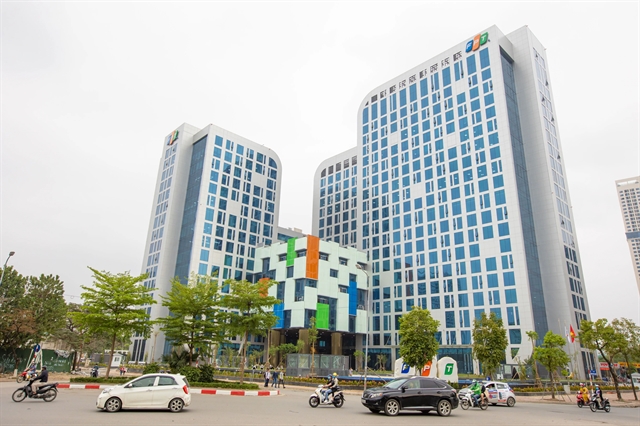
HÀ NỘI — The largest listed companies continue to dominate the domestic stock market in terms of market capitalisation, with industry leaders such as FPT Corporation, Vietcombank, Techcombank, Hoa Phat Group and Vinhomes remaining among the most valuable firms on the exchange.
However, behind their trillion-đồng valuations, differences in financial health, growth quality and investment prospects are becoming increasingly apparent.
According to market data, 23 listed companies currently belong to the exclusive group with market capitalisations exceeding VNĐ100 trillion (US$3.8 billion). These firms are concentrated primarily in the banking, technology, real estate, industrial production and consumer sectors and are widely regarded as market leaders with significant competitive advantages and considerable influence on market performance.
Among the group, FPT is considered one of the companies with the strongest financial foundations. The technology corporation has maintained consistent profit growth for many years, supported by software exports, digital transformation services and information technology operations.
Unlike many large corporations whose performance is closely tied to economic cycles, FPT benefits from stable cash flows, a relatively low debt burden and expanding international operations. These factors have helped the company maintain financial stability even during challenging economic periods.
In the banking sector, Vietcombank and Techcombank continue to stand out among the market's largest listed lenders.
Vietcombank is widely recognised for its asset quality, low non-performing loan ratio and effective risk-management capabilities.
Techcombank, meanwhile, is recognised for its strengths in digital banking, its high current account savings account (CASA) ratio and its position among the banking system's most profitable lenders.
Although banking remains sensitive to credit cycles, both institutions have managed to maintain strong market positions through sound governance and operational efficiency.
Industrial giant Hoa Phat is viewed as a leading representative of the manufacturing sector within the VNĐ100 trillion market-capitalisation group. Following a difficult period for the steel industry, the company has gradually recovered amid rising public investment demand and improving conditions in the real estate market.
As Việt Nam's largest steel producer, Hoa Phat continues to benefit from economies of scale and a strong competitive position within the sector.
In real estate, Vinhomes remains the market's largest landholder among listed developers.
Although the country's property sector has undergone a prolonged adjustment period, the company continues to benefit from an extensive land bank, strong project development capabilities and access to financing.
Not all large-cap companies, however, possess equally strong financial foundations.
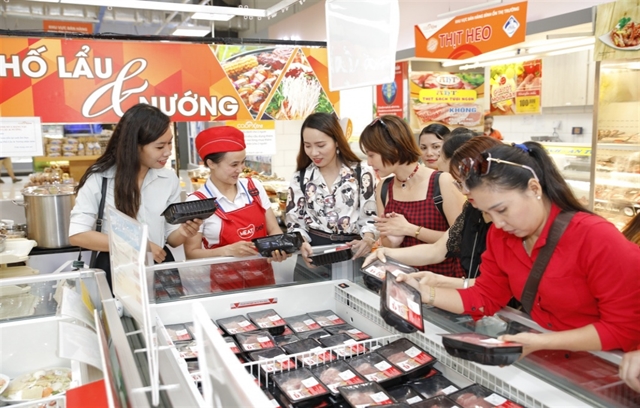
Companies such as Masan Group and Vingroup continue to face pressure from borrowing requirements and substantial investment needs.
While both groups own diverse business ecosystems and valuable assets, their financial performance remains closely tied to restructuring efforts and the successful execution of future growth plans.
Market capitalisation alone, therefore, does not necessarily determine a company's attractiveness to investors. While corporate fundamentals reflect underlying business quality, share prices often reflect investor expectations of future growth prospects.
In some cases, companies with strong financial positions have recorded relatively modest share-price gains, while others have posted significant increases driven largely by market expectations despite less pronounced improvements in operating results.
Among the VNĐ100 trillion group, FPT, Vietcombank and Techcombank are generally regarded as lower-risk investment options due to their strong balance sheets, stable earnings growth and relatively limited exposure to extraordinary risks.
However, these qualities are already reflected in their valuations, meaning investors are typically attracted to these stocks for sustainable long-term growth rather than expectations of rapid share-price appreciation.
For Hoa Phat and Vinhomes, the investment narrative remains closely linked to the broader economic cycle.
As public investment spending accelerates, steel demand rises and the real estate market recovers, both companies could enter a stronger growth phase. As a result, HPG and VHM are often viewed by investors as representative stocks of an economic recovery cycle.
Among the most closely watched stocks within the group are Vingroup and Masan.
For Vingroup, investor expectations are centred on the long-term potential of its ecosystem spanning real estate, industrial operations and electric vehicles.
Successful execution of its business plans could support further share-price gains, although such opportunities are accompanied by higher risks due to substantial capital requirements and reliance on long-term projects.
Masan presents a similar profile through its broad consumer ecosystem. The company's future share performance is expected to depend significantly on improvements in the operational efficiency of its WinCommerce retail network and efforts to optimise its financial structure. — BIZHUB/VNS