HCM City One Commune One Product makers eagerly await Tết bonanza
As the Lunar New Year approaches, HCM City cooperatives and businesses in the national One Commune One Product programme are entering their peak production period, with many scaling up output, upgrading packaging and expanding product lines to capture higher-value Tết demand.
HCM CITY — As the Lunar New Year approaches, HCM City cooperatives and businesses in the national One Commune One Product programme are entering their peak production period, with many scaling up output, upgrading packaging, and expanding product lines to capture higher-value Tết demand.
From processing facilities and agricultural growing areas to packaging workshops, operations are running at full capacity to meet year-end demand, reflecting a shift in the OCOP sector towards more professional production, branding and market positioning.
In recent years, demand for OCOP products during Tết has increased not only in volume but also expectations.
Consumers increasingly prioritise clear product origins, assured food safety standards and strong local identity, while paying closer attention to packaging suitable for gifting.
To meet these demands, OCOP producers have prepared early this year by securing raw materials, tweaking production plans, upgrading packaging, and diversifying product lines.
Across the city, workshops are operating at full speed.
At the Hải Đăng Pure Anchovy Fish Sauce Cooperative in Phước Thắng Ward, members are busy bottling traditional fish sauce to fulfil Tết orders.
The cooperative’s three-star OCOP product is made from freshly caught anchovies, naturally fermented with salt for a full year and filtered through multiple stages before being bottled.
According to Lê Viết Hùng, chairman of the cooperative’s board of directors, more than 5,000 litres of fish sauce in various bottle sizes are expected to be supplied during the Tết peak.
Alongside preserving traditional quality standards, the cooperative has invested in improved labels and packaging to raise product value and meet festive-season consumer expectations.
Strong growth has also been recorded among processed agricultural products.
At the cocoa processing facility operated by OCA Việt-Nhật Co., Ltd. in Bình Giã Commune, production lines have been running extended shifts to handle a sharp rise in orders.
Sales of chocolate, cocoa powder, cocoa wine, and Tết gift products have increased by more than 50 per cent from normal days.
Nguyễn Thị Thu Hồng, a manager at the company, said that, in addition to its core product range, the firm has introduced new chocolate varieties that contain nuts, cereals, fruits, and coffee.
Premium Tết gift sets with refined designs and festive colours have been a key focus.
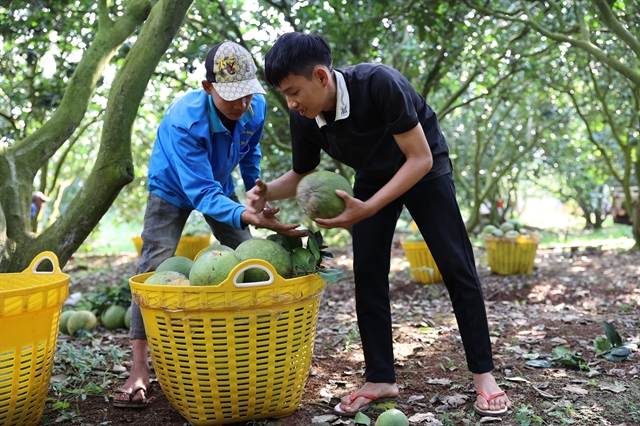
The Sông Xoài green-skin pomelo cooperative in Tân Thành Ward is also in its peak harvest season.
Trucks carrying freshly harvested pomelos arrive continuously at the cooperative for grading, processing and packaging before delivery to partners.
Hồ Hoàng Kha, its director, said around 200 tonnes of the fruit are being prepared for the Tết market this year.
Beyond fresh fruit, the cooperative has expanded into deep processing, offering products such as fermented pomelo, dried peel and flower tea and essential oil made from the fruit.
Packaged into Tết gift hampers, these products offer consumers more choice while sharply raising the economic value of the fruit.
According to the city Department of Agriculture and Environment, the OCOP programme has played a key role in building strong brands for local speciality products.
During Tết, when demand rises sharply, businesses and cooperatives show greater flexibility in production planning, stronger raw material management and closer alignment with consumer preferences.
HCM City has 1,006 OCOP products, including 786 with three stars and 220 with four stars, developed by 416 participating entities.
They are mostly in sectors such as food, beverages, handicrafts, ornamental plants, and medicinal products.
This provides a solid base for OCOP items to expand market presence and strengthen their place in both modern and traditional distribution channels.
Vũ Ngọc Đăng, head of the city’s rural development sub-department, said many OCOP products combine high quality with professional design, reflecting their local cultural identity.
OCOP producers are increasingly adopting sustainable approaches and meeting higher market standards while supporting the national campaign encouraging Vietnamese consumers to prioritise domestically made goods.
Beyond just causing a seasonal sales surge, the Tết period highlights the OCOP programme’s growing role in strengthening value chains, supporting rural incomes and anchoring local products more firmly in the market. — VNS