HCM City businesses urged to strengthen legal safeguards in digital trade: conference
Digital transformation is reshaping the way businesses negotiate, conclude and perform goods trading contracts, but enterprises need stronger legal and data-management safeguards to minimise risks arising from electronic transactions.
HCM CITY — Digital transformation is reshaping the way businesses negotiate, conclude and perform goods trading contracts, but enterprises need stronger legal and data-management safeguards to minimise risks arising from electronic transactions, experts said at a conference in HCM City on Wednesday.
The conference, themed “Digital Transformation in Goods Trading: From Partial to Comprehensive”, was jointly organised by the Investment and Trade Promotion Centre of HCM City (ITPC) and the Vietnam International Arbitration Centre (VIAC) as part of the HCM City Legal Management Series 2026 (LMS 2026). It attracted more than 200 representatives from businesses, law firms and other organisations.
The event took place as Việt Nam accelerates implementation of Resolution No. 57-NQ/TW on breakthroughs in science, technology, innovation and national digital transformation, which identifies science, technology and digital transformation as key drivers of development.
For businesses, the policy backdrop underscores the need to adopt digital tools while strengthening legal governance and risk management.
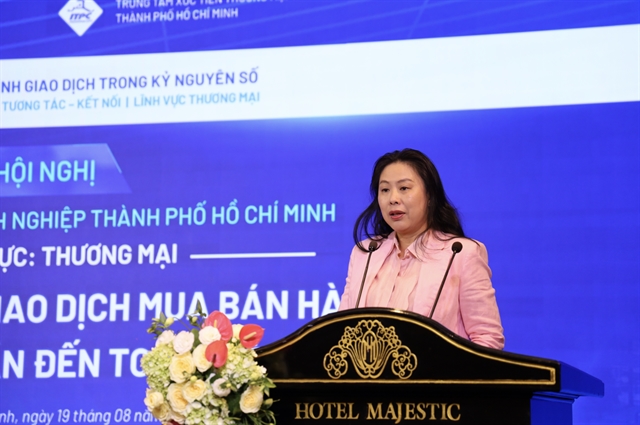
Speaking at the opening, Hồ Thị Quyên, deputy director of ITPC, said 2026 marked an important turning point for digital commerce, as businesses were moving from simply digitising individual processes towards building interconnected and intelligent commercial ecosystems.
The trend could help enterprises improve competitiveness, optimise costs and reach customers, particularly SMEs. However, businesses must also address challenges involving technological infrastructure, human resources, fraud, data protection and cybersecurity.
Châu Việt Bắc, deputy director of the VIAC HCM City Branch, said digital transformation in goods trading had become inevitable, but differences in technological infrastructure and operating strategies among enterprises could create risks both during contract performance and when disputes arose.
Drawing on VIAC's experience, he urged businesses to pay attention to legal issues from the contract negotiation stage and proactively store and manage data throughout the transaction process to identify risks early and avoid being placed at a disadvantage in disputes.
Nguyễn Xuân Minh, permanent deputy director of Foreign Trade University’s HCM City campus and a VIAC arbitrator, said digital transformation over the past decade had changed how businesses found partners, negotiated and performed goods trading contracts and resolved disputes.
Traditional paperwork was increasingly being replaced by digital platforms and data, while AI, smart contracts and blockchain were supporting automation, contract management and transaction authentication.
Electronic documents and interconnected digital ecosystems were also helping reduce manual processing, shorten transaction times and improve transparency.
However, technological development could outpace legal frameworks and corporate governance capabilities. Many disputes were not caused by technology itself, but by inadequate legal governance, making it difficult to determine authority, ensure data integrity or prove transactions.
Minh said businesses therefore needed comprehensive governance procedures from the outset, ensuring technology, management and legal requirements were developed together.
The first discussion session focused on changes in goods trading models amid digitalisation.
Vũ Lê Bằng, managing lawyer at Nishimura & Asahi Vietnam and a VIAC arbitrator, said global B2B e-commerce revenue reached about US$28 trillion across 45 economies in 2024.
In Việt Nam, digital transformation was also being promoted, with a target for all businesses to use electronic contract platforms by 2030.
Experts noted that partially electronic transactions remained common because businesses had different levels of resources and technological readiness. However, such hybrid models could complicate governance, particularly regarding the boundary between automation and human responsibility.
Lưu Xuân Vĩnh, founding and managing lawyer at Asia Legal and a VIAC arbitrator, said full electronicisation was inevitable and businesses should prepare early by strengthening infrastructure and anticipating risks.
Electronic contracts could face closer scrutiny regarding legal validity and evidentiary value, while data managed by third-party service providers presented additional risks.
The second session examined risks in disputes involving electronic transactions.
Vũ Xuân Hưng, head of the Legal Department of VCCI-HCM, said disputes could arise over the time and place of contract formation, the authority of signatories or inconsistencies between transaction platforms.
He said businesses should not simply transfer traditional transactions into the digital environment, but redesign procedures to prevent disputes, with four key safeguards: regulations, technological tools, data storage and dispute-resolution solutions.
Nguyễn Công Phú, a member lawyer at LNT & Partners and VIAC arbitrator, stressed that electronic evidence should be systematically preserved from the beginning of contract performance.
Such evidence was not automatically accepted in dispute proceedings. Its value depended on how data was created, sent, received and stored and whether it met legal requirements.
The conference concluded with exchanges between experts and businesses on practical situations, helping enterprises better identify risks and prepare for safer, more comprehensive digital transformation in commercial transactions. — VNS