Hải Phòng charts bold new vision as Free Trade Zone ushers in a new era of growth
Local leaders said this pioneering model in northern Việt Nam would redefine investment, logistics and institutional reform for years to come.

HẢI PHÒNG — Hải Phòng’s ambition to position itself as a gateway of global commerce took centre stage on Thursday as the city unveiled its comprehensive vision for the newly established Hải Phòng Free Trade Zone (FTZ).
Local leaders said this pioneering model in northern Việt Nam would redefine investment, logistics and institutional reform for years to come.
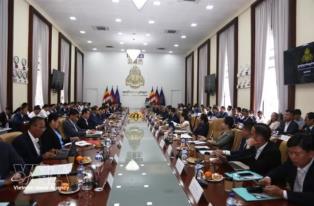
Speaking at the investment promotion conference titled 'Hải Phòng Free Trade Zone – The Destination of a New Era', Deputy Chairman of the Hải Phòng People’s Committee Lê Trung Kiên said the FTZ marked not only a milestone of pride but also “a major responsibility entrusted by the Central Government,” reflecting the trust placed in the port city at a moment of strong economic momentum.
With the country’s third-largest economic scale and 11 consecutive years of double-digit growth, Hải Phòng has become a magnet for domestic and foreign investors, yet continues to seek breakthrough models that expand its development space.
According to Kiên, the city’s new FTZ is more than a new designation – it represents “a new mindset in economic governance", built upon successful international experience and tailored to Hải Phòng’s distinct advantages as a port, industrial and logistics hub.
He stressed that the FTZ would create a transparent legal corridor that allows goods to move with maximum ease while helping businesses address complex global supply chain challenges.
Kiên said: “Instead of relying solely on tax incentives, Hải Phòng commits to building an investment environment where administrative procedures are minimised and investors’ rights are protected by the superior mechanisms approved by the National Assembly and the city People’s Council. Most importantly, it is a commitment that the city government will always accompany businesses, ready to change to serve their development.”
The Resolution No 226/2025/QH15 was described by officials as the “golden institutional framework” that enables Hải Phòng to make a decisive leap.
Representatives from the Ministry of Finance noted that the resolution provides the basis for continued refinement of legal, tax, customs and international trade governance mechanisms required to operate a modern FTZ, forming what they called an unprecedented incentive system for Việt Nam.
The FTZ, they added, is a strategic direction that elevates both Việt Nam’s and Hải Phòng’s position in regional and global value chains.
Phạm Văn Thép, head of the Hải Phòng Economic Zone Authority, underscored the strategic nature of the FTZ’s 6,292-hectare layout across three non-contiguous but interconnected sites linked to the Đình Vũ–Cát Hải and Nam Hải Phòng coastal economic zones.
The placement, he said, had been carefully studied to maximise advantages in existing and planned industrial and transport infrastructure, creating a flexible and adaptive FTZ capable of shaping new development dynamics for the entire region.
The conference drew nearly 150 participants, including major domestic and international investors. Nguyễn Anh Tuấn, deputy director general of the Ministry of Finance’s Foreign Investment Agency, emphasised Hải Phòng’s role as one of Việt Nam’s most important FDI destinations with cumulative registered capital exceeding US$50 billion from 50 countries and territories.
He noted that the city is no longer just a strong FDI magnet but “a leading engine of growth,” anchoring the industrial and logistics landscape of northern Việt Nam.
Discussions throughout the event converged on three core messages and three essential requirements for sustainable FTZ development: the need for Hải Phòng to transition from industrialisation to the internationalisation of trade and logistics; the importance of integrating the FTZ into broader national institutional and infrastructure reforms; and the necessity for the FTZ to play a leading role across the coastal northern region and the Lạng Sơn–Hà Nội–Hải Phòng economic corridor.
Experts also stressed the importance of green standards, international best practices, digitalisation, clean energy, modern logistics, and deeper cooperation in high-tech components, electronics, materials manufacturing, port logistics and supporting industries.
Bruno Jaspaert, chairman of EuroCham Việt Nam, said Hải Phòng held “the core advantages to pioneer a next-generation FTZ model,” citing deep-sea port capabilities, expressway and rail connectivity with Europe and China, and strong global supply chain linkages.
Existing European investors, he noted, had already contributed $28 billion and stood ready to expand if the FTZ aligns fully with EU-compatible standards. EuroCham recommended that the city develop a transparent, modern FTZ Information Gateway, offering real-time insights on permit status, customs flows, environmental data and investor obligations.
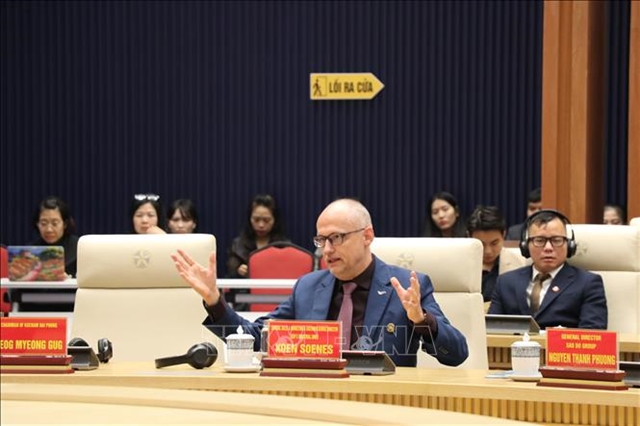
Industry leaders expressed similar confidence.
Koen Soenens, Sales and Marketing Director of DEEP C Industrial Zones, affirmed that DEEP C would “build the operating ecosystem for the FTZ” and stands ready to serve as its implementation arm.
He described the FTZ as “a promise that Hải Phòng will continue rising as an industrial and logistics centre of northern Việt Nam,” adding that clarity, co-ordination and consistency would be key to transforming the FTZ into “a destination that investors simply cannot overlook.”
Concluding the event, Vice Chairman Kiên said Hải Phòng wished to send three clear messages to the investor community. First, the legal foundation is now complete and coherent, with all preferential tax mechanisms, shortened land procedures, direct financial support packages for workforce training and R&D, and other incentives already codified and immediately enforceable.
“The FTZ is no longer an idea on paper,” he said.
Second, infrastructure is ready, with one of the FTZ’s sites equipped to receive investors immediately and others advancing on schedule to meet the long-term development needs of both the city and the wider region, supported by an integrated network of seaport, airport, expressways and future international railway connections.
Third, the city is determined to reform its management mindset, shifting decisively from a model of “control and permission” to one of “service and facilitation,” ensuring that any bottlenecks faced by investors will be resolved with the highest responsibility, fastest timelines and fewest intermediaries.
As Hải Phòng prepares to implement the FTZ, the city is signalling a profound transformation in both governance and economic ambition – one rooted in openness, institutional innovation and deepening global integration.
The FTZ, officials said, will not only usher in a new era of trade freedom and advanced logistics but also reaffirm Hải Phòng’s aspiration to become one of Asia’s most dynamic industrial and commercial centres. — VNS