Hà Nội promotes connection between SMEs with large firms in supply chain
Hà Nội is pushing deeper links between major corporations and SMEs to strengthen supply chains, boost autonomy and drive sustainable growth as global competition and restructuring intensify.

HÀ NỘI — Hà Nội is accelerating a partnership model between large enterprises and small- and medium-sized enterprises (SMEs) to expand production capacity and enhance supply autonomy for sustainable economic development.
A seminar on linking SMEs with large enterprises to create breakthroughs in supply chain for Hà Nội’s sustainable development was held on December 4 by the Hà Nội Department of Finance in coordination with the Vietnam Association of Foreign-Invested Enterprises (VAFIE).
This event attracted more than 150 delegates from ministries, local authorities, business associations and enterprises to discuss the collaborative models.
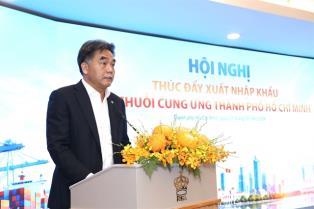
In his opening speech, Mai Công Quyền, deputy director of Hà Nội's Department of Finance, emphasised three major resolutions of the Politburo issued during 2019-25 that lay the strategic foundation for socio-economic development.
These include Resolution 50 on enhancing the quality of foreign investment attraction associated with innovation-based growth; Resolution 59 on international integration centering businesses as the main drivers of digital and circular economic transformation; and Resolution 68 on developing the private economic sector.
From these directions, Hà Nội has identified several development pillars for the new phase: green transition combined with digital transformation and circular economic models; modern and synchronised infrastructure; digital economy and smart urban development; and science–technology–innovation. Of which, Quyền stressed the crucial role of SMEs.
With 422,212 registered businesses accounting for 23 per cent of the national total, Hà Nội possesses the largest business ecosystem in Việt Nam. About 223,580 units out of the figure are under operation.
SMEs make up 98.2 per cent of all enterprises, employ 55.1 per cent of the workforce and contribute over 40 per cent of the city’s GRDP. This sector is increasingly affirming its role as a pillar of the capital’s economic growth.
Therefore, according to Quyền, SMEs need substantial support to integrate deeper into major supply chains.
In a global context marked by ongoing economic volatility, increasing competition and expanded restructuring of supply chains, Hà Nội must develop partnership models between large enterprises and SMEs.
Such linkages enable SMEs to access markets, technologies and management systems, while allowing large enterprises to secure more stable supply sources and expand their ecosystems.
The seminar had a discussion session with paticipantion of Nguyễn Anh Tuấn, deputy director of the Foreign Investment Agency; Dr Nguyễn Anh Tuấn, chairman of VAFIE; Mạc Quốc Anh, vice chairman and secretary-general of the Hà Nội Small and Medium-sized Enterprise Association; Nguyễn Đức Minh, vice chairman of the Hà Nội Association of Main Industries (HAMI) and CEO of Nutricare; along with leaders of associations, experts and business representatives.
Speakers emphasised the need to restructure cooperation models so that large enterprises take on a leading role, forming internationally standardised, interconnected ecosystems.
As global supply chains undergo major adjustments, building autonomous, flexible and competitive supply chains is essential for sustaining growth.
According to them, SMEs must rapidly standardise governance capacity, improve product quality, accelerate digital transformation and meet the requirements of major corporations. This challenge also presents an opportunity for Vietnamese enterprises to upgrade their position in the era of global integration.
Mạc Quốc Anh from the Hà Nội Small and Medium-sized Enterprise Association said that partnership models should be developed professionally, particularly through building industry clusters and standardised systems that meet the expectations of FDI enterprises and multinational corporations.
Once unified standards are established, SMEs will gain broader market access, while large enterprises will benefit from stable supply sources and reduced long-term production costs.
The speakers agreed that the Government plays a constructive role by creating a transparent, stable and predictable legal environment that fosters business confidence.
Large enterprises should act as leaders, while SMEs must proactively upgrade their competitiveness. When these three actors work cohesively, modern, autonomous and resilient supply chains will be formed, elevating regional competitiveness.
At the event, Trần Thị Ngọc Dung, director of Gia Bảo Import-Export Co, Ltd, proposed several recommendations to help SMEs expand their supply chain participation, highlighting the need for stronger access to information, improved financial capacity and high-quality human resource training.
The seminar took place as Hà Nội intensifies efforts to recover and accelerate economic growth post-pandemic while continuing to refine its investment environment toward transparency, efficiency and sustainability.
The city maintains regular dialogue with businesses to listen to challenges, remove obstacles and build trust, thereby stimulating collaborative programmes.
At the end of the seminar, the Hà Nội Department of Finance's representative reaffirmed its commitment to supporting the business community in policy development, implementation and problem-solving.
Strengthening ties between large enterprises and SMEs is viewed as a central solution for creating breakthroughs in the capital’s supply chain, contributing to fast and sustainable growth in the future. — VNS