Hà Nội eyes turning Hoà Lạc into Việt Nam’s Silicon Valley
The ambition reflects the city’s vision to nurture world-class research, high-tech manufacturing and a thriving startup ecosystem capable of powering long-term growth.
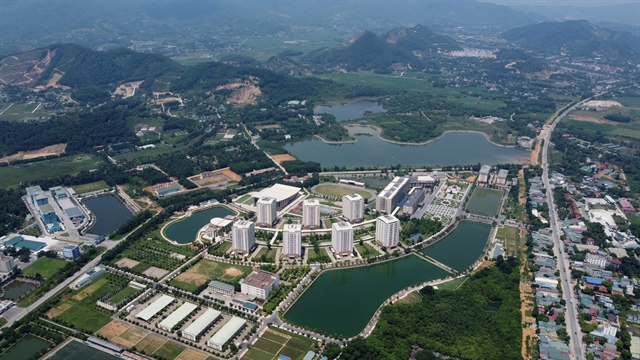
Hà Nội is stepping up efforts to turn the Hoà Lạc Hi-tech Park on the city’s western edge into a national centre for technology and innovation – a strategic bid to build Việt Nam’s own “Silicon Valley” and drive the next wave of socio-economic transformation.
The ambition reflects the city’s vision to nurture world-class research, high-tech manufacturing and a thriving startup ecosystem capable of powering long-term growth.
Vũ Xuân Hùng, head of the Hà Nội Hi-tech and Industrial Park Management Board, said that Hoà Lạc had been positioned as a core science and technology hub under major national strategies, including Resolutions 57 and 15 of the Communist Party of Việt Nam as well as the revised Law on the Capital.
Established in 1998 as Việt Nam’s first high-tech park, Hoà Lạc currently hosts 109 projects with a total registered capital of around VNĐ116 trillion (US$5 billion) from domestic and global tech companies such as Viettel, FPT, Vingroup, VNPT, Nidec and Hanwha Aerospace together with key institutions and universities such as the Vietnam-Korea Institute of Science and Technology (VKIST), the National Innovation Centre (NIC), the Vietnam Space Centre, and FPT University.
However, Hoà Lạc has yet to reach its full potential, according to Hùng. There are just around 80 laboratories while the social and technical infrastructure and transport connectivity remain insufficient to attract investors and talent.
The biggest difficulty is building a compatible ecosystem from research and development to production, while the linkage between universities, research institutes and businesses remains fragmented.
Drawing lessons from the US’ Silicon Valley, Chinese Taipei’s Hsinchu Science Park and China’s Zhongguancun, Bkav chief executive Nguyễn Tử Quảng said successful technology parks would require strong leadership, a world-class technical university, home-grown leading firms and a well-functioning venture capital system.
Quảng said Hoà Lạc lacked a close link with a large-scale technical university. The park also needed to enhance links with inner-city innovation areas in order to form a model smart city and create continuous urban innovation space.
Attracting talent and capital
Dương Kiều Oanh from FPT Software, which saw its workforce in Hoà Lạc grow from 1,500 employees a decade ago to nearly 6,000 today, said that the park needed to improve infrastructure and policies to attract talent, including incentives for high-tech professionals and housing finance mechanisms.
She proposed that expenses in R&D be recognised as legitimate costs to create a framework that allows research teams to experiment and take risks. More importantly, it was necessary to have large-scale national-level challenge projects to attract top talent.
Hoà Lạc has significant potential to become the core of the capital city’s digital transformation with an infrastructure system including a Uptime Tier III data centre and the readiness of cloud computing, AI, Big Data, IoT and Blockchain, according to Nguyễn Duy Nhân, deputy director of VNPT Hà Nội.
However, there are gaps in 4G and 5G coverage and a shortage of space for BTS installations and a lack of telecommunications infrastructure planning.
He urged faster deployment of shared telecom infrastructure and pilot regulatory sandboxes for 6G technologies in Hoà Lạc together with the development of a smart management system for the entire park.
Experts say Hoà Lạc needs strong incentives, including preferential corporate tax for technology firms, import tax exemptions for R&D equipment, long-term credit incentives, personal income tax incentives for R&D personnel and preferential housing policies for talent to better attract investment.
Strategic master plan
Trương Việt Dũng, deputy chairman of Hà Nội People’s Committee (the municipal government) said that a master plan for Hoà Lạc Hi-tech Park development to 2030 with a vision to 2045 was being finalised.
Hà Nội aims to build Hoà Lạc into the country’s leading centre for innovation, research and development and high-tech manufacturing, according to Dũng.
The plan will focus on developing strategic solutions to accelerate infrastructure development and improve transport connectivity with priorities such as ensuring the supply and quality of clean electricity, clean water, telecommunications, internet, and essential services.
But Hoà Lạc will be selective in investment attraction, targeting core technologies while developing a robust innovation ecosystem and crafting breakthrough policies on income, housing, taxation, insurance and visas for experts together with incentives for R&D, data centres and pilot technology sandbox models.
Administrative reforms will also be enhanced with maximum decentralisation to ensure a transparent, convenient and efficient investment environment to attract talent.
“The aspiration to build Việt Nam’s 'Silicon Valley' is being translated into concrete steps,” Dũng said, urging businesses, universities, research institutions and intellectuals to join hands. The city pledged to create the most favourable conditions for every high-tech project in Hoà Lạc.
“Hoà Lạc is well positioned to rise to leading global models if institutions are opened up, infrastructure is improved, top talent is attracted and the innovation ecosystem is properly nurtured,” Dũng said.
In 2026, Hà Nội plans to allocate about 4 per cent of its budget to science, technology, innovation, and digital transformation, higher than the national average of 3 per cent and equivalent to VNĐ9.088 trillion (US$345 million).
Former Minister of Science and Technology Nguyễn Quân said the lack of a venture capital fund remained one of the biggest barriers to the startup ecosystem.
In that context, Hà Nội’s move to pioneer a venture capital fund would send a positive signal, expected to enable Hoà Lạc to nurture a complete innovation ecosystem, Quân said. VNS