Hà Nội apartment market sees record supply, clear price difference
Despite the sharp increase in supply, demand remained resilient. Total apartment sales in the fourth quarter exceeded 13,500 units, lifting full-year transactions to 34,760 units.
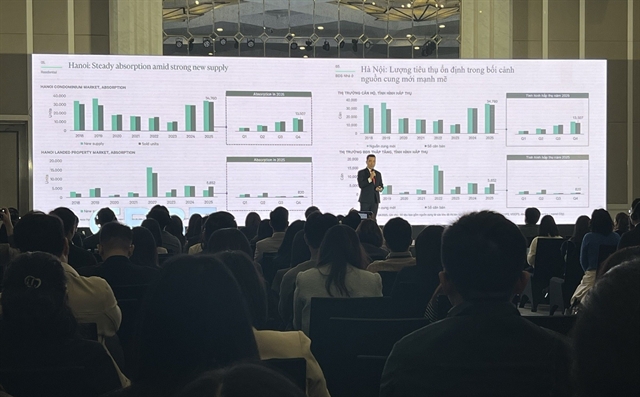
HÀ NỘI — Hà Nội’s residential property market last year saw a surge in new supply, while apartment prices showed increasingly clear differences between inner-city areas and neighbouring suburban zones, according to CBRE’s latest market report.
In the fourth quarter of 2025, Hà Nội recorded 14,905 newly launched apartments, bringing total new supply for the year to nearly 36,000 units.
This marked the second-highest annual launch volume ever in the capital's apartment market, surpassed only by 2019, Võ Huỳnh Tuấn Kiệt, director of residential at CBRE Việt Nam told CBRE Vietnam's conference on real estate market outlook held in Hà Nội on Wednesday.
Notably, 2025 also set a record for the number of newly launched apartments priced above VNĐ120 million per sq.m (excluding VAT, maintenance fees and before discounts), with nearly 4,000 units, accounting for 11 per cent of total launches during the year.
Another prominent trend observed in the final quarter of 2025 was the significant contribution of large-scale township developments in Văn Giang, Hưng Yên Province in the proximity of Hà Nội.
New launches in this area accounted for more than 60 per cent of total market supply in the last quarter and nearly 40 per cent of Hà Nội’s total new supply for the full year.
Despite the sharp increase in supply, demand remained resilient. Total apartment sales in the fourth quarter exceeded 13,500 units, lifting full-year transactions to 34,760 units.
Newly launched projects in the final quarter achieved an average absorption rate of 79 per cent. This figure was slightly lower than the previous quarter, but it continued to reflect the primary market’s solid absorption capacity amid abundant new supply.
Price movements highlighted clear divergence between inner-city and suburban areas. The average primary selling price across the market in the last quarter of 2025 reached over VNĐ78 million per sq.m (excluding VAT, maintenance fees and before discounts), down 14 per cent quarter-on-quarter but still 8 per cent higher year-on-year.
This decline was largely driven by a substantial volume of suburban supply priced at VNĐ50-60 million per sq.m. Meanwhile, newly launched projects in Hà Nội’s inner districts continued to command prices ranging from VNĐ90-100 million per sq.m.
In the secondary market, the average resale price in the fourth quarter stood at VNĐ62 million per sq.m, remaining nearly unchanged from the third quarter. Year-on-year growth slowed to 24 per cent, down from the peak of 26 per cent recorded in the third quarter.
This cooling trend toward year-end was attributed to several factors, including the sharp price increases in previous quarters, the strong pull of abundant primary supply on buyer capital, and the initial reaction of buyer sentiment to rising interest rates.
Looking ahead to 2026, Hà Nội’s apartment market is expected to see about 33,000 new units launched - nearly on par with 2025.
Primary prices are anticipated to be moderated by a combination of strong supply, competitive pricing from projects in Văn Giang, and the continued introduction of high-priced projects in inner-city areas.
Meanwhile, secondary market prices may face pressure amid rising interest rates and a substantial pipeline of future supply.
Nguyễn Hoài An, senior director of CBRE Vietnam’s Hà Nội branch, said: "Infrastructure development, especially transportation infrastructure, continues to be a key driver for new real estate projects, including many large-scale developments.
"In a macroeconomic environment and competitive landscape that are constantly evolving, developers are expected to prepare thoroughly in the investment stage to ensure appropriate financial, business and product strategies, enabling effective adaptation to each phase of market volatility.”
Landed property segment
Meanwhile, in 2026, Hà Nội’s land property market is forecast to welcome approximately 6,600 newly launched units. Supply is expected to be more diversified, encompassing projects in both inner-city and suburban areas, developed by both domestic and foreign investors.
The growing presence of foreign developers is anticipated to push up primary market prices. Meanwhile, movements in the secondary market will continue to be closely linked to interest rate trends, broader macroeconomic conditions, and the progress of key infrastructure projects connecting the city centre with satellite urban areas.
According to the CBRE Việt Nam, in the last quarter of 2025, new supply of this segment in Hà Nội reached 654 units. For the full year, total new supply exceeded 3,800 units. This figure represented a 40 per cent decline compared to 2024, but it still reflected a relatively healthy annual launch volume for the Hà Nội market.
The market recorded stable liquidity in the final quarter, with 820 units sold. This brought total transactions in 2025 to 5,852 units - exceeding the number of newly launched units during the year.
The participation of foreign developers such as CapitaLand in the low-rise residential segment attracted strong buyer interest and intensified competition.
Substantial supply in suburban areas exerted downward pressure on prices. By the end of the last quarter, the average primary price for landed properties stood at VNĐ187 million per sq.m of land (including construction costs, but excluding VAT, maintenance fees and before discounts).
This level remained stable quarter-on-quarter but declined 15 per cent year-on-year, mainly due to the dominance of suburban primary inventory throughout 2025.
In the secondary market, prices remained largely flat in the fourth quarter, averaging VNĐ201 million per sq.m of land.
Buyers became more cautious amid rising interest rates and weighed their options against upcoming primary supply from large-scale township projects. VNS