Green transition seen as critical risk management imperative
As global Environmental, Social and Governance (ESG) regulations enter a peak enforcement phase, particularly from 2026 onwards, the key question for the Vietnamese business community is no longer whether to go green, but how to do so without undermining financial viability, speakers said at a conference in HCM City on January 22.
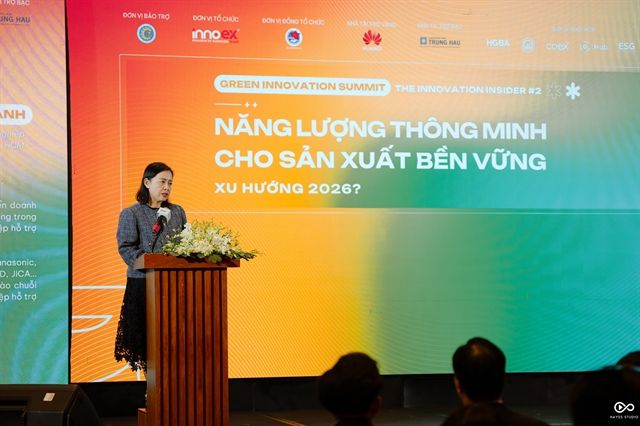
HCM CITY — As global Environmental, Social and Governance (ESG) regulations enter a peak enforcement phase, particularly from 2026 onwards, the key question for the Vietnamese business community is no longer whether to go green, but how to do so without undermining financial viability, speakers said at a conference in HCM City on January 22.
Speaking at the Green Innovation Summit – The Innovation Insider #2, themed “Smart Energy for Sustainable Manufacturing: Trends for 2026,” Lê Nguyễn Duy Oanh, Deputy Director of the Centre for Supporting Industry Development under the HCM City Department of Industry and Trade, said Việt Nam is undergoing a profound transformation of its growth model.
To achieve a sustainable green transition, she highlighted three key pillars: institutions and policies, including the completion of legal frameworks and regulatory sandboxes; green energy technologies and infrastructure, such as renewable energy, energy storage, and core technologies; and human resources and international cooperation, focusing on developing talent for green and digital transformation, attracting experts, and strengthening international partnerships.
However, she acknowledged that businesses, particularly manufacturers and firms operating in industrial parks, face numerous practical concerns. These include whether emissions reduction can truly optimise costs, where companies should begin to avoid overstretching resources, which low-emissions manufacturing models are most suitable for Vietnamese enterprises, and whether smart energy solutions can deliver clear and timely returns for factory operations.
“As a major industrial and services hub, HCM City has a diverse network of export processing zones, industrial parks and industrial clusters. The transition towards green, smart, and sustainable industry is therefore seen as an inevitable path to maintaining the city’s role as a national economic engine, while aligning with the country’s green growth goals,” she said.
“Energy transition and sustainable manufacturing are long-term journeys that cannot be completed overnight. Yet without starting today, businesses will struggle to meet the requirements of 2026 and beyond,” she added.
From an international market perspective, Phạm Thị Ngọc Thuỷ, Chief of the Office of the Private Economic Development Research Board (Board IV), said 2026 will mark a clear point of differentiation among enterprises in global supply chains. With mechanisms such as the Carbon Border Adjustment Mechanism (CBAM) and Digital Product Passports (DPP) being rolled out simultaneously, companies will have little room left to delay action.
She noted that Việt Nam still has a carbon intensity per unit of GDP higher than the average among middle-income countries. Without early preparation in carbon data, measurement systems, and ESG governance, businesses will not only face higher tax burdens but also risk exclusion from global supply chains. Green transition is no longer a matter of branding or communications, but one of survival and risk management.
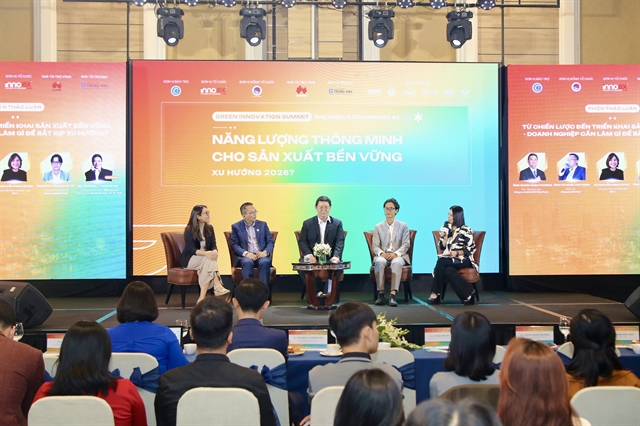
The panel discussion, moderated by Trương Lý Hoàng Phi, Chairwoman and CEO of IBP & InnoEx, brought the debate back to a central question: does green transition deliver tangible economic benefits?
Kingspan Vietnam emerged as a notable example of a “green for growth” approach. Rather than treating sustainability as a compliance cost, the company invested in a green manufacturing facility at Phú Mỹ Industrial Park – the group’s first newly built factory in Asia to achieve LEED Platinum v4 certification. By adopting Huawei FusionSolar solutions, Kingspan Vietnam not only pioneered green manufacturing practices domestically but also achieved strong financial results, including annual electricity savings of more than VNĐ2 billion and a solar system payback period of around six years.
From a broader infrastructure perspective, Giang Ngọc Phương, Deputy General-Director of Hiệp Phước Industrial Park JSC in HCM City, said green transition has become a race for survival under mounting pressure from European and US markets. Capital constraints should not be an excuse for inaction.
At Hiệp Phước Industrial Park, where 74 per cent of enterprises are ready to embrace green transition, businesses have achieved electricity savings of up to 35 per cent by focusing on lean operational management and optimising core systems such as boilers and internal power networks. This underscores a practical lesson: start with management thinking before investing in costly technologies, he said.
A representative from Huawei Digital Power Vietnam said smart energy represents the most critical intersection between sustainability goals and business efficiency.
Rather than viewing green energy as a major upfront cost, companies are increasingly treating it as a long-term cost management tool from cutting electricity bills and improving cash flow to mitigating energy risks amidst volatile power prices and tightening emissions requirements. When return-on-investment calculations are clearly defined, green transition becomes not a burden, but a competitive advantage, he said.
The Green Innovation Summit – The Innovation Insider is a specialised event series focusing on green innovation trends and solutions for Vietnamese businesses. — VNS