Green credit is lever for agricultural transformation
Green credit is increasingly seen as an inevitable trend to support sustainable growth in the agriculture sector, yet its scale in Việt Nam remains modest compared with overall credit in the economy.
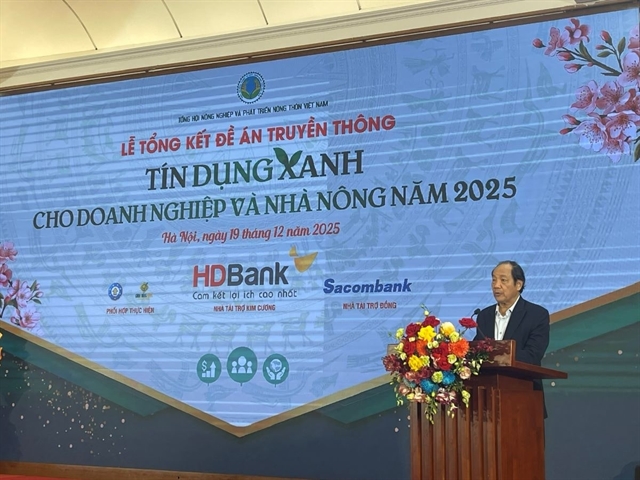
HÀ NỘI — As Việt Nam accelerates green growth and advances its net zero commitments, the dissemination of green credit policies is enabling businesses and farmers to better access preferential financing, thereby enhancing the competitiveness of Vietnamese agricultural products.
Experts made the remarks at a workshop on green credit for businesses and farmers held on December 19 in Hà Nội by the Vietnam General Council of Agriculture and Rural Development.
On this occasion, the general council also reviewed results of its communication project on green credit for businesses and farmers this year.
Agriculture is one of the sectors most heavily affected by climate change, while also holding strong potential for emissions reduction, circular economy development, and sustainable value creation.
Access to finance - particularly green credit - is a decisive factor in ensuring a meaningful green transition, according to the experts.
Through communication campaigns, surveys, training programmes, and experience-sharing activities, the communication project has reached hundreds of enterprises, cooperatives, and farming households nationwide.
Awareness of green, clean, circular, and organic production models, as well as climate change adaptation and sustainable development, has improved significantly.
Green credit policies from the State and banking system have also been more widely disseminated, contributing to positive momentum for green agriculture and emissions reduction.
However, access to green credit remains challenging. Demand for capital for environmentally friendly and low-emission production continues to rise, while information gaps, weak linkages between banks and borrowers, limited ESG capacity among enterprises, and incomplete legal frameworks persist.
As of November 30, outstanding green credit across the banking system was estimated at around VNĐ750 trillion, accounting for approximately 4.5 per cent of total outstanding loans.
Although green credit has grown by more than 21 per cent annually on average since 2017, this figure remains below the targets set under the National Green Growth Strategy for 2021–2030, with a vision to 2050.
Small and medium-sized enterprises face particular difficulties due to limited collateral, high transition costs, and long payback periods.
Experts stressed the need for the State to further refine policies and incentives to attract private investment into green projects, while improving transparency and financial stability.
According to the general council's chairman Hồ Xuân Hùng, the absence of a standardised national database on emissions and energy use makes it difficult for banks to assess green projects.
Existing incentives are also insufficient, as green loan interest rates are not significantly lower than conventional credit, reducing banks’ motivation to expand green lending.
From the enterprise side, limited ESG capacity remains a major bottleneck, especially for small and medium-sized firms lacking expertise and resources to meet ESG standards.
At the workshop, participants proposed key solutions, including building a national emissions and energy database, introducing stronger incentives beyond interest-rate subsidies, enhancing ESG capacity for enterprises, and aligning green bond regulations with international standards.
Sharing practical experiences, Trần Hoài Phương, director of HDBank's corporate customer division, said the bank had deployed large-scale green credit packages with competitive interest rates for infrastructure, digital technology, agriculture, import–export, and seasonal business activities, to support sustainable growth.
Sacombank has also launched its Sacombank Eco - a green finance package to support customers while promoting environmental protection. — BIZHUB/VNS