Food Bank Việt Nam, MM Mega Market partner for circular economy
Under the agreement, the two sides aim to build a "green-circular supermarket" model.
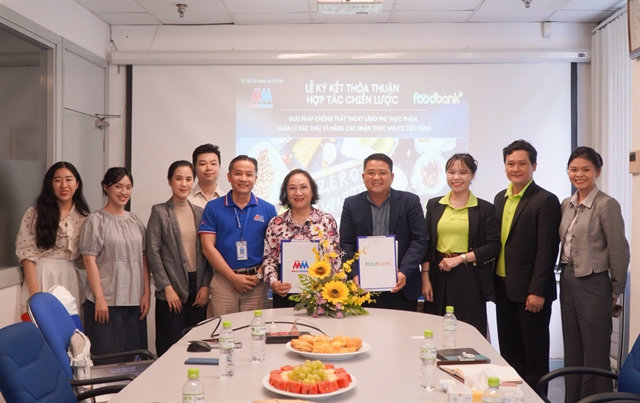
HCM CITY — Food Bank Việt Nam and MM Mega Market Việt Nam (MMVN) on May 26 signed a strategic partnership to reduce food loss and waste, while promoting a circular economy model in the domestic retail sector.
Under the agreement, the two sides aim to build a "green-circular supermarket" model.
Food waste and organic by-products from MMVN’s system will be collected, sorted, and converted by Food Bank Việt Nam into raw materials for community gardens and organic fertiliser production, following a transparent and traceable procedure.
The initiative is part of the Green Hero Solution project—a sustainable development campaign jointly implemented by Food Bank Việt Nam, the Youth Union of the Ministry of Agriculture and Rural Development, the Danish Embassy in Việt Nam, and other partners.
In its initial phase, the programme will be piloted at MM Mega Market Bình Phú in HCM City before being replicated nationwide.
Nguyễn Tuấn Khởi, chairman of Food Bank Việt Nam, said the project aimed to connect businesses and communities to build a complete circular loop, from collection and sorting to resource regeneration for agriculture.
"Reducing food loss and waste is an opportunity to build a more sustainable retail ecosystem.”
Trần Kim Nga, External Relations Director of MMVN, said the company had already implemented food waste classification at several branches since 2023, effectively managing over 500 tonnes of surplus food.
"This partnership allows us to further minimise environmental impacts in our supply chain, promote responsible consumption, and spread sustainable values to the community," she said.
Food loss and waste remain a critical challenge in Việt Nam, heavily impacting both the economy and the environment.
Recent reports indicate that the country wastes millions of tonnes of food annually, a significant portion of which originates from the retail and catering sectors.
In response, the Vietnamese Government has set ambitious targets to transition towards green agriculture and a circular economy, aiming for net-zero emissions by 2050.
Collaborative efforts between social organisations and major retailers are expected to play a pivotal role in achieving these national sustainability goals. — VNS