Flight delays rise as air traffic climbs in 2025
The main causes of delays were late aircraft arrivals and airline-related operational issues, alongside weather conditions, airport infrastructure constraints.
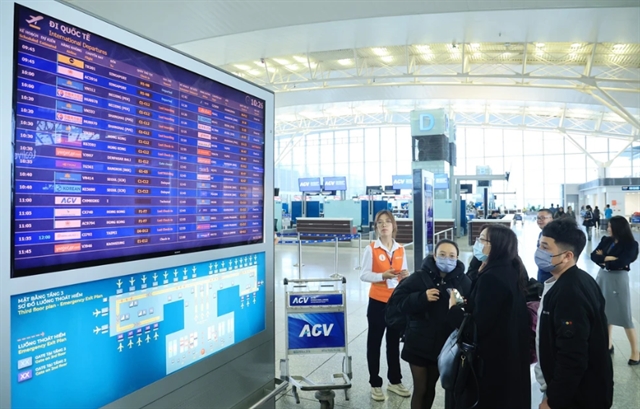
HÀ NỘI — Việt Nam’s airlines flew more passengers and cargo in 2025 but punctuality slipped sharply, underscoring the strain on a fast-growing aviation sector grappling with aircraft shortages and infrastructure limits.
On-time flight performance fell to 65.8 per cent last year, down 7.5 percentage points from 2024, despite a continued rise in air traffic, according to the Civil Aviation Authority of Việt Nam (CAAV).
CAAV statistics show Vietnamese carriers operated 275,246 flights in 2025, an increase of 22,566 flights year on year.
The authority said the main causes of delays were late aircraft arrivals and airline-related operational issues, along with weather conditions and airport infrastructure constraints.
Bamboo Airways led the industry in punctuality, with 83.2 per cent of its flights departing on schedule, although this still represented a slight year-on-year decline of 0.5 percentage points.
Flight cancellations also edged higher. A total of 1,740 flights were cancelled in 2025, equivalent to 0.6 per cent of total operations, up 0.2 percentage points from the previous year.
Bamboo Airways again recorded the strongest performance, with a cancellation rate of 0.2 per cent, or 24 flights.
Passenger and cargo volumes continued to rise, with 83.5 million passengers and 1.5 million tonnes of cargo handled last year, increases of 10.7 per cent and 18.5 per cent respectively.
Despite this expansion, the CAAV said the sector remains under pressure from aircraft shortages. As many as 28 aircraft were grounded due to engine shortages, accounting for 13.1 per cent of the commercial fleet of 213 aircraft.
The industry has also been affected by global political instability and military conflicts, which have disrupted aircraft parts supply chains.
Looking ahead, the CAAV said the aviation sector aims to carry 95 million passengers and 1.6 million tonnes of cargo in 2026, representing increases of 13 per cent and 15 per cent respectively.
The authority also plans to draft and submit five decrees and 10 circulars this year to guide the implementation of the 2025 Law on Civil Aviation, with the goal of aligning domestic regulations with International Civil Aviation Organization standards.
The domestic air route between Hà Nội and HCM City meanwhile remained one of the world’s busiest in 2025, ranking fourth globally, according to a recent report by aviation data firm OAG.
The route offered around 11 million seats last year, about 3.3 million fewer than the world’s busiest route. This was 4 per cent higher than in 2024 and around 8 per cent above the pre-pandemic levels in 2019.
OAG said the strong performance of the Hà Nội–HCM City route reflects robust travel demand between Việt Nam’s two largest economic centres.
Six airlines operate on the route, where average ticket prices fell by about 11 per cent to roughly US$67 for a one-way trip.
Globally, the Jeju–Seoul Gimpo route in the Republic of Korea remained the busiest, with 14.3 million seats in 2025, followed by domestic Japanese routes linking Tokyo Haneda with Sapporo and Fukuoka, each exceeding 11 million seats.
OAG said the Asia-Pacific region remained the most robust market, with nine of the world’s 10 busiest air routes located in the region. — VNS