Farmers build organic pepper brand in Đồng Nai
Pepper farmers in Đồng Nai Province are steadily shifting from conventional cultivation to organic and microbiological farming practices.
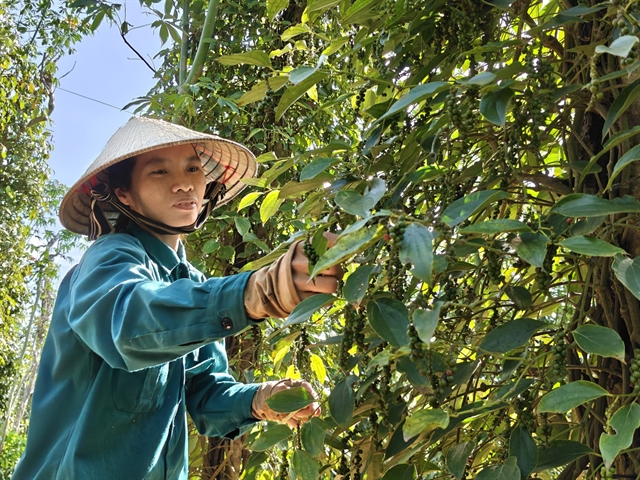
ĐỒNG NAI — Pepper farmers in Đồng Nai Province are steadily shifting from conventional cultivation to organic and microbiological farming practices.
This transformation, both in mindset and action, is not only enhancing the value of local agricultural products but also opening up a sustainable pathway to long-term prosperity.
In recent years, volatile market prices have tested the resilience of pepper growers.
However, for farmers like Lê Văn Đen in Tân Tiến Commune, perseverance and strategic adaptation have proven key.
Despite enduring periods when pepper prices plunged to record lows, forcing many growers to abandon their farms, Đen remained committed to his nearly 4,000 pepper pillars, many of which are over a decade old.
Initially reliant on chemical fertilisers, Đen gradually transitioned to organic farming as production costs rose and profits declined.
“Organic cultivation helps protect our health, improves soil quality, and significantly reduces input costs,” he said.
Thanks to the crop’s resilience, his farm continues to yield around four tonnes of pepper annually.
After years of hardship, a recent market recovery has brought renewed optimism.
Pepper prices have rebounded to between VNĐ150,000 and VNĐ160,000 per kilogramme (approximately US$6–6.4), providing farmers like Đen with both financial stability and motivation to expand production.
Encouraged by this, his family has planted an additional 500 pepper plants, which are expected to yield harvests next year.
For Đen, the lesson learned is clear: sustainable farming, rather than short-term trends, is the foundation of long-term success.
During low-price periods, organic methods helped cut costs; now, in times of higher prices, clean and high-quality produce commands greater economic returns.
A similar story can be found in Lộc Quang Commune, where Đỗ Thị Liên has cultivated pepper since 2010.
She affirmed that pepper has been one of the most economically valuable crops per unit area compared to traditional alternatives such as cashew or rubber.
Liên attributes her resilience during market downturns to persistence and a structured approach to organic farming.
Rather than abandoning her pepper fields during difficult times, she chose to optimise costs while safeguarding soil health.
“Prices may fall temporarily, but they will recover. Organic farming allows us to maintain stability and protect our land,” she said.
Her model stands out for its integrated ecosystem combining pepper cultivation, living support trees, and goat farming.
Leaves from the support trees serve as feed for goats, while composted goat manure is returned to nourish the pepper plants.
This circular system enhances soil fertility, improves structure, and ensures stable yields without the long-term degradation often caused by chemical inputs.
With over 2,000 pepper pillars, Liên’s farm produces between three and four tonnes annually.
By utilising self-produced organic fertiliser and reducing unnecessary inputs, she has cut production costs by 20–30 per cent compared to conventional methods.
Organic farming models like these are increasingly being replicated across Đồng Nai, offering farmers a stable income and reinforcing the region’s reputation for high-quality pepper.
At current price levels, organic pepper cultivation enables farmers not only to sustain their livelihoods but also to accumulate capital and reinvest in production.
Beyond individual success stories, the shift towards organic farming is contributing to the development of a strong local agricultural brand.
According to Nguyễn Văn Hà, chairman of the Farmers’ Association in Lộc Quang Commune, pepper remains a key crop closely tied to the livelihoods of local residents.
Over the past year, as prices stabilised at levels sufficient for farmers to earn a living, growers have regained confidence and resumed investment in their fields, including replanting previously damaged areas.
To ensure long-term sustainability, the association has actively encouraged members to adopt organic practices, which enhance plant resilience, extend lifespan, and reduce the risk of diseases such as quick wilt and slow decline.
Notably, around 90 per cent of local pepper farmers have now adopted organic processes.
At the same time, many have strengthened linkages with major enterprises such as Nedspice through cooperatives and collaborative groups, helping to reinforce the reputation of local pepper.
Farmers are also embracing diversified farming strategies.
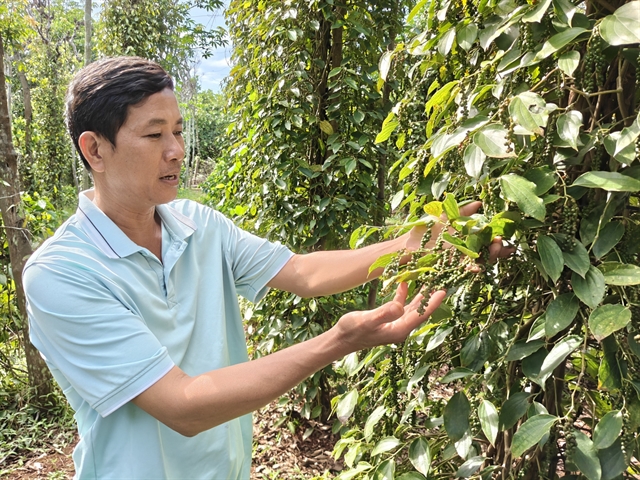
By integrating coffee into pepper gardens and combining cultivation with livestock farming, they create multiple income streams.
This approach ensures that even as older pepper plants decline, alternative crops like coffee can sustain household income.
At the cooperative level, the Lộc Quang Organic Pepper Cooperative is playing a pivotal role in upgrading production standards and expanding market access.
According to its director, Phạm Thành Chung, the key to restoring pepper gardens lies in a complete transition away from chemical inputs towards microbiological solutions.
Farmers are encouraged to retain natural vegetation, apply biofertilisers, and use beneficial fungi such as Trichoderma to improve soil health.
Avoiding chemical pesticides and herbicides helps preserve beneficial microorganisms, creating natural resistance against major diseases while maintaining optimal soil conditions.
Many cooperative members have also adopted automated irrigation systems and maximised the use of local resources.
Agricultural by-products such as plant residues, leaves, and livestock manure are composted with microbial agents and reused as fertiliser.
This circular approach not only reduces costs but also produces high-quality pepper that meets stringent market standards.
Currently spanning 29 hectares with 12 core members, the cooperative is expanding its organic production area.
Its products have achieved OCOP 3- and 4-star certification, gaining recognition in both domestic and international markets.
Clean cultivation practices have enabled the cooperative to secure higher prices from enterprises for processing and export.
The transition to organic and diversified farming models in Đồng Nai is gradually revitalising soil health while enhancing the value of local agricultural products. — VNS