Electric trucks shift gears in policy and infrastructure push
Diesel trucks can operate continuously for hundreds or even thousands of kilometres, creating a significant gap compared with electric vehicles.
HÀ NỘI — Electric trucks remain a nascent but promising segment in Việt Nam as barriers related to infrastructure, investment costs and technology continue to slow adoption, even as the country edges towards greener freight transport.
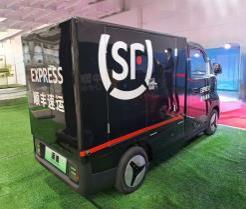
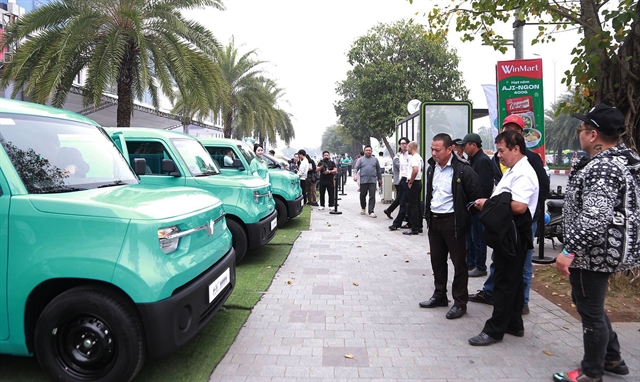
The domestic market has begun to see several commercial models, mostly light-duty trucks and delivery vans used in urban logistics.
Examples include the Karry X5 with a payload of about 1.49 tonnes and a range of roughly 230 kilometres, the Karry E5 carrying around 950 kilograms with a range of 250 kilometres and the VinFast Van EC with a payload of 600 kilogrammes and a range of about 175 kilometres. Chinese manufacturer Sany has also introduced an electric tractor unit capable of hauling up to 40 tonnes with a range of around 300 kilometres.
However, comprehensive assessments comparing the economic efficiency of electric trucks with conventional internal combustion vehicles remain limited. From an environmental perspective, the shift towards electrification is widely viewed as inevitable.
Nguyễn Văn Quyền, chairman of the Vietnam Automobile Transport Association, said electric trucks in Việt Nam were still at an early stage of development.
Technology, market demand and policy frameworks have yet to converge sufficiently to enable rapid expansion, he said.
“In the short term, this segment will likely grow slowly, mainly in urban areas or closed environments such as industrial zones. But in the long run, once charging infrastructure improves, battery technology advances and policies become more supportive, electric trucks could become a pillar of green transport,” Quyền said.
At present, the variety of available models remains limited, particularly in the heavy-duty segment that plays a central role in inter-provincial freight transport.
Diesel trucks can operate continuously for hundreds or even thousands of kilometres, creating a significant gap compared with electric vehicles. As a result, electric trucks are not yet able to meet the requirements of long-distance logistics which accounts for a large share of Việt Nam’s freight transport activities.
Trần Việt An, head of sales at Fuli Machinery Vietnam Co., Ltd., said electric trucks offer several clear advantages. They operate quietly and their energy costs are around 40–60 per cent lower than those of diesel vehicles especially when travelling on flat terrain.
Nevertheless, these benefits have not yet been sufficient to convince many transport companies to invest.
According to An, a Chinese Sany electric tractor with a payload of more than 40 tonnes costs about VNĐ3 billion per unit, roughly double the price of a diesel truck. Charging costs are about half those of diesel fuel but the vehicle’s range is only about 300 kilometres per charge.
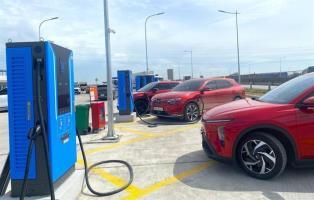
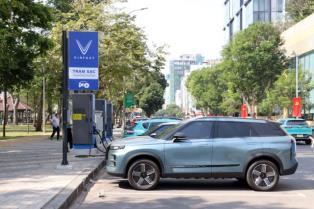
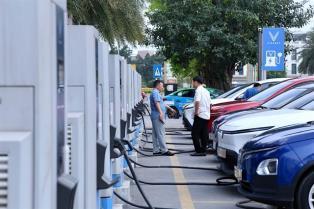
Charging infrastructure also remains a major constraint. Dedicated charging stations for electric trucks particularly heavy-duty ones are not yet available while using charging facilities designed for passenger cars is largely impractical.
Battery technology is another challenge as electric trucks consume energy more quickly when climbing slopes or travelling on complex terrain.
From an operator’s perspective, Phạm Đức Chính, a long-haul driver at Vietco Logistics Co., Ltd. in HCM City, said electric trucks are not yet suitable for inter-provincial transport while diesel vehicles still offer better operational efficiency.
Bùi Phi Long, permanent vice chairman of the Hà Nội Transport Association, said electric trucks were an inevitable trend but their application remained limited for now.
“At present, electric trucks are mainly suitable for operating in confined areas such as industrial parks, seaports, mining sites or urban delivery networks where distances are shorter and operations are more predictable,” Long said.
In the longer term, experts say Việt Nam should promote domestic production to lower costs and invest in battery research to extend driving range and shorten charging times. — VNS