East West Barbershop takes Vietnamese men’s grooming into global markets
From one HCM City barbershop to more than 130 locations, East West Barbershop is taking its Vietnamese grooming model global, combining an experience-led approach with standardised operations to build a scalable international brand.
HÀ NỘI - From a single store opened in 2018, East West Barbershop (Đông Tây Barbershop) has grown into a network of more than 130 locations, with a team of over 1,000 barbers, while gradually expanding into international markets.
Its inclusion in the global Top 10 of professional men’s grooming chains places the Vietnamese brand in a competitive field long dominated by companies from the United States, the United Kingdom, Japan, China and India.
The business behind the barber’s chair
In traditional terms, a barbershop provides a relatively straightforward service: a haircut and grooming.
For leading barbershop chains, however, the business becomes considerably more complex as the network expands.
Operators must address a range of challenges: How can multiple locations be managed efficiently? How can service quality remain consistent across the network? And how can customers entering a new location receive the same experience they associate with the brand?
The global men’s grooming industry has produced a number of large-scale chains. Great Clips has built a network of more than 4,400 salons, while Supercuts and Sport Clips Haircuts each operate around 1,800 locations. TONI&GUY has established its brand around hair fashion and professional training.
In Japan, QB House and 3QCUT have developed fast, streamlined haircut models. Jawed Habib Hair & Beauty has expanded through professional training and franchising, while China’s Yongqi Beauty & Hair has developed an integrated beauty-service model.
What these brands have in common is their ability to turn a relatively simple service into a scalable business system.
Against this backdrop, East West Barbershop (Đông Tây Barbershop) has emerged as a Vietnamese representative in the global Top 10 of professional men’s grooming chains.
Building an experiential barbershop
Rather than centring its stores solely on the barber’s chair, East West Barbershop (Đông Tây Barbershop) has developed what it describes as an “experiential barbershop” model.
Its stores incorporate amenities such as pool tables, chess boards, pianos, reading areas, bar areas, green spaces and children’s play areas. Some locations also feature car-shaped barber chairs for younger customers.
Selected locations offer additional personal-care services, including hair washing, massage, hair treatments, perming, colouring, nail care, shoe cleaning and phone sanitising.
The model is designed to broaden the customer experience and give customers more reasons to return beyond the haircut itself.
The challenge shifts from expansion to standardisation
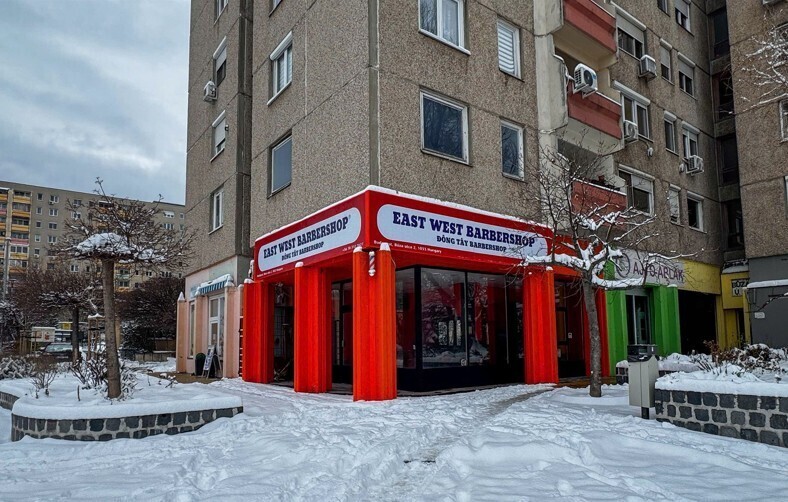
In less than a decade, East West Barbershop (Đông Tây Barbershop) has expanded to more than 130 locations in Vietnam and begun entering international markets in Asia and Europe.
The company identifies barber training and operational standardisation as two key pillars of its expansion strategy.
More than 1,000 barbers have been trained within the system, while standardised operating processes are designed to maintain consistent service quality and reduce dependence on individual employees.
The approach represents a shift from operating a single barbershop to building a scalable chain business.

For many years, professional grooming has been dominated by brands from markets with highly developed service industries.
The United States has Great Clips, Supercuts and Sport Clips; the United Kingdom has TONI&GUY; Japan has QB House and 3QCUT; India has Jawed Habib Hair & Beauty; and China has Yongqi Beauty & Hair.
Against this competitive landscape, East West’s presence in the global Top 10 represents more than an expansion in the number of stores. It highlights the company’s effort to develop a Vietnamese service model that can be replicated across markets.
The company has also begun taking its model overseas, with plans to expand through franchising.
When growth is measured by more than store count
For chain businesses, opening new locations is often the most visible measure of growth. In service industries, however, the number of stores tells only part of the story.
Behind every location are people, service standards, operating capabilities and the ability to create long-term value for both customers and the wider community.
For East West Barbershop (Đông Tây Barbershop), network expansion has been accompanied by vocational training and community initiatives. The company has launched free vocational training programmes for young people, organised mobile haircut stations for local communities and supported social welfare initiatives.

In the barbering industry, where skills and people directly influence service quality, vocational training serves two purposes. It helps the company develop a skilled workforce while also creating employment opportunities for young people.
This approach reflects East West’s broader effort to build a business system around people, training and operations, linking brand growth with workforce development.
From a local barbershop to an international model
The inclusion of East West Barbershop (Đông Tây Barbershop) in the global Top 10 is therefore not simply a story about store numbers.
The journey began with a single location in 2018 and has since grown into a network of more than 130 locations in Vietnam, alongside an expanding presence in international markets.
As competition in the grooming industry intensifies, younger customers are increasingly looking beyond the haircut itself. They are paying greater attention to the overall experience: Is the space comfortable? Is the service consistent? And is there a reason to return?
These questions may be simple, but they can influence customer retention and brand loyalty.
The “experiential barbershop” model developed by East West Barbershop (Đông Tây Barbershop) is built around this broader concept of customer experience.
The company’s development points to a wider direction for Vietnamese service businesses: rather than simply building a larger network of stores, the focus is on developing standardised, scalable business models that can be adapted to international markets.-BIZHUB/VNS