Digital tech contributes over VNĐ1 trillion to economy: conference
Minister Nguyễn Mạnh Hùng said 2025 was a pivotal year, marking the merger of the Ministry of Information and Communications and the Ministry of Science and Technology to form the Ministry of Science and Technology, with expanded responsibilities and higher development demands.

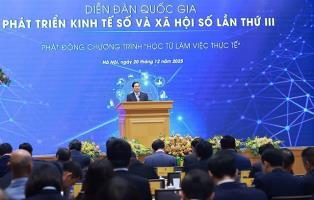
HÀ NỘI — Total revenue of the digital technology industry in 2025 was estimated at US$198 billion, up 26 per cent compared to 2024 and 16 per cent higher than the annual plan, heard participants at a conference organised by the Ministry of Information and Communications in Hà Nội on Sunday to review the industry's milestones this year and set objectives for 2026.
The sector was estimated to contribute more than VNĐ1.075 trillion (US$41 billion) to GDP, an increase of 10 per cent year-on-year, with estimated profits of over VNĐ371 billion, reflecting strong operational efficiency.
Addressing the conference, Minister Nguyễn Mạnh Hùng said 2025 was a pivotal year, marking the merger of the Ministry of Information and Communications and the Ministry of Science and Technology to form the Ministry of Science and Technology, with expanded responsibilities and higher development demands.
He stressed that the merger was not simply an organisational consolidation, but an effort to generate synergy, positioning science and technology, innovation and digital transformation as three core drivers of national development.
Emphasising the need for fundamental renewal in advisory work, the minister said units must move away from managing procedures towards managing tasks and results, and shift from 'doing on behalf' to supporting and enabling the system to operate more effectively. Advisory work, he added, should be closely aligned with reality, avoid formalism, and focus on practical impact in support of national development.
At the conference, the ministry presented the allocation of an additional VNĐ25 trillion package, proposing VNĐ16.716 trillion for ministries, sectors and localities. It also prepared the 2026 state budget plan and estimates, with a total outlay of VNĐ95 trillion, which were approved by the National Assembly.
Through its task monitoring system, the ministry tracked 3,382 tasks assigned by the Government, the Prime Minister and the ministry’s leadership, up 40 per cent compared to 2024. It coordinated preparations for the minister’s participation in National Assembly sessions, resolved all voters’ petitions, and responded to 355 recommendations from localities and businesses.
In the information technology sector, semiconductor development was identified as a key national priority. The systematic rollout of the Strategy for Việt Nam’s Semiconductor Industry Development to 2030, with a vision to 2050, together with the issuance of organisational regulations and the establishment of the National Centre for Semiconductor Chip Prototyping Support, was highlighted as an important step in strengthening domestic technological capacity and supporting local enterprises.
At the same time, efforts to develop the market and digital technology enterprises were intensified through the publication of the 'List of Major Problems in Science, Technology, Innovation and Digital Transformation', aimed at promoting localisation and increasing Vietnamese value content in technology products.
Export turnover of hardware and electronics in 2025 was estimated at $178 billion, an increase of 35 per cent compared to 2024 and equivalent to 112 per cent of the annual plan, maintaining its position as a major national export category. The number of operating digital technology enterprises was estimated at 80,052, up 10 per cent year-on-year.
Deputy Minister Bùi Hoàng Phương said 2025 was a year of particular significance, involving heavy workloads, high requirements and many unprecedented tasks. Following the merger, the ministry prioritised organisational stability, staff welfare and the rapid completion of the legal framework.
In the first ten months of the year, the ministry reviewed, drafted, amended and revised ten laws, along with numerous decrees and circulars, and served as the focal point for implementing Resolution No. 57-NQ/TW, which involved new tasks under tight timelines and demanding requirements. — VNS